 AstraLink
Free tool · No signup · Tropical zodiac, Placidus houses
Free birth chart calculator with AI reading
Your birth chart is a snapshot of the sky at the minute you were born, drawn for the place you were born. Enter your date, time and city below to see your Sun, Moon and rising sign, every planet by sign and house, and what the full AI reading in the AstraLink app adds on top.
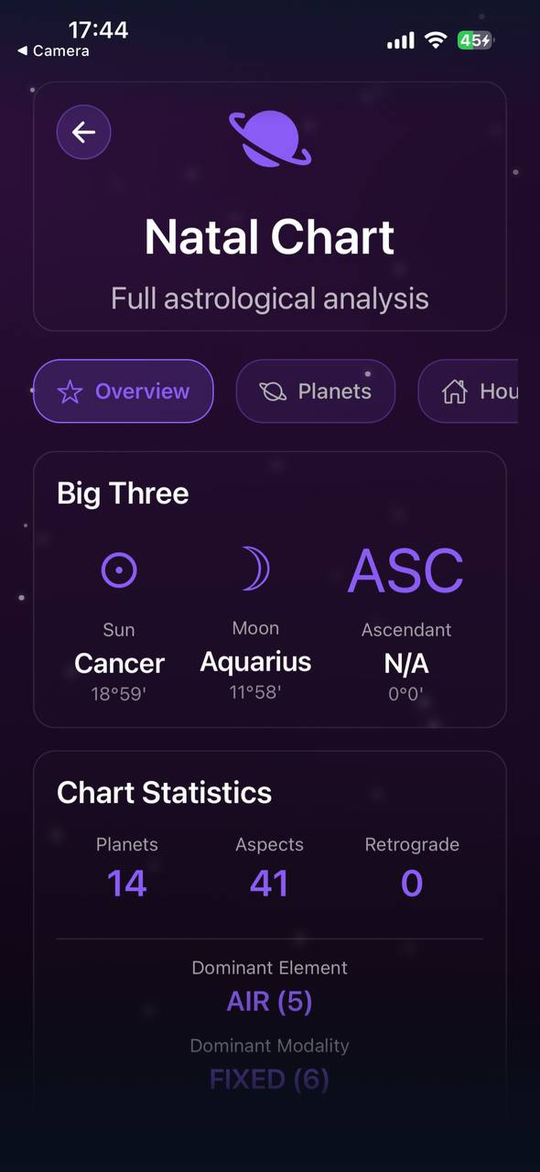
A birth chart (natal chart) maps where the Sun, Moon and planets were at your exact birth time and place. To calculate yours you need three things: birth date, birth time and birth city. The calculator returns your Big Three (Sun, Moon, rising), planets in signs and houses, and the major aspects between them.
Free birth chart calculator
Runs in your browser. Sun sign is exact; Moon and rising are close approximations. The app computes your chart from ephemeris-grade positions and shows every house cusp and aspect.
Birth chart & AI reading: how it works
What is a birth chart?
A birth chart, also called a natal chart, is a map of the sky drawn for one moment and one place: the minute you took your first breath, seen from the hospital or house where it happened. Astrologers freeze that sky into a wheel with twelve slices (the houses), place the Sun, Moon and eight planets on it by zodiac sign, and read the geometry between them (the aspects).
The reason a birth chart feels more personal than a horoscope is simple math. A Sun sign describes roughly one twelfth of people. A full chart, with a rising sign that changes every two hours and a Moon that moves a degree every two hours, is practically unique to you. Two people born the same day in different cities have the same Sun sign and very different charts.
AstraLink uses the tropical zodiac (the one used in Western astrology and most US apps), Placidus houses by default, and ephemeris-grade planetary positions. If you have seen your chart elsewhere and the houses look different, the house system is usually why; see the section on house systems below.
What you need to calculate your birth chart
- Birth date. This fixes your Sun sign and the slow-moving planets (Jupiter through Pluto) with certainty.
- Birth time. Ideally to the minute. It sets your rising sign, the twelve house cusps and the exact degree of your Moon. In the US the time is printed on the long-form birth certificate; hospital records and baby books are the next best sources.
- Birth place. City is enough. Latitude and longitude decide which sign was rising in the east and how the houses are sized.
If you are searching "how to find your astrology chart" and you only have the date, you are not stuck: skip to No birth time? below. You will still get a real chart, just one with the rising sign and houses left open.
What is my astrology sign? Start with the Big Three
When people ask "what is my astrology sign?", they usually mean the Sun sign. Your chart actually gives you three headline signs, known as the Big Three:
- Sun sign: the sign the Sun occupied on your birthday. Core identity, vitality, what you are here to become.
- Moon sign: the sign the Moon was in. Emotional needs, what makes you feel safe, how you react before you think.
- Rising sign (Ascendant): the sign on the eastern horizon at your birth time. Your approach, first impressions, and the lens the rest of the chart is read through. It also decides your chart ruler.
A Virgo Sun with a Pisces Moon and Scorpio rising, for example, reads as precise on the surface, tender underneath and intense in close-up. In the app that trio (plus your numerology life path) becomes a named cosmic archetype, in this case The Precise Alchemist. Not sure of your rising sign? The rising sign guide explains how to narrow it down.
Planets, houses and aspects: the three layers of a chart
Planets are the what. Each one carries a function: the Sun (identity), Moon (emotion), Mercury (thinking and speech), Venus (love, values, pleasure), Mars (drive, desire, anger), Jupiter (growth, luck, belief), Saturn (structure, limits, maturity), Uranus (change, freedom), Neptune (imagination, dissolution) and Pluto (power, transformation). Most readings also include Chiron, Black Moon Lilith and the lunar nodes.
Signs are the how. A planet expresses its function in the style of its sign. Mars in Aries acts fast and directly; Mars in Cancer acts sideways and protectively. Learn the signs one planet at a time, starting with Venus in astrology, which explains how you love and what you value.
Houses are the where. The twelve houses are areas of life: self (1st), money (2nd), communication (3rd), home (4th), romance and creativity (5th), work and health (6th), partnership (7th), intimacy and shared resources (8th), travel and belief (9th), career (10th), community (11th) and the inner world (12th). The 7th house is the one most people check first, because it describes the partner you attract.
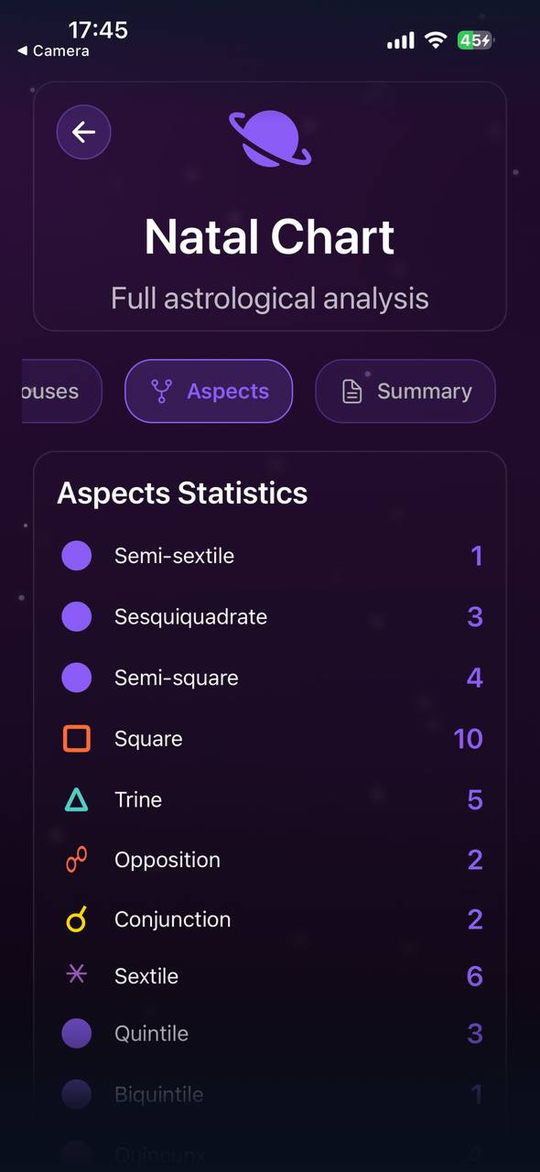
Aspects are the conversations. Angles between planets show which parts of you cooperate (trines, sextiles), which merge (conjunctions) and which argue (squares, oppositions). A square is friction that builds skill; an opposition is a tug of war you learn to referee. When three or more planets cluster in one sign or house, that is a stellium, and it will dominate the reading.
See your chart in the app
How to read your birth chart in 5 steps
- Confirm your Big Three. Find the Sun, Moon and Ascendant (marked AC or ASC on the wheel's left edge). Say them in one sentence: "I am a Leo Sun, Taurus Moon, Gemini rising." This is your chart's headline.
- Find the chart ruler. Look up the planet that rules your rising sign (Mars for Aries, Venus for Taurus and Libra, Mercury for Gemini and Virgo, Moon for Cancer, Sun for Leo, Pluto or Mars for Scorpio, Jupiter for Sagittarius and Pisces, Saturn for Capricorn and Aquarius, Uranus or Saturn for Aquarius). Note its sign and house: that is where your life keeps steering.
- Count the elements and modalities. Tally how many placements fall in fire, earth, air and water, then cardinal, fixed and mutable. A chart heavy in water and fixed signs behaves differently from one heavy in air and mutable signs, whatever the Sun sign says.
- Read the tightest aspects. Aspects within 2 degrees of exact are the loudest. Start with anything touching the Sun, Moon, Ascendant or chart ruler. One tight Saturn square explains more than five loose trines.
- Check the busiest house. The house holding the most planets (or a stellium) is where life keeps sending you. Combine it with the sign on its cusp and you have the chart's main storyline.
What the AI birth chart reading in the app contains
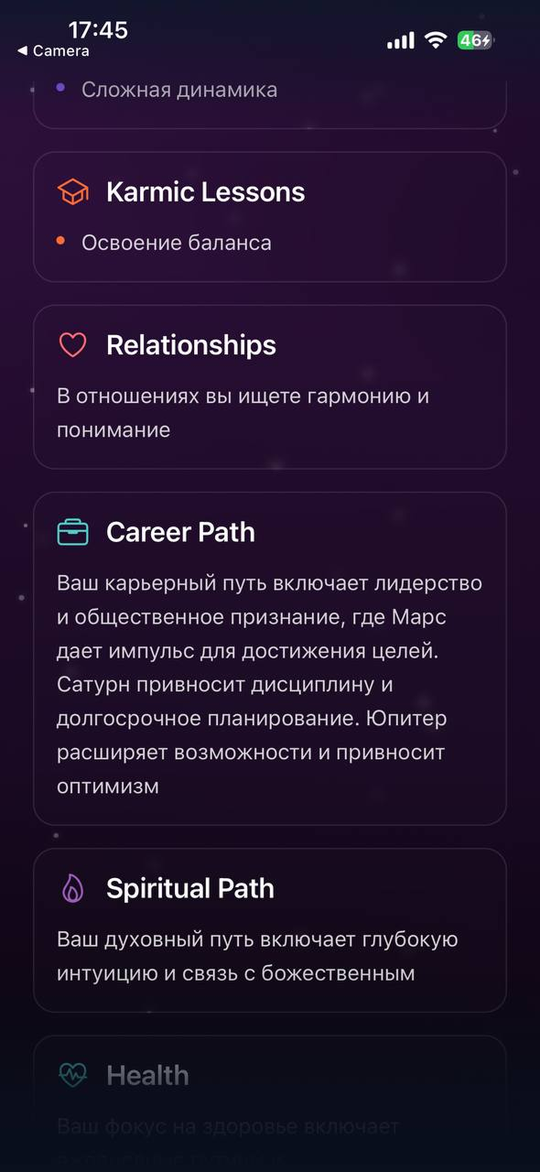
The calculator above gives you the raw positions. The AI reading in AstraLink interprets them as one connected story, and it is the reason people who already have a free chart still want this one. Each reading is organised into sections you can return to:
- Summary and key chart meaning: the two paragraphs that describe you most accurately, written from the whole wheel rather than one sign.
- Cosmic archetype: Sun, Moon, rising and life path combined into a named archetype with strengths, shadow and what you need from a partner.
- Chart ruler and the dispositor centre: which planet steers the chart and which planet the others ultimately answer to. See dispositors in the glossary.
- Lunar nodes: the North Node direction of growth and the South Node comfort zone.
- Strongest aspects: the three to five contacts doing the most work, ranked by orb and planetary weight, each explained in plain English.
- Life cycle: where you are in the long cycles (Saturn, Jupiter, the nodes) right now.
- Talents and life themes: what comes easily and what keeps recurring.
- Karmic lesson: the one pattern the chart asks you to outgrow, usually written from Saturn, the South Node and the hardest square.
- Relationships: Venus, Mars, the Moon and the 7th house together: how you love, what you attract, what you need to hear.
- Career and money approach: Midheaven, 10th and 2nd houses, and the planets that rule them.
- Spirituality and health themes: 9th and 12th house placements, and the 6th house read as habits and energy, never as diagnosis.
- Dominant elements and modalities: the temperament summary that explains why you are not a "typical" version of your Sun sign.
If you want the same depth in a written document, the full birth chart report page explains what is included and how it is generated.
Which house system does the calculator use?
AstraLink defaults to Placidus, the most widely used system in Western astrology and the one most other US apps use, so your houses will match what you have seen before. Placidus divides the sky by time rather than space, which is why houses are unequal in size and why it behaves oddly above roughly 60 degrees latitude.
Other systems you may meet: Whole Sign (each house is exactly one sign, popular in traditional and Hellenistic astrology), Equal (thirty-degree houses starting from the Ascendant), Koch and Porphyry. Your planets and signs never change between systems; only the house cusps move. If a planet sits within a few degrees of a cusp, it may swing into the next house under a different system. When that happens, read both and notice which description you recognise.
No birth time? Here is what still works
Without a time, you still get your Sun sign, your Mercury, Venus and Mars signs (they change sign every few weeks, so the date is usually enough), and Jupiter through Pluto. What you lose is the rising sign, the houses and, on about one day in three, certainty about the Moon sign, because the Moon changes sign every two and a half days.
Three practical fixes:
- Ask. Parents, older siblings, a baby book, the hospital's records office. US long-form birth certificates carry the time; short-form ones often do not.
- Use noon. A noon chart puts the Moon within about six degrees of its true position and is the standard placeholder for a date-only reading.
- Rectify. If you know major life dates (a move, a marriage, a big career change), an astrologer can work backward to a likely birth time. The rising sign page has a quick self-check based on how people describe you.
AstraLink accepts date-only charts and simply hides the house-based sections until you add a time.
From your chart to your relationships
Once your chart exists, the next question is almost always about someone else. The compatibility calculator compares two charts, and the app's Cosmic Dating feature matches people by synastry rather than photos. It reads the same placements described above, Venus, Mars, the Moon and the 7th house, in both charts at once, and explains the score it gives. Early-access members get their full chart free when they join the waitlist.
Birth chart questions
How do I find my astrology chart?
Use a birth chart calculator with your birth date, birth time and birth city. The calculator converts that moment into the positions of the Sun, Moon and planets, places them in the twelve houses and draws the wheel. If you do not know your birth time, check your long-form birth certificate or hospital record; otherwise enter 12:00 noon and treat the rising sign and houses as unknown.
What is my astrology sign?
Your astrology sign usually means your Sun sign, the zodiac sign the Sun was in on your birthday. The dates run roughly Aries (Mar 21–Apr 19) through Pisces (Feb 19–Mar 20), shifting by a day depending on the year. If you were born within a day of a sign change, a calculator with your birth time settles it. Your Moon and rising signs are equally important and only a chart reveals them.
What is a birth chart reading?
A birth chart reading interprets your natal chart as a whole: the Big Three, the chart ruler, the strongest aspects, the busiest house and the balance of elements. A good reading explains how these parts interact rather than listing them one by one. AstraLink's AI reading adds a named archetype, a karmic lesson, life cycles, and sections on relationships, career, money approach and spirituality.
Is a natal chart the same as a birth chart?
Yes. Natal chart and birth chart mean the same thing: the map of the sky for the moment and place of your birth. Astrologers tend to say natal chart; most searches say birth chart. The wheel, the planets, the houses and the aspects are identical whichever name you use.
Why is my rising sign different on different websites?
Three common reasons. First, a slightly different birth time: the Ascendant moves about one degree every four minutes, so a time near a sign boundary can flip it. Second, time zones and daylight saving errors for older births. Third, a different zodiac: sidereal (Vedic) charts shift every sign back by about 24 degrees compared with tropical charts, which is what this calculator and most US apps use.
How accurate is a free birth chart calculator?
The planetary positions are as accurate as the ephemeris behind them; AstraLink's app uses ephemeris-grade data, so positions are precise to the minute of arc. The browser tool on this page approximates the Moon and Ascendant to keep it instant, so treat those two as close rather than exact. Accuracy of interpretation is a different question: astrology is a reflective language, not a measurement.
What is the most important thing in a birth chart?
There is no single ruler of the chart for everyone, but most astrologers start with the Sun, Moon and Ascendant, then the chart ruler (the planet ruling the rising sign) and the tightest aspects to those points. A stellium or a planet exactly on an angle will also dominate. The order matters less than reading them together.
Early access · US launch
Your whole chart, read by AI — free at launch
Cosmic archetype, chart ruler, strengths, karmic lesson and more, written for your exact placements. Join early access for the complete reading, free.
- Free full birth chart + cosmic archetype at launch
- First in line for chart-based matching in your city
- Founding-member pricing, forever
AstraLink content is written by our editorial team, reviewed for astrological accuracy, and refreshed as the sky moves. Interpretations are for reflection and entertainment; they are not medical, legal or financial advice.