 AstraLink
Glossary
Ascendant (rising sign): definition, why birth time matters, and how it shapes first impressions
The Ascendant is the first thing an astrologer looks at and the first thing a stranger sees. It is your rising sign, the sign on the eastern horizon when you were born, and it decides where every house in your chart begins. Here is what the Ascendant is, why it needs an exact birth time, what all twelve rising signs look like, and what happens when yours meets someone else's.
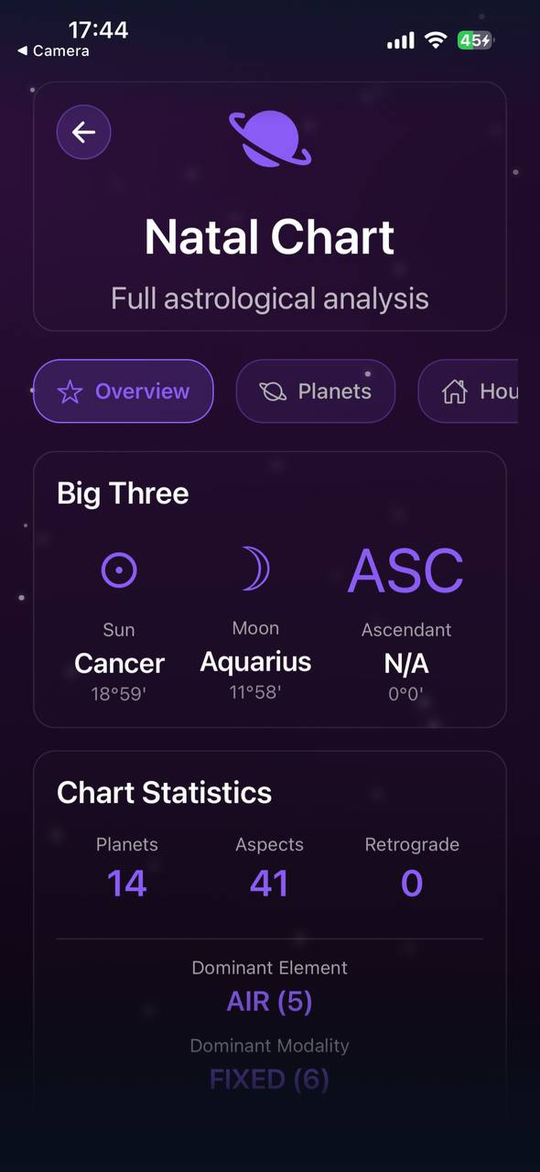
The Ascendant in astrology is the zodiac sign and exact degree rising on the eastern horizon at the moment and place of your birth. It is the cusp of the 1st house and is the same thing as your rising sign. The Ascendant shapes first impressions, appearance, instinctive reactions and the lens through which the whole chart is read.
What is the Ascendant in astrology?
The Ascendant (abbreviated ASC or AC) is the point of the zodiac that was rising on the eastern horizon at the exact moment and place of your birth. The Earth turns once a day, so over 24 hours every sign rises in turn; the Ascendant is the snapshot of that rotation at your first breath. The word is simply Latin ascendens, "climbing up".
The Ascendant is a degree, and the sign containing that degree is your rising sign. Ascendant and rising sign therefore mean the same thing; astrologers use "Ascendant" when they care about the exact degree and "rising sign" when they care about the sign. Directly opposite, on the western horizon, is the Descendant, the 7th-house cusp and the point of partnership. Together with the Midheaven and IC, these are the four angles of the chart.
Interpretively the Ascendant is the lens. It shapes appearance, body language, instinctive reactions, the way you walk into a room and the way people describe you before they know you. It is also structural: in every house system the Ascendant marks the cusp of the 1st house, so it sets where each house begins and, through the sign's ruling planet, appoints the chart ruler, the planet whose placement steers the whole chart. That is why astrologers say the rising sign is the third of the Big Three with the Sun and Moon, and why many read it first.
How to find your Ascendant
You need three things: birth date, birth time to the minute if possible, and birth place. The Ascendant moves about one degree every four minutes and changes sign roughly every two hours, though not evenly. Because of the tilt of the Earth, signs of short ascension (Capricorn through Gemini in the northern hemisphere) rise quickly, sometimes in under an hour, while signs of long ascension (Cancer through Sagittarius) take up to three. Near a sign boundary, ten minutes can change your rising sign.
Enter the data into the rising sign calculator or the full birth chart; the Ascendant is the line on the left of the wheel marked ASC or AC. If your birth time is unknown, options in order of reliability are: the birth certificate (many US states record time), a hospital record, a parent's memory, and, as a last resort, a rectification by an astrologer who works backwards from life events. A noon chart without a time gives you planets but not a real Ascendant.
Once you have the degree, write it down to the minute. The exact Ascendant degree is what transits and synastry use: a Saturn transit across 14° Scorpio is a different season from one across 29° Scorpio, and the Ascendant's decan refines how the rising sign shows up. If your Ascendant sits within a degree or two of a boundary, read both descriptions and notice which one people actually use about you; that is a legitimate check.
The Ascendant by sign
What each rising sign tends to look like from the outside, and the chart ruler it appoints.
- Aries rising (ruler Mars): direct, quick, a little combative; walks fast, decides faster. First impression: energy.
- Taurus rising (ruler Venus): calm, sensual, steady; good voice, good taste, hard to hurry. First impression: solidity.
- Gemini rising (ruler Mercury): talkative, curious, restless; young-looking, expressive hands. First impression: wit.
- Cancer rising (ruler the Moon): warm, guarded, receptive; a soft face that reads every room. First impression: care.
- Leo rising (ruler the Sun): presence, hair, posture; enters like the room was waiting. First impression: confidence.
- Virgo rising (ruler Mercury): neat, observant, modest; notices the typo. First impression: competence.
- Libra rising (ruler Venus): charming, balanced, well put together; mirrors you slightly. First impression: grace.
- Scorpio rising (rulers Pluto and Mars): intense gaze, controlled stillness, magnetism. First impression: depth, and a little danger.
- Sagittarius rising (ruler Jupiter): open, funny, restless; laughs loudly, plans a trip. First impression: freedom.
- Capricorn rising (ruler Saturn): reserved, composed, older-seeming when young; ages in reverse. First impression: authority.
- Aquarius rising (rulers Uranus and Saturn): friendly but detached, unusual style, unbothered. First impression: originality.
- Pisces rising (rulers Neptune and Jupiter): dreamy, changeable, sympathetic; the face people tell secrets to. First impression: softness.
The AstraLink archetype system combines the rising sign with the Sun and Moon; The Precise Alchemist, for instance, is a Virgo Sun and Pisces Moon behind a Scorpio Ascendant, and the archetype quiz works out yours.
The Ascendant in relationships and synastry
The Ascendant-Descendant axis is the relationship axis, which makes it central to synastry. Your Descendant sign describes the qualities you seek in partners and tend to attract, so a person whose Sun or Venus falls on your Descendant often feels like "your type" before you can say why. A partner's planets conjunct your Ascendant affect how you present yourself around them: their Venus on your Ascendant makes you feel more attractive; their Saturn there makes you feel judged, or steadied, depending on the day. Couples whose Ascendants are in the same element tend to make a similar first impression as a pair and move at a similar pace. Because the Ascendant needs a birth time, a compatibility reading done without one skips this axis entirely, which is why the compatibility calculator asks for times.
Common misconceptions about the Ascendant
- "The rising sign is a mask." It is a real part of you: the instinctive layer, not a fake one. The Sun is not "the real you" underneath it.
- "Ascendant and rising sign are different things." They are the same point, described by degree or by sign.
- "You can guess it from your appearance." Appearance is one clue among many; a Leo Sun with Capricorn rising can look very Capricorn. Use a birth time.
- "The Ascendant changes every few years." The natal Ascendant is fixed. What changes is the progressed Ascendant, which advances about a degree a year.
The Big Three: three layers of you
Sun, Moon and rising sign are where every chart reading starts.
Frequently asked questions
What is the Ascendant in astrology?
The Ascendant is the degree of the zodiac rising on the eastern horizon at the exact time and place of your birth. It is the cusp of the 1st house and the same thing as your rising sign. It describes first impressions, appearance and instinctive reactions, sets where every house in your chart begins, and appoints the chart ruler through its sign's ruling planet. Calculating it requires an accurate birth time.
What is my Ascendant and how do I find it?
Your Ascendant is whichever sign was rising when you were born, and you find it by entering your birth date, exact time and place into a rising sign calculator or full birth chart. It changes sign roughly every two hours, faster for Capricorn through Gemini and slower for Cancer through Sagittarius, so the time matters to the minute near a boundary. Without a birth time, the Ascendant cannot be reliably determined.
Is the Ascendant the same as the rising sign?
Yes. The Ascendant is the exact rising degree, for example 14° Scorpio, and the rising sign is the sign that degree falls in, Scorpio. Astrologers say "Ascendant" when the degree matters, such as for transits and synastry, and "rising sign" in everyday conversation. There is no third thing; anyone treating them as separate placements is mistaken.
Why does the Ascendant need an exact birth time?
Because the Earth rotates once a day, the Ascendant moves through all twelve signs every 24 hours, about one degree every four minutes. An hour's error can shift it by a full sign, and near a sign boundary ten minutes can. The Ascendant also fixes the house cusps and the chart ruler, so an inaccurate time distorts the whole chart, not just one placement. Use the birth certificate where possible.
How does the Ascendant work in synastry?
The Ascendant and its opposite, the Descendant, form the relationship axis. A partner's Sun or Venus on your Descendant often feels like your type; their planets on your Ascendant change how you present yourself around them, warmer with Venus, more serious with Saturn. Same-element Ascendants tend to move at a similar pace. Because it depends on birth time, the axis is skipped in compatibility readings that lack times.
Early access · US launch
Your whole chart, read by AI — free at launch
Cosmic archetype, chart ruler, strengths, karmic lesson and more, written for your exact placements. Join early access for the complete reading, free.
- Free full birth chart + cosmic archetype at launch
- First in line for chart-based matching in your city
- Founding-member pricing, forever
AstraLink content is written by our editorial team, reviewed for astrological accuracy, and refreshed as the sky moves. Interpretations are for reflection and entertainment; they are not medical, legal or financial advice.