 AstraLink
Glossary
Opposition in astrology: the 180° aspect of tension and balance
Some aspects flow and some push. An opposition pushes. When two planets sit directly across the chart from each other, roughly 180° apart, they create a tug-of-war you feel in relationships, decisions and timing. Here is what an opposition is, how to spot it in your chart, why it matters, and how to work with its tension instead of against it.
An opposition is a major aspect formed when two planets sit about 180° apart, on opposite sides of the chart. It is a hard aspect: the two energies pull against each other, creating tension, awareness and a tendency to project one pole onto other people, until you learn to balance both.
What is an opposition in astrology?
An opposition is one of the five major aspects — the angles planets make to each other around the birth chart. It forms when two planets sit roughly 180° apart, facing each other across the wheel, usually within an orb of about 8°. Alongside the square, it is one of the two classic hard aspects: the planets are in tension, so the energy shows up as friction, awareness and the pull to reconcile two things that seem opposed.
Because 180° is exactly half of the 360° circle, an opposition always links two opposite signs — Aries and Libra, Taurus and Scorpio, Gemini and Sagittarius, Cancer and Capricorn, Leo and Aquarius, Virgo and Pisces. Opposite signs share a modality (both cardinal, both fixed, or both mutable) and sit in complementary elements (fire with air, earth with water), which is why the two poles are more alike than they first look. They often want the same thing by opposite routes.
How an opposition works, and how to find it
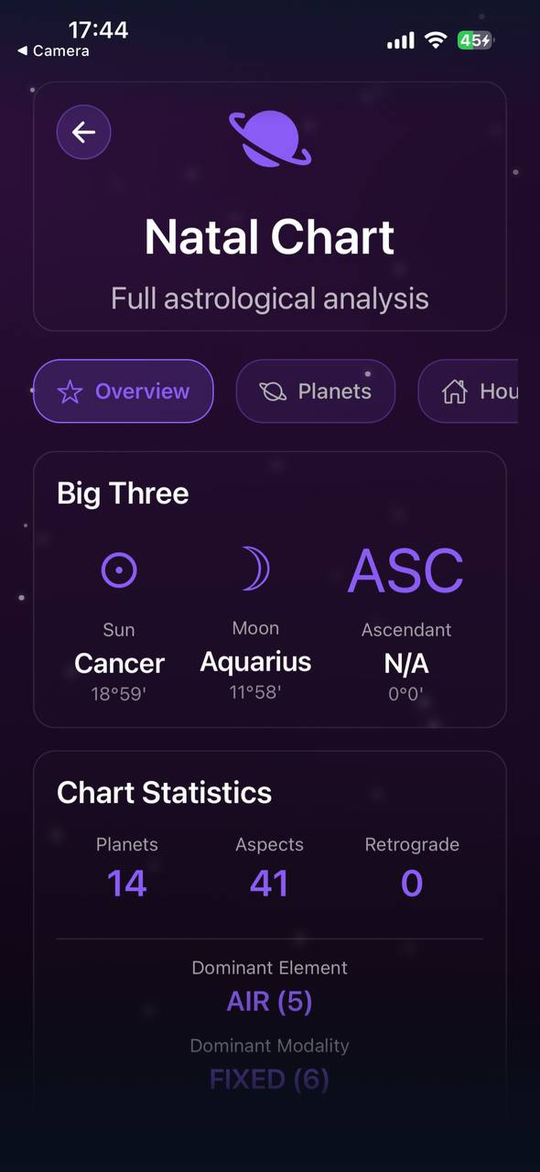
To spot an opposition, look for two planets on opposite sides of the chart wheel, about six signs apart. Draw your free chart and the aspect grid marks oppositions for you. If Venus sits at 10° Aries and Mars at 14° Libra, that is a 4° orb opposition — tight and strongly felt; past roughly 8°, the aspect fades.
The felt experience of an opposition is projection and see-saw. Each planet holds one end of a pole, and it is easy to live out one end yourself while meeting the other end in other people — a partner, a boss, a rival. A Sun–Moon opposition, for example, can feel like a lifelong negotiation between what you want (Sun) and what you need (Moon); it is the exact aspect behind every full moon, when the Sun and Moon face each other across the sky. The work of any opposition is balance: owning both ends instead of splitting them between yourself and someone else.
Why oppositions matter, with real examples
Oppositions mark the relationships and choices you cannot look away from. The most personal one in every chart is the Ascendant–Descendant axis: the 1st house of self opposite the 7th house of partnership, the reason opposite signs are famous for attracting each other. The lunar nodes are always an exact opposition too — the North Node sits 180° from the South Node, your growth edge facing your comfort zone.
Two concrete cases. In transit: at the full moon on October 26, 2026, the Sun in Scorpio opposes the Moon in Taurus, lighting up whichever houses that axis rules in your chart and bringing something to a head — the moon calendar tracks each one, and the Cosmic Simulator shows the exact transit. In the natal chart: an opposition often anchors a T-square, where a third planet squares both ends, turning a two-way tension into a driving, achievement-hungry pattern. Read against the flowing trine or the easy sextile, the opposition asks the most of you — and, handled well, hands back the most self-awareness. Remember astrology is a lens here, not a verdict: an opposition names a tension to work with, not a fate to endure.
The Big Three: three layers of you
Sun, Moon and rising sign are where every chart reading starts.
Frequently asked questions
What does an opposition mean in astrology?
An opposition means two planets sit about 180° apart, on opposite sides of the birth chart, within an orb of roughly 8°. It is a hard aspect, so the two energies pull against each other and create tension, awareness and a tendency to see one side in other people. The invitation is balance: to hold both ends of the axis rather than split them between yourself and someone else.
What is the difference between an opposition and a square?
Both are hard aspects, but the angle differs. An opposition is 180° — planets face each other across the chart, which feels like a see-saw or a relationship you keep negotiating. A square is 90°, an inner friction that feels more like being blocked or pushed to act. Oppositions tend to play out through other people and partnerships; squares tend to be felt as internal pressure you carry yourself.
Is an opposition a bad aspect?
No. Oppositions are called hard aspects because they create tension, not because they are bad. That tension brings awareness: you see both sides of an issue clearly and are pushed to find balance. Many people with prominent oppositions are natural mediators, negotiators or partners. The difficulty is only projection — living one pole and blaming the other end on someone else — which eases once you consciously own both.
What orb is used for an opposition?
Most astrologers allow an orb of about 8° for an opposition, and up to 10° when one of the planets is the Sun or Moon. That means two planets are considered in opposition when they are between roughly 170° and 190° apart. The tighter the orb, the stronger the effect: a 1–3° opposition is intense and defining, while an 8° one is present but gentler.
What does an opposition mean in synastry?
In synastry — comparing two charts — an opposition between your planet and a partner's is a classic attraction signature. Opposite signs and planets complete each other, so the pull is magnetic, which is why the Ascendant–Descendant axis governs partnership. The same aspect can also create push-pull, where you keep meeting the very quality you have not developed in yourself. Handled consciously, opposition contacts make couples feel like two halves that balance.
Early access · US launch
Your whole chart, read by AI — free at launch
Cosmic archetype, chart ruler, strengths, karmic lesson and more, written for your exact placements. Join early access for the complete reading, free.
- Free full birth chart + cosmic archetype at launch
- First in line for chart-based matching in your city
- Founding-member pricing, forever
AstraLink content is written by our editorial team, reviewed for astrological accuracy, and refreshed as the sky moves. Interpretations are for reflection and entertainment; they are not medical, legal or financial advice.