 AstraLink
Glossary
Lunar nodes: the North Node and South Node axis
The lunar nodes are two invisible points that carry more weight in a birth chart than almost anything their size suggests. Together they form the karmic axis: where you are growing toward and what you are growing out of. This is the hub for the pair — what the nodes are, how the North and South Node differ, where they sit in the sky right now, and how to read them in your own chart.
The lunar nodes are the two points where the Moon's orbit crosses the ecliptic, the Sun's apparent path. They form the karmic axis of a birth chart: the North Node marks growth and the direction to stretch toward, while the South Node marks comfort, habit and the past you already know well.
What are the lunar nodes?
The lunar nodes are the two points where the Moon's orbit crosses the ecliptic — the plane of the Sun's apparent path around the zodiac. They are not physical bodies; they are intersections, which is why they matter for eclipses (more on that below). The North Node is where the Moon crosses heading north, the South Node exactly opposite where it crosses heading south. Old texts call them the Dragon's Head (Caput Draconis, the North Node) and the Dragon's Tail (Cauda Draconis, the South Node).
The two are always exactly 180 degrees apart, so they work as a single axis rather than two separate points. In astrology this is the karmic axis of the chart: a line describing the pull between what is familiar and what you are being invited to develop. Read it as a compass for growth and reflection, never as a fixed destiny — the nodes describe a direction of travel, not a track you are locked onto.
North Node vs South Node
The two ends tell opposite halves of one story.
- The North Node points to unfamiliar territory you are here to grow into. Its sign and house describe qualities that can feel awkward or effortful at first but bring the most meaning when you lean in. It is the stretch.
- The South Node marks what already comes naturally — innate talents, deep-worn habits, the comfort zone. It is a gift and a crutch at once: reliable, but somewhere you can hide when growth feels risky.
The healthiest reading is not "good node, bad node." You do not abandon the South Node; you draw on its strengths while deliberately reaching for the North Node's lessons. Because they sit opposite each other, the nodes always pair complementary signs — for example a North Node in Aquarius with a South Node in Leo balances individual spotlight against collective contribution.
The nodal axis right now: North Node in Aquarius, South Node in Leo
The nodes move backward through the zodiac, spending about 18 months in each pair of signs. Since roughly 26 July 2026 the North Node has been in Aquarius and the South Node in Leo — a collective theme swap that runs into 2028. Broadly, it nudges a shift away from pure personal spotlight, ego and performance (Leo) toward community, shared causes, friendship and the greater good (Aquarius). This is a cultural weather pattern, a prompt to reflect on where you over-rely on being seen versus where you contribute — not an instruction handed down by the sky.
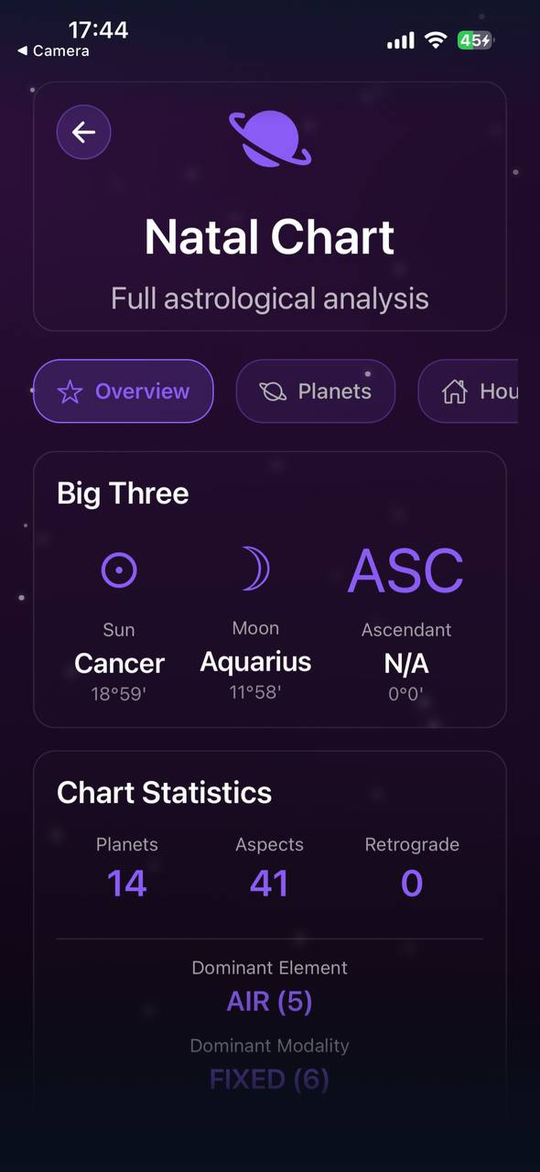
Where this lands for you depends on which houses Aquarius and Leo rule in your own chart, which is exactly what a personalised reading shows. The app's extended natal reading lists your nodes by sign and house, and the Cosmic Simulator shows when transiting planets touch your nodal axis.
True node vs mean node, and eclipses
You will see two versions in chart settings. The true node tracks the Moon's actual, slightly wobbling crossing point moment to moment; the mean node uses a smoothed average. They are usually within a degree or two, and most modern astrologers default to the true node — either is fine, just be consistent.
The nodes are also the reason eclipses happen: an eclipse is simply a new or full moon occurring close to a lunar node, when Sun, Moon and Earth line up on that crossing plane. That is why eclipse seasons cluster around wherever the nodal axis currently sits — in this cycle, the Aquarius–Leo line. If you are new to the nodes, start by finding yours, then read each end in turn. Ready to look? Enter your birth details and the reading maps your full nodal axis.
The Big Three: three layers of you
Sun, Moon and rising sign are where every chart reading starts.
Frequently asked questions
What are the lunar nodes in astrology?
The lunar nodes are the two points where the Moon's orbit crosses the ecliptic, the Sun's apparent path through the zodiac. The North Node is the northward crossing and the South Node the southward one, always exactly opposite. Together they form the chart's karmic axis, describing the balance between what you already know well and the growth you are being drawn toward.
What is the difference between the North Node and South Node?
The North Node points to unfamiliar qualities you are here to develop — the growth edge that feels awkward at first but most rewarding to pursue. The South Node marks what already comes easily: innate talents and comfortable habits that can also become a place to hide. They are one axis, so the aim is to lean toward the North Node while still drawing on the South Node's gifts.
Where are the lunar nodes now in 2026?
Since about 26 July 2026 the North Node has been in Aquarius and the South Node in Leo, and the axis stays there into 2028. The broad theme is a shift from personal spotlight and performance toward community, friendship and shared causes. How it affects you personally depends on which houses Aquarius and Leo fall in within your own birth chart.
What is the difference between the true node and the mean node?
The true node follows the Moon's actual crossing point, which wobbles slightly from day to day, while the mean node uses a smoothed mathematical average. The two are usually within a degree or so of each other. Most modern astrologers use the true node by default, but either is valid — the important thing is to stay consistent with one setting when you read a chart.
How are the lunar nodes connected to eclipses?
Eclipses only happen when a new or full moon occurs close to a lunar node, because that is when the Sun, Moon and Earth line up on the same crossing plane. That is why eclipse seasons follow wherever the nodal axis currently sits. With the nodes in Aquarius and Leo, eclipses through this period cluster along that axis, activating the themes of those two signs.
Early access · US launch
Your whole chart, read by AI — free at launch
Cosmic archetype, chart ruler, strengths, karmic lesson and more, written for your exact placements. Join early access for the complete reading, free.
- Free full birth chart + cosmic archetype at launch
- First in line for chart-based matching in your city
- Founding-member pricing, forever
AstraLink content is written by our editorial team, reviewed for astrological accuracy, and refreshed as the sky moves. Interpretations are for reflection and entertainment; they are not medical, legal or financial advice.