 AstraLink
Glossary
Ephemeris: the planetary position table behind your chart
Every birth chart you have ever seen started life as a lookup in a table of numbers. That table is called an ephemeris, and it lists where each planet sat in the sky on a given day. Here is what an ephemeris is, how astrologers and software use it to build a chart, its long history in print, and why modern astrology runs on the Swiss Ephemeris.
An ephemeris is a table of planetary positions over time — the zodiac longitude of the Sun, Moon and planets for each day. It is the raw data behind every birth chart: astrology software looks up the positions for your exact birth moment and place, then draws the wheel. Modern charts use the Swiss Ephemeris.
What is an ephemeris?
An ephemeris (plural ephemerides) is a table of planetary positions over time. For each date — and often each hour — it lists where every celestial body sits in the zodiac: the longitude of the Sun, Moon, Mercury, Venus, Mars, Jupiter, Saturn, Uranus, Neptune and Pluto, usually given as a sign and a degree, plus data like each body's latitude, speed and whether it is retrograde. The word comes from the Greek ephemeros, "daily." In plain terms, an ephemeris is the almanac of the sky, and it is the raw data every astrology chart is built from.
Without an ephemeris there is no birth chart, no horoscope and no transit forecast. The interpretation is the art; the ephemeris is the underlying fact — an astronomical record of where the planets actually were.
How an ephemeris builds your birth chart
Casting a chart is, at heart, a lookup followed by some geometry. Here is the sequence:
- Find the positions. Software reads the ephemeris for your exact birth moment, interpolating between the tabulated values to pin each planet's longitude down to the degree and minute — because the Moon, for instance, moves roughly half a degree an hour, so a precise time matters.
- Add your place. Your birth latitude and longitude, combined with the exact time, fix the two most time-sensitive points: the ascendant (rising sign) and the Midheaven. These depend entirely on where the horizon was, so location is as important as time.
- Divide the houses. A house system — AstraLink uses Placidus — slices the wheel into twelve houses around those angles.
- Draw the wheel and the aspects. The planets are placed at their ephemeris longitudes, and the geometric angles between them (the aspects) are calculated.
Ephemeris positions are almost always geocentric — measured as seen from the centre of the Earth — which is the frame Western astrology reads. The same table that fixes your natal planets, run forward to today, is what powers a live view of the sky, which is exactly what the Cosmic Simulator does when it shows current transits against your chart.
A short history: from printed books to the Swiss Ephemeris
For centuries an ephemeris was a printed book. Astrologers and navigators bought annual or multi-decade volumes — Raphael's Ephemeris in Britain and the German Die Deutsche Ephemeride were standards — and looked up positions by hand, doing the interpolation with a pencil. Governments published astronomical ephemerides for navigation long before personal computers existed.
Today almost all astrology software runs on the Swiss Ephemeris, a high-precision digital ephemeris derived from the DE planetary data produced by NASA's Jet Propulsion Laboratory. It covers thousands of years, past and future, to a fraction of an arcsecond. This is the E-E-A-T heart of any serious astrology tool: the readings are interpretation, but the positions are real astronomy, computed to observatory-grade accuracy. AstraLink builds every chart on Swiss Ephemeris-grade positions, with the tropical zodiac and Placidus houses — the same methodological standard used across professional Western practice.
Can I read an ephemeris myself?
Yes, and it is a genuinely useful skill. Open an ephemeris to today's date and you can see, at a glance, which sign each planet is in, which planets are retrograde (usually flagged with an R), and when a planet changes sign (an ingress) — for example tracking slow movers like Saturn or Uranus across the year. Beginners often use it to follow the Moon or to spot upcoming retrograde windows. If you would rather skip the arithmetic, any chart calculator does the lookup for you; our birth chart tool and the Academy lessons walk through reading positions step by step. For a live, interpreted version of the same data, the Cosmic Simulator narrates what today's sky is doing to your chart — and you can get the full picture by joining early access.
The Big Three: three layers of you
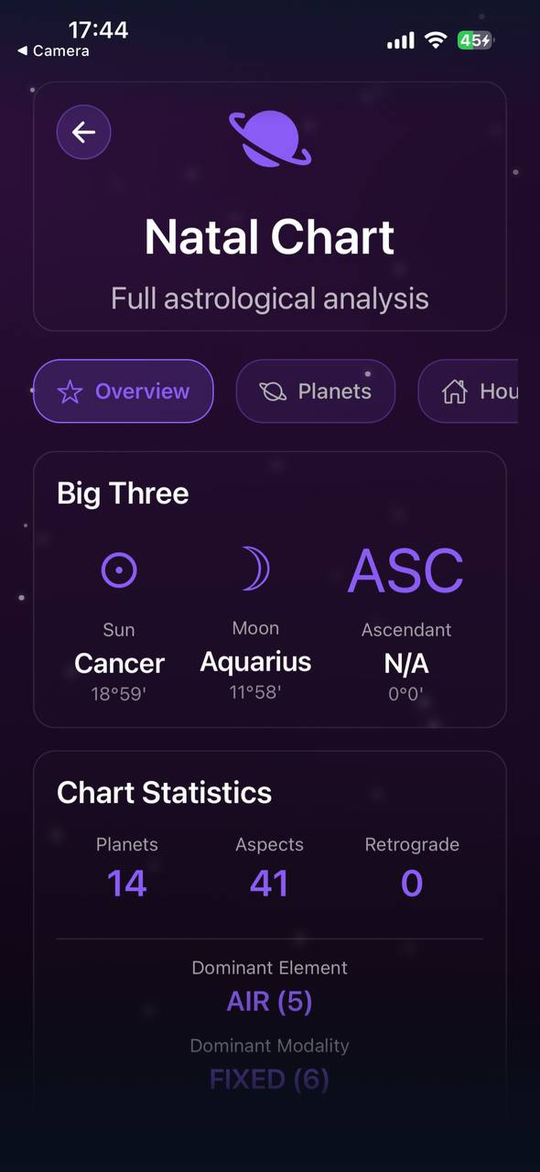
Sun, Moon and rising sign are where every chart reading starts.
Frequently asked questions
What is an ephemeris in astrology?
An ephemeris is a table that lists the positions of the Sun, Moon and planets in the zodiac for each date, usually as a sign and degree, along with details like speed and retrograde status. It is the astronomical data that every birth chart, horoscope and transit forecast is built from. Astrologers or software look up the positions for a specific moment and place, then use them to draw and interpret the chart wheel.
How does an ephemeris make a birth chart?
Software reads the ephemeris for your exact birth time, interpolating between the tabulated values to fix each planet's precise longitude. It then combines your birth latitude and longitude with the time to calculate the ascendant and Midheaven, applies a house system such as Placidus to divide the wheel, and places the planets at their ephemeris positions. Finally it computes the aspects between them. The ephemeris supplies the raw positions; the rest is geometry and interpretation.
What is the Swiss Ephemeris?
The Swiss Ephemeris is a high-precision digital ephemeris used by most modern astrology software. It is derived from the DE planetary data computed by NASA's Jet Propulsion Laboratory and covers thousands of years to a fraction of an arcsecond. Because it delivers observatory-grade positions, it has become the standard engine behind professional charts. AstraLink uses Swiss Ephemeris-grade positions with the tropical zodiac and Placidus houses, so the astronomy underlying each reading is accurate.
Can I read an ephemeris myself?
Yes. Open an ephemeris to any date and each column shows a planet's sign and degree, with an R marking retrograde motion. You can see which sign every planet is in, when a planet changes sign, and when retrogrades begin and end. Beginners often start by tracking the Moon or watching slow planets like Saturn. It takes a little practice to interpolate for an exact time, but a chart calculator will do that lookup for you automatically.
Is an ephemeris the same as a birth chart?
No. An ephemeris is the source data — a table of where the planets are on each date — while a birth chart is a single snapshot built from that data for one exact moment and place. The chart takes the ephemeris positions for your birth time, adds your location to fix the houses and angles, and arranges everything into a wheel. So the ephemeris is the almanac the whole sky follows, and your chart is one page pulled from it and personalised.
Early access · US launch
Your whole chart, read by AI — free at launch
Cosmic archetype, chart ruler, strengths, karmic lesson and more, written for your exact placements. Join early access for the complete reading, free.
- Free full birth chart + cosmic archetype at launch
- First in line for chart-based matching in your city
- Founding-member pricing, forever
AstraLink content is written by our editorial team, reviewed for astrological accuracy, and refreshed as the sky moves. Interpretations are for reflection and entertainment; they are not medical, legal or financial advice.