 AstraLink
Electional astrology, made conversational
AI astrology advisor: ask your chart what to do next
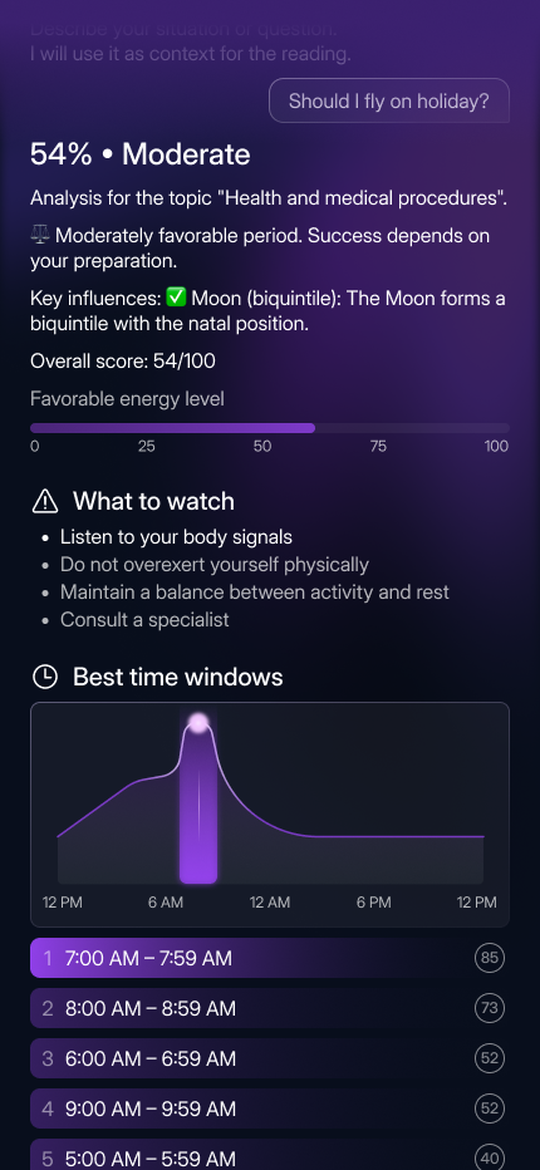
The AI Advisor is the part of AstraLink built for decisions rather than descriptions. You choose a topic (Contract, Meeting, Negotiations, Date, Travel, Purchase, Health or Other) and a date, and it checks that day's sky against your natal chart to tell you whether the timing supports what you want to do, and why.

AI astrology uses a language model to interpret real astronomical positions, your natal chart and the day's transits, instead of generic Sun-sign text. AstraLink's AI Advisor takes a topic and a date, measures the transits to your chart, and returns timing advice: sign, wait, travel, speak. It is electional astrology made conversational, with the reasoning shown.
AI Advisor: how it works
What is AI astrology?
AI astrology is the use of a language model to interpret real astronomical data, your natal chart and the current positions of the planets, instead of serving the same paragraph to everyone born under one Sun sign. The calculation underneath is classical: an ephemeris places the planets to the arc-minute, the chart is cast in the tropical zodiac with Placidus houses, and transits are measured as exact angles between today's sky and your birth positions. What is new is the layer on top. The model reads those positions the way a trained astrologer would (which planet, which house, which aspect, how tight the orb) and writes an interpretation for the question you actually asked.
That last part is the point. Most "AI astrologer" chatbots start from a blank prompt and let you type anything, which produces confident, vague answers. AstraLink's Advisor is narrower on purpose. It is built on electional astrology, the branch concerned with choosing a good moment for an action, and it always works from two inputs it can verify: a topic and a date.
How the AI Advisor works
- Pick a topic. Eight chips: Contract, Meeting, Negotiations, Date, Travel, Purchase, Health, Other. The topic tells the Advisor which planets and houses to weight. Contract pulls Mercury, Saturn and the 3rd house forward; Travel pulls the 9th house, Jupiter and Mercury; Date pulls Venus, the Moon and the 5th and 7th houses; Health pulls the 6th house, Mars and the Moon.
- Pick a date. Today, tomorrow, in a week, or another date you choose. The Advisor casts the sky for that day and lays it over your natal chart.
- Get targeted advice. A short read of the day's conditions for that topic, a verdict (go, wait, go with care), the reasons in plain English, and a better alternative date when the one you chose is weak.
Under the hood it is the same engine that powers the Cosmic Simulator: every transit to your chart, with orbs, ranked by strength. The Advisor filters that list through the lens of your topic. If you want to see the raw transits behind an answer, they are one tap away.
What the Advisor checks for every question
- Moon phase and sign. A New Moon for beginnings, a Full Moon for culmination and confrontation, a waning Moon for endings and clearing out. The Moon's sign colours the mood of the day: Libra negotiates, Aries pushes, Scorpio digs in.
- Void-of-Course Moon. The window between the Moon's last aspect in a sign and its move into the next, when things begun tend to go nowhere. Read our guide to the Void-of-Course Moon.
- Mercury's condition. Direct or retrograde, fast or slow, combust or cazimi. Mercury governs paperwork, messages, transport and negotiation.
- Transits to your natal planets. A Saturn square to your Sun on the day of a job interview reads very differently from a Jupiter trine.
- The house the day's planets are activating in your chart, which turns a general "good day for money" into "good day for your 2nd-house income, less so for shared finances."
- The slow backdrop. Saturn in Aries (since 14 February 2026), Neptune in Aries, Uranus in Gemini (since April 2026) and Jupiter in Leo (since June 2026) set the climate that the fast planets play out in, and where they fall in your chart matters.
Six questions people ask the Advisor, and what it looks at
"Should I sign this contract on Thursday?"
Topic: Contract. The Advisor checks Mercury first. Mercury retrograde (in 2026: 26 February to 20 March, 29 June to 23 July, and 24 October to 13 November) is the classic reason to delay a signature, renegotiate or read the fine print twice; a combust Mercury is a quieter warning. Then it looks at the Moon: a Void-of-Course window during business hours is a reason to sign Friday morning instead. Finally it checks Saturn's aspect to your natal Mercury and Sun: a Saturn trine supports a binding commitment, a Saturn square suggests the terms are heavier than they look. Our guide to the best time to sign a contract goes deeper.
"Is next Tuesday a good day to launch my project?"
Topic: Other. Launches want a waxing Moon in a cardinal or fixed sign, Mercury direct, and ideally a Jupiter or Sun aspect to your Midheaven or 10th-house ruler. The one thing the Advisor will not let you do is launch during a Void-of-Course Moon: the traditional reading is that what starts then "comes to nothing," which is a poor omen for a product. It will also flag a Mars–Saturn square on the day as friction (expect delays, keep the scope small) and a Venus–Jupiter trine as a wind at your back for anything public-facing.
"When should I ask them out?"
Topic: Date. The Advisor reads Venus transits to your chart: Venus conjunct or trine your natal Venus or Moon is warmth; Venus square your Saturn is awkward timing. It likes the Moon in Libra, Taurus or Pisces for first dates, steers the message itself away from a Void-of-Course window, and looks at your 5th and 7th houses. With Venus retrograde from 3 October to 13 November 2026 in Scorpio, it will suggest reconnecting with someone from the past rather than opening something brand new. Our piece on the best time to text them covers the texting version.
"I need to have a hard conversation with my boss. When?"
Topic: Negotiations. Mars rules confrontation, so the Advisor checks Mars's sign (Mars in Libra bargains, Mars in Aries escalates), its aspects to your natal Sun and Mercury, and whether Mars is squaring Pluto that day, which makes power struggles harder to walk back. It favours a Moon in an air sign for hearing both sides, Mercury direct for being understood, and avoids a Full Moon in your 10th house, when everything said at work gets amplified.
"Should I book the flight for the 14th?"
Topic: Travel. Mercury direct matters most (retrograde travel is famous for missed connections and rebooked hotels), then Jupiter's condition as the natural ruler of long journeys, then the Moon: a Void-of-Course Moon at departure is the traditional "you will get there, but nothing will go to plan" signal. It also checks transits to your natal 9th-house ruler and to Mercury, and it will suggest the 15th if the 14th is void all morning.
"Is this the week to buy the car?"
Topic: Purchase. Big purchases are a Venus question (value, price, whether you will still love it) and a Mercury question (paperwork, the deal itself). The Advisor avoids Venus retrograde for anything expensive and hard to return, avoids Mercury retrograde for the contract, and looks for the Moon in Taurus or a Venus–Jupiter aspect to your 2nd house. In late October 2026, with both Venus and Mercury retrograde, it will tell you to test-drive now and sign after 13 November.
What the AI Advisor cannot do
- It does not predict outcomes. It describes conditions. A good electional chart improves the odds of a smooth process; it does not guarantee a result.
- It is not a doctor, lawyer or financial adviser. For Health, Contract and Purchase questions it gives timing, not substance, and it says so on every such answer. Choose the treatment with your doctor; the Advisor helps you choose the day.
- It cannot read a chart it does not have. Without a birth time it works from the planets and Moon sign but cannot use your houses, and it tells you which parts of the answer are affected.
- It does not know your life. It knows the sky. Whether Thursday's contract is fair is your job.
- It is not a substitute for a human astrologer when the question is large: a marriage, a relocation, a career change you have circled for years. Premium includes two human consultations a year for exactly those moments, and our decision guides are a good middle ground.
AI astrologer vs human astrologer
Both read the same sky. The difference is scope, speed and judgment. The Advisor is fast, consistent and tireless, and it knows nothing about you except your chart. A good human astrologer is slower, costs more, and can hear the thing you did not say. We built the app to include both.
Questions to ask an astrologer, AI or human
The best questions are specific, dated and about an action you control. "Should I send the proposal Monday or Wednesday?" beats "What does my chart say about my career?" Ask about timing, ask about pattern ("why do I keep hiring the same kind of person?"), ask about the next month. Avoid asking any astrologer whether someone loves you or when you will die; the honest ones will decline, and the dishonest ones will answer. If you are new to this, the astrology reading guide explains what a good consultation covers, and the Academy will teach you enough to follow the reasoning.
See it in the app
AI Advisor vs a human astrologer
| AI Advisor | Human astrologer | |
|---|---|---|
| Speed | Seconds, any hour of the day | A booked session, usually 30 to 60 minutes |
| Scope | One topic, one date, your chart | Your whole life, context and history |
| Consistency | Same inputs, same reasoning, every time | Varies by astrologer, school and day |
| Judgment | Pattern and timing, no life context | Reads you, not only the chart |
| Best for | Daily and weekly timing decisions | Big decisions, long cycles, grief, relationships |
| In AstraLink | Included in the app | Two consultations a year on Premium |
Neither replaces a doctor, lawyer or financial adviser.
AI astrology, answered
What is AI astrology?
AI astrology combines classical chart calculation (an ephemeris, the tropical zodiac, house systems, transits) with a language model that writes the interpretation. The model reads the actual positions in your natal chart and the day's sky and explains them for your question, rather than reproducing a generic horoscope. In AstraLink it powers the natal reading, horoscopes, the Cosmic Simulator and the AI Advisor.
Is an AI astrologer accurate?
The astronomy is exact: planetary positions come from ephemeris data and are the same ones a professional astrologer would use. The interpretation is astrology, which is a symbolic language rather than a science, so "accurate" is the wrong test. What we can promise is that the Advisor reasons from real positions, shows its work, and never invents a placement or an outcome.
Can AI read my birth chart?
Yes. AstraLink's AI birth chart reading covers your cosmic archetype, chart ruler, dispositor centre, chart sect, house rulers, strongest aspects, nodes, talents, life themes, karmic lesson, relationships, career, money and health, all written from your exact placements. Early-access members receive the full reading free when they are invited.
What questions should I ask the AI Advisor?
Specific, dated, action-based questions get the best answers: should I sign on Thursday, is Saturday a good first date, should I book the flight for the 14th, is this the week to negotiate a raise. Pick the closest topic chip (Contract, Meeting, Negotiations, Date, Travel, Purchase, Health, Other) and the date, and the Advisor does the rest.
Does the AI Advisor work without my birth time?
It works, with less precision. Without a time the Advisor still uses your planets, their signs and aspects, and the day's Moon, Mercury, Venus and Mars conditions. It cannot use your houses or Ascendant, so house-specific advice (which area of life a transit touches) is left out, and the answer tells you so. Adding your time later upgrades every future answer.
Is AI astrology better than a human astrologer?
It is better at some things: speed, consistency, and answering a small timing question at 11 p.m. A human astrologer is better at context, nuance and the questions that need a conversation. AstraLink includes both; the Advisor for daily and weekly decisions, and two human consultations a year on Premium for the big ones.
Is the AI Advisor free?
The Advisor is part of the AstraLink app, which is in early access. Joining the waitlist is free, and early members get their full chart at no cost. Some depth features, such as detailed transits in the Cosmic Simulator, belong to Premium, with founding-member pricing for the early-access list. We do not publish prices before launch.
Early access · US launch
Ask your chart what to do next
Pick a topic and a date; the AI Advisor checks the transits to your chart and answers — go, wait, or a better day. Join early access, full chart free.
- Free full birth chart + cosmic archetype at launch
- First in line for chart-based matching in your city
- Founding-member pricing, forever
AstraLink content is written by our editorial team, reviewed for astrological accuracy, and refreshed as the sky moves. Interpretations are for reflection and entertainment; they are not medical, legal or financial advice.