 AstraLink
Live sky below · Your transits in the app
Cosmic Simulator: a transit calculator that explains your current transits
The Cosmic Simulator is AstraLink's transit calculator. It lays today's planetary positions over your natal chart, lists every active transit ranked by strength (Saturn trine Venus, Lilith square Mercury, Moon conjunct Uranus) and writes an AI interpretation for each one. The preview below shows the sky right now; the app shows what it does to you.
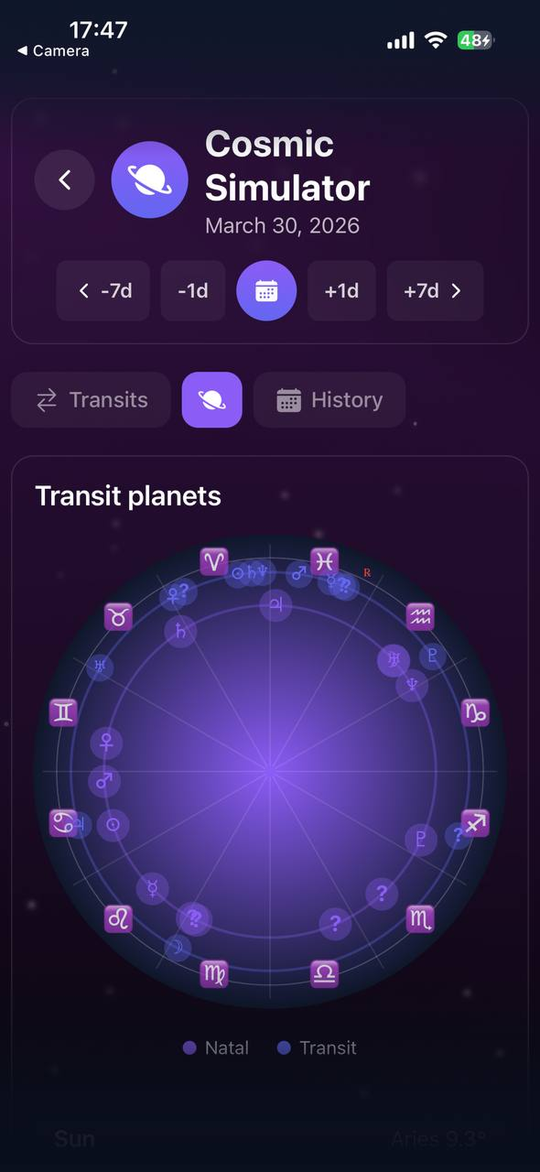
A transit calculator measures the angles between the planets right now and the planets in your natal chart, then lists the active contacts with their orbs and meanings. AstraLink's Cosmic Simulator ranks your current transits by strength, explains each with AI, and shows when every transit begins, peaks and ends. The browser preview shows today's sky free.
The sky right now
Computed live in your browser: Moon phase, sign and the planets' current positions. Sign in the app to see how they touch your own chart.
Cosmic Simulator: how it works
What is a transit calculator?
A transit calculator takes the positions of the planets at a given moment (usually right now) and measures the angles they make to the planets and points in your natal chart. When transiting Saturn sits at 8° Aries and your natal Sun is at 8° Cancer, that is Saturn square Sun, exact today. A transit calculator lists it, gives its orb (how far from exact), and ideally tells you what it tends to mean. A transit is the mechanism behind every real horoscope; the difference between a good horoscope and a bad one is whether it was computed for your chart or for your Sun sign.
The Cosmic Simulator is AstraLink's transit calculator. The browser preview above shows today's sky for everyone; the app overlays that sky on your natal chart and writes an interpretation for each contact.
What the Cosmic Simulator shows
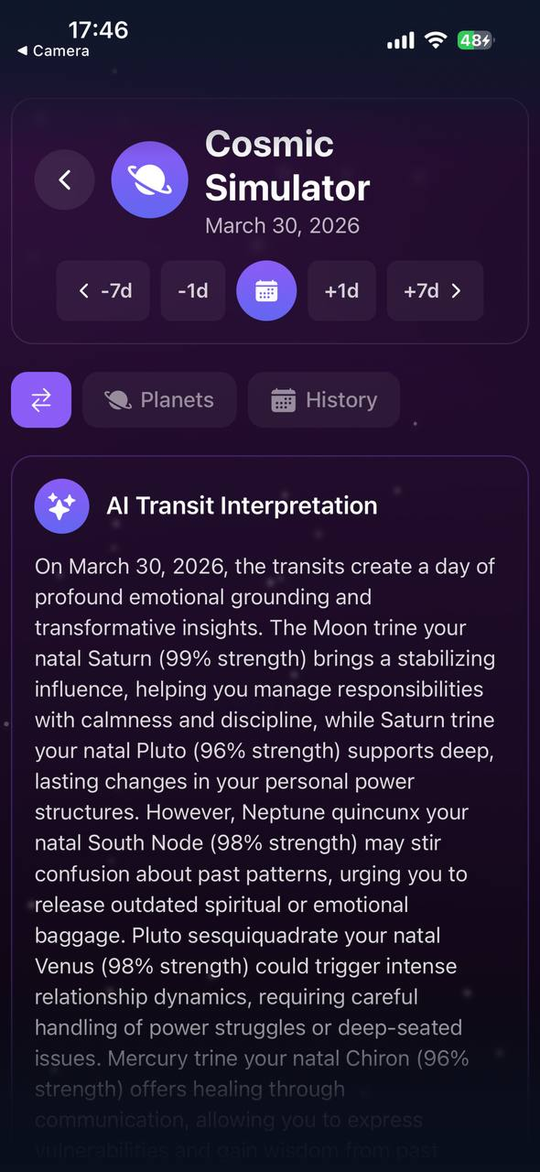
- A ranked list of active transits to your natal planets and angles: Lilith square Mercury, Moon conjunct Uranus, Saturn trine Venus, Jupiter opposite Midheaven. Ranking is by orb and by the weight of the planets involved, so a Pluto conjunction to your Sun outranks a Moon sextile to your Chiron even when the Moon is closer to exact. The top one becomes "today's main transit" on the home screen, with its strength as a percentage.
- An AI interpretation for each transit, written for the houses involved in your chart. "Moon conjunct Uranus in your 3rd house: expect a surprise message or a change of plan before noon; good for a bold idea, bad for signing." Not "Uranus brings surprises."
- The energy of the day: a percentage summarising how supportive or demanding the day's transits are for you, with the one or two contacts that dominate it.
- A timeline for every transit: when it began, when it is exact, when it ends, so you can see that the Saturn square you are feeling has three more weeks to run, or that a Mars transit peaks on Thursday.
- Slow transits as life chapters. Saturn, Uranus, Neptune, Pluto and the lunar nodes move slowly, so their contacts are shown as the backdrop to the fast daily changes, with a key window such as "active until Jul 4, about 35 days, while Pluto sextiles your natal Uranus." This is where you will see your Saturn return or a Pluto square to your Moon.
- The Moon and its Void-of-Course windows, because the Moon is the transit you feel most often and the VoC window is the one worth scheduling around. The calendar for today shows the same sky for everyone; the Simulator shows how it lands on you.
How to read a transit
A transit has three parts: the transiting planet (what is happening), the aspect (how it is happening) and the natal planet or point (which part of your life it is happening to). Then two modifiers: the houses involved, and the orb.
Take Saturn square natal Venus. Saturn is structure, delay, testing. A square is friction that demands action. Venus is love, money, pleasure, values. So: a period of roughly two to three weeks at Saturn's pace, repeated up to three times as Saturn retrogrades, when relationships and finances get tested for durability. If Saturn is moving through your 7th house, it is a partnership being tested; in the 2nd, it is income. An orb of half a degree means it is peaking now; four degrees means it is approaching or fading.
Fast planets (Moon, Mercury, Venus, Sun, Mars) create the texture of a day or a week. Slow planets (Jupiter, Saturn, Uranus, Neptune, Pluto) create chapters of months or years. The Cosmic Simulator shows both, and its AI reading tells you which one is running the show today. If you want to learn the grammar, the Academy has a full module on transits, and the Big Three guide explains why transits to your Sun, Moon and Ascendant matter most.
The transits that matter most in 2026–27
Saturn in Aries (14 February 2026 to 2028)
Saturn left Pisces for Aries on 14 February 2026 and stays until 2028. Aries is initiative and self-assertion; Saturn there asks you to build discipline around starting things and standing on your own. If you have planets in the early-to-mid degrees of the cardinal signs (Aries, Cancer, Libra, Capricorn), Saturn is aspecting them now: conjunctions for Aries placements, squares for Cancer and Capricorn, oppositions for Libra. Anyone born with Saturn in Aries (roughly 1996 to 1999, and 1967 to 1969) is in a Saturn return, and the Simulator shows the exact hits and the calculator gives the dates.
Neptune in Aries (since January 2026)
Neptune spends about fourteen years in a sign, so this is a generational shift: Neptune's idealism and blur now attach to identity, courage and new beginnings. Personally, it matters when Neptune reaches a natal planet in early Aries, Cancer, Libra or Capricorn, which for many people means a first exact contact in 2026 or 2027. Neptune transits are slow and hard to notice from the inside; the Simulator's timeline is the easiest way to see one coming.
Uranus in Gemini (since April 2026)
Uranus entered Gemini in April 2026 for a stay of about seven years. Gemini is communication, learning, siblings and local movement; Uranus there disrupts and modernises all of it. Mutable placements (Gemini, Virgo, Sagittarius, Pisces) in the early degrees feel this first. Expect sudden changes of plan, new tools, and an urge to relearn something. Uranus conjunct your natal Mercury is one of the more electric transits a person can have.
Jupiter in Leo (June 2026 to July 2027)
Jupiter moved from Cancer into Leo in June 2026. For a year it expands whatever Leo means in your chart: creativity, romance, children, visibility, the 5th-house side of life. Jupiter trine your Sun or Venus during this period is one of the friendliest transits in the calendar, and the AI Advisor leans on it when you ask about launches and dates.
Venus retrograde, 3 October to 13 November 2026, in Scorpio
The only Venus retrograde of 2026 runs in Scorpio, the sign of intimacy, shared money and what we do not say out loud. Venus retrograde transits to your natal Venus, Moon or 7th-house ruler are the classic "an ex reappears" and "reassess what I value" windows. The Simulator flags the retrograde as a modifier on every Venus transit during those six weeks, and our Venus retrograde brief covers what to do with it.
Mercury retrograde, 24 October to 13 November 2026, Scorpio into Libra
The third and last Mercury retrograde of 2026 overlaps Venus's, which makes late October and early November a period for reviewing, renegotiating and reconnecting rather than launching. The Simulator shows Mercury retrograde as a condition on every Mercury transit to your chart; our Mercury retrograde guide has the 2026 and 2027 dates, and the October 2026 transit brief walks through the month day by day.
Current transits vs my transits
"Current transits" is what everyone shares: Saturn in Aries, the Moon in Gemini, Venus stationing retrograde. "My transits" is what those positions do to your chart. The cosmic calendar covers the first; the Cosmic Simulator covers the second. Both are useful, but only the second explains why your week and your friend's week feel so different under the same sky.
How we calculate transits
Tropical zodiac, Placidus houses, ephemeris-grade positions. Orbs are conventional: wider for the Sun, Moon and conjunctions, tighter for minor aspects and the outer planets, and every transit shows its current orb so you can judge intensity yourself. We track the Moon's nodes, Chiron and Black Moon Lilith as well as the planets. The browser preview computes the Moon's phase and sign and the planets' signs for the current moment; the app does the full natal overlay with your exact birth data.
See it in the app
How to use the transit calculator
- Enter your birth date, time and place. In the app; the browser preview shows the sky only. Time and place give you houses, which is where a transit's meaning becomes specific.
- Read the energy of the day and today's main transit. The percentage tells you how supportive the day is; the main transit, with its strength, tells you what is driving it.
- Open any transit for its interpretation and timeline. Each contact shows the planets, the aspect, the houses involved, its orb, and when it began, peaks and ends.
- Check the slow transits for the chapter you are in. Saturn, Uranus, Neptune, Pluto and the nodes set the backdrop; the key window shows how long it runs.
- Turn a transit into a decision. Ask the AI Advisor about a topic and a date; it uses the same transit list to tell you whether the timing supports your move.
Key transit dates, October 2026 to early 2027
| Date | Event | What it touches |
|---|---|---|
| 3 Oct 2026 | Venus stations retrograde in Scorpio | Relationships, shared money, old attachments |
| 10 Oct 2026 | New Moon in Libra | Beginnings in partnership and balance |
| 24 Oct 2026 | Mercury stations retrograde in Scorpio | Contracts, messages, travel plans |
| 26 Oct 2026 | Full Moon in Taurus | Money, possessions, what you keep |
| 9 Nov 2026 | New Moon in Scorpio | Intimacy, debts, decisions made in private |
| 13 Nov 2026 | Venus and Mercury station direct | Green light for signing and reconnecting |
| 24 Nov 2026 | Full Moon in Gemini | Conversations, siblings, information |
| 9 Dec 2026 | New Moon in Sagittarius | Travel, study, the bigger plan |
| 24 Dec 2026 | Full Moon in Cancer | Home, family, emotional closure |
| Jan 2027 | Mars stations retrograde | Energy, conflict, projects that need a rethink; exact date in the live calendar |
Since July 2026 the lunar nodes sit on the Aquarius–Leo axis, which sets the eclipses of 2027. See the eclipse season preview.
Transit questions, answered
What is a transit calculator?
A transit calculator compares the planets' positions on a chosen date, usually today, with the planets in your natal chart and lists the aspects between them: conjunctions, squares, trines, oppositions and sextiles, each with an orb. Good ones rank the transits, show when each begins and ends, and explain what the contact tends to mean for the houses involved.
How do I find my current transits?
You need your natal chart (birth date, time and place) and the sky for today. The Cosmic Simulator does both in the app: it casts your chart, overlays the current positions, and lists every active transit with its orb and an interpretation. The free preview on this page shows today's sky; the app shows what it does to your chart specifically.
Is there a free transit chart?
Yes. The browser tool on this page shows the sky right now, free and without an account, and the site's calendar pages list the month's key transits for everyone. Your personal transit chart, with the sky overlaid on your natal placements and each contact explained, is part of the AstraLink app; early-access members get their full chart free when invited.
How long does a transit last?
It depends on the transiting planet. The Moon's transits last hours; Mercury, Venus and the Sun a day or two; Mars about a week. Jupiter takes weeks, Saturn two to three weeks per pass but often three passes over a year because of retrogrades, and Uranus, Neptune and Pluto can hold a contact for one to two years. The Simulator shows the timeline for each.
Which transits are the most important?
Slow planets to your personal planets and angles: Saturn, Uranus, Neptune or Pluto in hard aspect to your Sun, Moon, Ascendant or Midheaven mark the chapters of a life. Among these, the Saturn return (around 29, 58 and 87) is the most famous. Day to day, the Moon's aspects and Mercury's condition shape mood and communication far more than their reputation suggests.
What is the difference between transits and progressions?
Transits are the real planets moving through the sky now, compared with your birth chart. Progressions are a symbolic technique: in secondary progressions each day after birth stands for a year of life, so the progressed chart moves slowly and describes inner development. Transits are events and weather; progressions are the season you are growing through. The Simulator works with transits.
Do daily transits really affect me?
Astrology is a symbolic language, not a physical force, so the honest answer is that daily transits describe a mood and a timing rather than causing anything. Used that way, they are practical: a Void-of-Course Moon is a reason to hold a launch, a Mercury retrograde is a reason to reread the contract. The Simulator shows the reasoning so you can decide what to do with it.
Early access · US launch
Ask your chart what to do next
Pick a topic and a date; the AI Advisor checks the transits to your chart and answers — go, wait, or a better day. Join early access, full chart free.
- Free full birth chart + cosmic archetype at launch
- First in line for chart-based matching in your city
- Founding-member pricing, forever
AstraLink content is written by our editorial team, reviewed for astrological accuracy, and refreshed as the sky moves. Interpretations are for reflection and entertainment; they are not medical, legal or financial advice.