 AstraLink
Glossary
The sextile in astrology: the 60° aspect of opportunity
A sextile is astrology's quiet green light. When two planets sit 60 degrees apart, they strike up an easy, encouraging conversation — but unlike its showier cousin the trine, a sextile does not do the work for you. It hands you an open door and waits to see whether you walk through. Here is what it is, how to spot it, and why it matters.
A sextile is an astrological aspect formed when two planets are about 60 degrees apart, one-sixth of the zodiac circle. It is a soft, supportive aspect of opportunity: it links planets in compatible elements and offers helpful potential, but that potential only pays off when you consciously act on it.
What is a sextile?
A sextile is one of the five major aspects in astrology — the geometric angles planets make to one another around the zodiac wheel. It forms when two planets sit 60 degrees apart, exactly one-sixth of the 360° circle, which is why its glyph is a small six-pointed star (⚹) and its keyword is opportunity.
Sextiles sit among the soft or harmonious aspects, the same family as the trine — the opposite camp from tense aspects like the square and the opposition. But a sextile is deliberately understated. Where a trine (120°) hands you talent that flows whether you ask for it or not, a sextile offers potential that stays dormant until you act on it. Think of it as an unlocked door rather than a moving walkway: helpful, low-friction, and entirely dependent on you choosing to walk through.
How a sextile works
The magic of the 60° angle is elemental chemistry. Signs that sit two apart almost always belong to complementary elements — fire with air, or earth with water. Fire and air excite each other (a flame needs oxygen); earth and water nourish each other (soil needs rain). So a planet in Aries (fire) sextiles planets in Gemini or Aquarius (air), while a planet in Taurus (earth) sextiles planets in Cancer or Pisces (water). The two energies are different enough to stay interesting, similar enough to cooperate.
That cooperative-but-not-automatic quality is the whole point. A sextile is stimulating rather than effortless: it asks a small, conscious move — a phone call, a first draft, a yes — and then rewards it generously.
How to find a sextile in your chart
Every aspect grid marks sextiles, including the free birth chart here and the reading in the app. Three quick checks:
- Count the signs. Two signs apart (about 60°) is a sextile: Sun in Virgo and Moon in Scorpio, say, or Venus in Leo and Mars in Libra.
- Look for the light line. Chart software draws soft aspects in blue or green; the sextile is the thin one, distinct from the bolder trine.
- Mind the orb. Sextiles use a tight orb — usually about 3–4°, though some astrologers stretch to 6°. The closer to an exact 60°, the more you feel it.
One caution: near a sign boundary the degrees, not the sign names, are what count, so let the calculator do the maths rather than eyeballing it.
Why a sextile matters (with examples)
Because it rewards initiative, the sextile is the aspect of skills you can build and chances you can take — the opposite of fixed fate.
In a birth chart: picture Mercury in Virgo sextile Venus in Scorpio (earth and water). It gives a precise, emotionally intelligent voice — great for writing, counselling or design — but only if the person actually sends the words out into the world; left unused, it is just quiet good taste. Or take Mars in Cancer sextile Jupiter in Virgo: the drive and the luck are ready to team up the moment you start the project.
In the sky: slow planets form sextiles too. Jupiter in Leo and Uranus in Gemini — two signs and roughly 60° apart across 2026–2027 — drift in and out of sextile, a classic window for inventive risks that pay off if you move first. For the exact dates, check the live transit calendar in the app rather than trusting a rough estimate.
In relationships: a sextile between two people's charts (your Moon to a partner's Mercury, say) shows easy encouragement — you get each other — but, true to form, the bond grows only when you both invest in it.
More advanced patterns lean on it too: a sextile forms the base of a yod, the "finger of fate" (two planets in sextile both pointing to a third), and a sextile is one leg of a kite built on a grand trine.
The Big Three: three layers of you
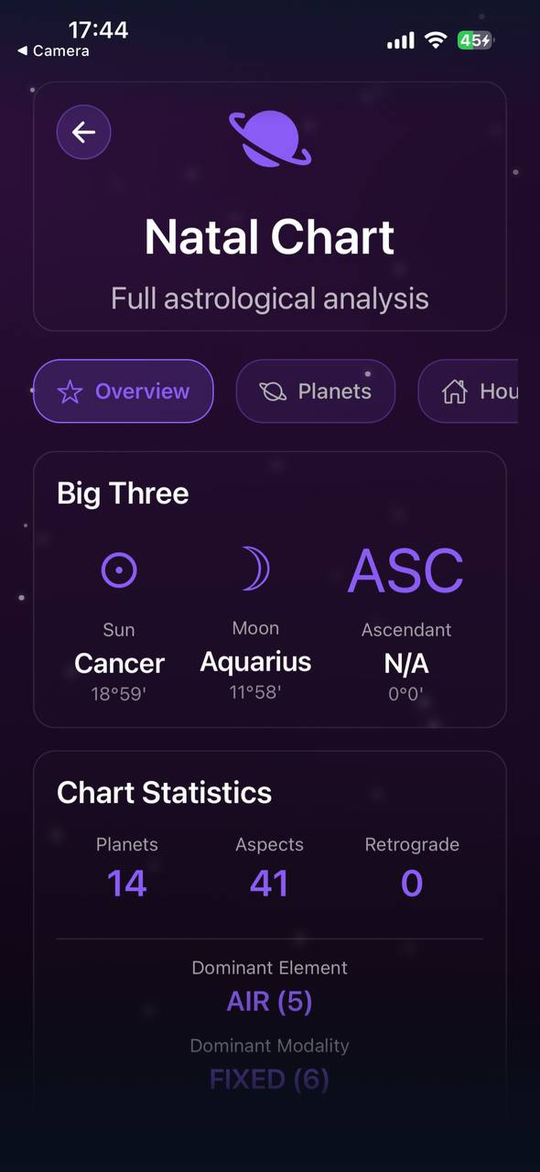
Sun, Moon and rising sign are where every chart reading starts.
Frequently asked questions
What does a sextile mean in astrology?
A sextile means two planets are about 60 degrees apart and working together easily — a soft, supportive aspect. Its keyword is opportunity: it shows where different parts of your chart can cooperate and where talent is available to you. The catch is that a sextile is not automatic. It offers helpful potential that only turns into results when you make a conscious effort to use it.
What is the difference between a sextile and a trine?
Both are harmonious aspects, but they differ in angle and attitude. A trine is 120 degrees and links planets in the same element, giving talent that flows effortlessly — sometimes so easily you take it for granted. A sextile is 60 degrees, links complementary elements (fire with air, earth with water), and is gentler and more conditional: it hands you an opportunity, then waits for you to act before it delivers.
Is a sextile a good aspect?
Yes, a sextile is considered a positive, low-friction aspect — there is no inner conflict in it. But 'good' comes with a condition. Because a sextile only offers potential rather than forcing an outcome, its benefits can pass you by if you never engage them. Read it as encouragement rather than a guarantee: a green light that still needs you to press the accelerator.
How do I find a sextile in my birth chart?
Look at the aspect grid or wheel in any chart tool, including the free birth chart calculator here. Planets roughly two signs (about 60 degrees) apart are in sextile, and software usually draws the line in blue or green. Sextiles use a tight orb of about 3 to 4 degrees, so the closer the two planets are to an exact 60 degrees, the stronger and more noticeable the aspect.
What signs are sextile each other?
Signs that sit two positions apart are naturally sextile, and they almost always pair fire with air or earth with water. For example, Aries is sextile Gemini and Aquarius; Taurus is sextile Cancer and Pisces; Leo is sextile Gemini and Libra. This is why a sextile feels cooperative — the two signs share an active or a receptive temperament without being identical.
What does a sextile mean in a transit or in synastry?
In a transit, a sextile from a moving planet to one of your natal planets opens a helpful, low-pressure window — a good time to start something, though you have to take the step. In synastry (comparing two charts), a sextile between your planets and a partner's shows easy encouragement and mutual understanding that grows when you both invest in it rather than waiting for it to happen on its own.
Early access · US launch
Your whole chart, read by AI — free at launch
Cosmic archetype, chart ruler, strengths, karmic lesson and more, written for your exact placements. Join early access for the complete reading, free.
- Free full birth chart + cosmic archetype at launch
- First in line for chart-based matching in your city
- Founding-member pricing, forever
AstraLink content is written by our editorial team, reviewed for astrological accuracy, and refreshed as the sky moves. Interpretations are for reflection and entertainment; they are not medical, legal or financial advice.