 AstraLink
Journal · How-to
How to Read Your Birth Chart in 7 Steps: a beginner's method that actually sticks
Most people open their birth chart, see a wheel full of symbols and close it again. The problem is not the chart; it is reading it without an order. This guide gives you a seven-step method, carries one example chart through every step, lists the mistakes beginners make, and points to the free tools you need to follow along.
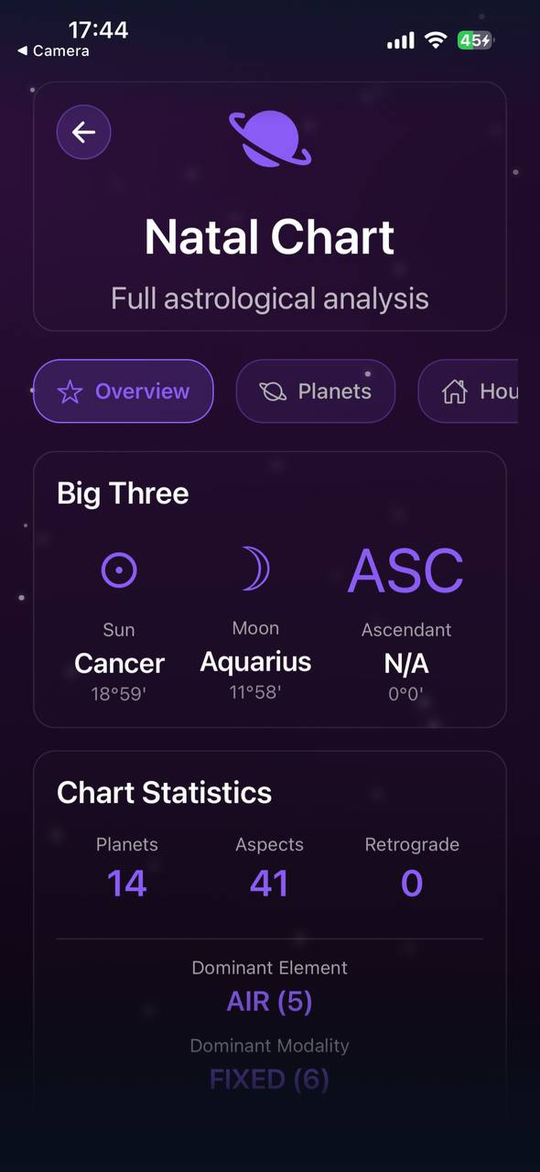
To read your birth chart: get your exact birth date, time and place; read your Sun, Moon and rising sign; find the chart ruler; read each planet by sign and house; map the aspects and patterns; add the nodes, Chiron and Lilith; then write a three-sentence synthesis and check current transits. Read in that order and nothing gets missed.
How to read a birth chart in 7 steps
- Get accurate birth data Date, exact time and place of birth. The time sets your rising sign and houses; use a birth certificate or hospital record, not memory.
- Read your Big Three Sun (core identity), Moon (emotional needs) and rising sign (how you meet the world). Write one sentence for each before going further.
- Find your chart ruler The planet that rules your rising sign. Its sign, house and aspects describe how your life tends to unfold and where your energy goes.
- Read every planet by sign and house Sign says how the planet operates, house says where it shows up. Go in order: Mercury, Venus, Mars, Jupiter, Saturn, then the outer planets.
- Map the aspects and patterns Conjunctions, oppositions, squares, trines and sextiles within tight orbs, then shapes: stelliums, T-squares, grand trines, yods.
- Add the nodes, Chiron and Lilith North and South Node for direction and default, Chiron for the wound that becomes a skill, Black Moon Lilith for what refuses to be tamed.
- Synthesize, then add timing Count elements and modalities, trace the dispositor chain, write three sentences that describe the person. Then check current transits to see what is active now.
The Big Three: three layers of you
Sun, Moon and rising sign are where every chart reading starts.
How to read a birth chart: what you are actually looking at
A birth chart (natal chart) is a map of the sky at the exact minute and place you were born, drawn as a wheel. Around the outside run the twelve zodiac signs. Inside are the twelve houses, numbered counter-clockwise from the left-hand horizon line, the Ascendant. Scattered through them are the ten planets (astrologers count the Sun and Moon as planets for convenience), each sitting in a sign and a house. Lines across the middle are the aspects, the angles between planets. AstraLink and this guide use the tropical zodiac, Placidus houses and ephemeris-grade positions; if a chart from elsewhere looks slightly different, that is usually a different house system, not an error.
The chart is not a horoscope. A horoscope is timing: today's planets compared with your sign or, better, with your chart. The chart itself is fixed, and reading it is about personality, patterns and potential. Learn to read the chart first and horoscopes become far more useful, because you will know when a transit is landing on something that matters.
To make the method concrete, we will read one chart all the way through. Call her the Alchemist, after the cosmic archetype the AstraLink app gives this combination: Sun in Virgo, Moon in Pisces, Scorpio rising, with Mercury in Virgo, Venus in Libra, Mars in Leo, Jupiter in Cancer and Saturn in Aquarius. It is a constructed example, but every placement in it is one you will meet in real charts.
Step 1: Get accurate birth data (and know what you lose without it)
How to find your astrology chart is the easy part: a free calculator, including ours, draws it in seconds from three inputs. The hard part is the third input. Date and place are rarely wrong; time is where charts go wrong, and it matters more than beginners expect. The rising sign changes roughly every two hours, and the houses move with it, so an hour's error can shift every planet into a different area of life. A birth at 6:10 a.m. and a birth at 8:10 a.m. on the same day in the same city can produce a Scorpio rising and a Sagittarius rising, two people with the same Sun and Moon whose charts read completely differently.
Where to find it: the long-form birth certificate (in most US states the hospital-issued version records the time; the short certificate often does not), hospital records, baby books, or a parent who remembers. If none of those exist, you have two options. Read the chart without houses: the Sun, Mercury, Venus, Mars and the outer planets by sign are unaffected by time, and the Moon usually is unless it changed sign that day. Or work with an astrologer on rectification, which estimates a birth time from the timing of major life events. The AstraLink app accepts an approximate time and flags which parts of the reading depend on it.
For the Alchemist we have a recorded time, which gives Scorpio on the Ascendant, Leo on the Midheaven and, using whole-sign houses for simplicity in this example, the Sun in the 11th house and the Moon in the 5th.
Step 2: Read your Big Three
The Big Three are the Sun, the Moon and the rising sign (Ascendant), and they answer three different questions. The Sun is who you are becoming: your core identity, vitality and the kind of purpose that makes you feel alive. The Moon is what you need to feel safe: your emotional reflexes, comfort and the way you process feelings when no one is watching. The rising sign is how you meet the world: first impressions, your instinctive style, the lens the rest of the chart is seen through. Our Big Three guide goes deeper on each, and the rising sign calculator is there if you only need the Ascendant.
Write one sentence for each before you go further; this discipline is what makes the method stick. For the Alchemist:
- Sun in Virgo (11th house): identity built through being precise, useful and quietly excellent, expressed among friends, groups and causes rather than on a stage.
- Moon in Pisces (5th house): feelings that are porous, imaginative and romantic, needing creative outlets and time alone to reset; the Moon opposes the Sun, so head and heart argue.
- Scorpio rising: a guarded, intense first impression that gives little away, and a life that proceeds through deep commitments and periodic reinventions.
Already you can hear a person: an analyst with a poet's inner life, hiding both behind a composed exterior. Most beginners stop here, which is fine for a week. The next five steps are where the reading becomes yours.
Step 3: Find your chart ruler
Every rising sign has a ruling planet, and that planet becomes the chart ruler: the captain of the whole chart, the planet whose sign, house and aspects describe how your life actually unfolds. Aries rising is ruled by Mars, Taurus and Libra by Venus, Gemini and Virgo by Mercury, Cancer by the Moon, Leo by the Sun, Scorpio by Mars (traditional) and Pluto (modern), Sagittarius by Jupiter, Capricorn by Saturn, Aquarius by Saturn (traditional) and Uranus (modern), Pisces by Jupiter (traditional) and Neptune (modern). We read the traditional ruler first and the modern one as a second voice; the chart ruler guide explains why.
The Alchemist's chart ruler is Mars, in Leo in the 10th house, squaring the Ascendant. That single line explains something the Big Three did not: this guarded, private person is driven toward visible achievement. Mars in the 10th wants a career that can be seen; in Leo it wants that career to carry some personal flair; the square to the Ascendant means the drive is felt as friction with the Scorpio instinct to stay hidden. Life moves, in other words, through the tension between wanting to be private and needing to be seen. Pluto, the modern co-ruler, adds a taste for transformation: careers that reinvent, not careers that accumulate.
Step 4: Read every planet by sign and house
Now the body of the reading. For each planet, ask two questions. Sign: how does this planet operate? House: where in life does it show up? Read them in order from the inside out, because the personal planets say the most about daily life:
- Mercury: how you think, learn, speak and text. The Alchemist has Mercury in Virgo in the 11th, conjunct the Sun: exact, editorial, quick to spot the flaw, at her best analyzing for a group.
- Venus: what you are drawn to, how you show affection, what you value and spend on. Venus in Libra in the 12th: refined taste, a strong need for fairness, and a habit of loving in private, sometimes people who are unavailable. Compare our page on Venus in Scorpio in the 7th house to see how differently the same planet reads two signs and houses over.
- Mars: drive, desire, anger, pursuit. Covered above as the ruler, and note that a planet can wear two hats; the ruler is still Mars, and Mars is still Mars.
- Jupiter: where you grow, believe and get lucky, and where you overdo it. Jupiter in Cancer in the 9th: faith in family and belonging, growth through travel and education, generosity that can tip into rescuing.
- Saturn: where you are cautious, disciplined and, eventually, an authority. Saturn in Aquarius in the 4th, squaring the Ascendant: a reserved home life, early lessons in self-sufficiency, a first impression that seems cooler than the person.
- Uranus, Neptune, Pluto: generational by sign (everyone your age shares them), personal by house and aspect. Read the house, and only read the sign when the planet aspects a personal planet or an angle.
Every planet in every sign and house is in the Learn hub, which is built for exactly this step: one page per combination, such as Venus in Scorpio or Venus in the 7th house. Two rules while you read. Empty houses are not empty lives; they are areas that run on default settings, described by the sign on the cusp and its ruler. And a planet in its own sign (Mercury in Virgo, Venus in Libra) is strong and consistent, while a planet in the opposite sign (Venus in Scorpio, Mars in Libra) works harder and often more interestingly.
Step 5: Map the aspects and patterns
Aspects are the angles between planets, and they are where a chart gets its tension and its talent. The five that matter for beginners: conjunction (0°, two planets blended), opposition (180°, a tug of war that needs balance), square (90°, friction that produces action), trine (120°, ease and natural talent), sextile (60°, opportunity that needs a nudge). Use tight orbs, within about 6° for the Sun and Moon and 4–5° for other planets, and read the close ones first; a 1° square will be felt every day, a 7° trine mostly in theory. Our square aspect guide is a good place to learn the logic.
Then look for patterns, the shapes several aspects make together. A stellium is three or more planets in one sign or house, a concentration that dominates the chart. A T-square is two planets in opposition both squared by a third, the classic engine of driven people. A grand trine is three planets in a triangle of trines, gifted and sometimes complacent. A yod is rarer and stranger: two planets sextile, both quincunx a third, which points like a finger at something the person must adjust to.
The Alchemist's tightest aspects: Sun opposite Moon (a “full moon” birth, life spent reconciling analysis with feeling), Mars square Ascendant (drive versus discretion), Saturn square Ascendant (the reserve), Moon trine Jupiter (an easy, generous emotional life once she lets people in), and Mercury conjunct Sun (a mind fused with identity; she is her thinking). Notice how the aspects confirm and sharpen the earlier steps rather than contradicting them. That is what a coherent reading feels like.
Step 6: Add the nodes, Chiron and Lilith
These are not planets, but modern readings would be incomplete without them, and the AstraLink chart reading gives each its own section.
The lunar nodes are the points where the Moon's path crosses the Sun's. The North Node is the direction of growth, the unfamiliar thing life keeps asking of you; the South Node, always opposite, is the default you fall back on and eventually have to loosen. The Alchemist has the North Node in Taurus in the 7th house and the South Node in Scorpio in the 1st: a life pulled from intense self-reliance toward steady, patient partnership. For someone with Scorpio rising, that is the whole plot in one line.
Chiron is the wounded healer: the place you were hurt early, over-compensated, and eventually became skilled enough to help others with. Chiron in Aries in the 6th here suggests an early wound around being allowed to assert herself, worked out through work and health routines and, later, a talent for helping others take up space.
Black Moon Lilith is the part of you that will not be domesticated, and the place you were once shamed for it. Lilith in Capricorn in the 3rd: a refusal to be told how to speak or think, a sharp tongue when authority gets it wrong, and an appeal that has nothing to do with being agreeable.
Read all three lightly. They are commentary on the chart, not the chart. If a node, Chiron or Lilith closely aspects a personal planet or sits on an angle, promote it; if it sits alone in an empty house, note it and move on.
Step 7: Synthesize, then add timing
A reading is not a list; it is a portrait. Three quick tools turn the notes into one. Count the elements and modalities. The Alchemist's chart is water-heavy (Moon, Ascendant, Jupiter) and earth-strong (Sun, Mercury), mostly mutable with a fixed Ascendant: adaptable, feeling, precise, and stubborn only about her own identity. Trace the dispositor chain. Each planet is disposed by the ruler of its sign; follow the chain until it stops. Her Sun in Virgo is disposed by Mercury, and Mercury in Virgo disposes itself, so Mercury is the final dispositor: the whole chart reports, in the end, to the planet of analysis. Meanwhile the Moon in Pisces and Jupiter in Cancer dispose each other, a mutual reception that gives the emotional life its own private loop of generosity. Write three sentences. Who this person is, what they need, what they are here to learn. For the Alchemist: A precise, useful mind in a romantic, porous heart, meeting the world behind a guarded face. She needs creative solitude and honest people who stay. She is here to learn that partnership, not self-sufficiency, is where her intensity belongs.
Then add time. A natal chart is a still photograph; transits are the film. Look at where Saturn, Jupiter and the current retrogrades fall in your chart today: which house, which natal planet they touch. The Saturn return is the first transit most people meet by name; the Cosmic Simulator in the AstraLink app shows all of them live against your chart, contact by contact, with a plain-English reading of each. That is the moment reading a chart stops being an exercise and becomes a way to make decisions.
Common mistakes when reading a birth chart
- Reading the Sun sign as the whole chart. It is one placement in ten. A Virgo with Moon in Pisces and Scorpio rising is not a magazine Virgo.
- Skipping the birth time. Without it you are reading half a chart and guessing at the houses. Find it or say honestly that you are reading without houses.
- Reading every aspect at any orb. A 9° trine is not a talent; a 1° square is a daily companion. Tight aspects first.
- Treating outer-planet signs as personal. Everyone born within a few years of you has Pluto in the same sign. Read the house and the aspects instead.
- Ignoring the chart ruler. It is the fastest route from “these are my placements” to “this is how my life works”.
- Reading placements in isolation. Venus in the 12th means one thing next to Saturn and another next to Jupiter. Always check what a planet is aspecting before deciding what it means.
- Diagnosing. A hard Moon–Saturn aspect is a pattern to understand, not a verdict on your childhood or your lovability. If a reading makes you feel smaller, it is a bad reading.
Tools to use while you read
- Free birth chart calculator: your Sun, Moon and rising sign, with a Big Three reading.
- Rising sign calculator: when you only need to check the Ascendant against a possible birth time.
- Big Three guide and chart ruler guide: the two steps most people rush.
- Learn hub: every planet in every sign and house, every aspect and pattern.
- Glossary: definitions for the Ascendant, the Midheaven, stelliums and every other term you will hit.
- Academy in the app: 55 short lessons that run this same method on your own chart, from your Sun sign to your Saturn return.
- Birth chart basics on video: the wheel explained on screen, if you learn better by watching.
Reading a chart for someone else
The method is the same; the manners are different. Ask before you read someone's chart, tell them what you are looking at, and lead with the strengths. Never read a chart at someone as an argument. If the person is a partner or a prospect, add the second chart and read the two together: that is synastry, and the free compatibility calculator gives a first scored read from two birth dates. In the app, the same engine reads any pairing in full and, in Cosmic Dating, finds people whose charts fit yours. Early-access members get their full AI birth chart free; join here.
Reading your birth chart: common questions
How do I find my astrology chart?
Enter your birth date, exact time and place into a birth chart calculator; ours draws the chart free in seconds and reads your Sun, Moon and rising sign. Birth time comes from your long-form birth certificate, hospital records or a parent. If you do not have it, you can still read the planets by sign and use an approximate time for the houses.
What do I need to read my birth chart?
Three things: accurate birth data (date, time, place), the chart itself from a calculator, and an order to read it in. The seven-step method here goes Big Three, chart ruler, planets by sign and house, aspects and patterns, nodes, Chiron and Lilith, then synthesis and transits. Keep the Learn hub or glossary open for any placement you have not met before.
Which is more important: Sun, Moon or rising sign?
They answer different questions, so none outranks the others. The Sun is identity and purpose, the Moon is emotional need, the rising sign is how you meet the world and the lens for the whole chart. In practice the rising sign and its ruler explain how life unfolds, the Moon explains how it feels, and the Sun explains what it is for.
What if I do not know my birth time?
Read the chart without houses. The Sun, Mercury, Venus, Mars and the outer planets are unaffected by time, and the Moon usually is unless it changed sign that day. Skip the rising sign, houses and angles, or estimate them with a noon chart and say so. Rectification with an astrologer can reconstruct a time from major life events.
How long does it take to learn to read a birth chart?
Your own Big Three and chart ruler take an afternoon. Working through all seven steps for one chart takes about an hour the first time and gets faster with each chart. Reading a stranger's chart fluently, without notes, usually takes a few months of practice on charts of people you know well enough to check your reading against.
What is the difference between a birth chart and a horoscope?
A birth chart is the fixed map of the sky at your birth, read for personality, patterns and potential. A horoscope is timing: the current planets compared with your sign or, in a personalized horoscope, with your own chart. Reading your chart first makes horoscopes more useful, because you know which transits touch placements that matter to you.
Can AI read my birth chart?
Yes, and well, if it is working from accurate positions and a sound method. AstraLink's AI reading covers the same steps as this guide, from the Big Three and chart ruler to aspects, nodes, the dispositor centre and a cosmic archetype, and explains each conclusion so you can check it. Treat it as a skilled reader's draft, not an oracle; your own judgment stays in charge.
Early access · US launch
Your whole chart, read by AI — free at launch
Cosmic archetype, chart ruler, strengths, karmic lesson and more, written for your exact placements. Join early access for the complete reading, free.
- Free full birth chart + cosmic archetype at launch
- First in line for chart-based matching in your city
- Founding-member pricing, forever
AstraLink content is written by our editorial team, reviewed for astrological accuracy, and refreshed as the sky moves. Interpretations are for reflection and entertainment; they are not medical, legal or financial advice.