 AstraLink
Birth chart basics
Birth chart without birth time: what you can still read
No birth time? You can still get a real, useful birth chart. Your Sun, Mercury, Venus, Mars and every slow planet are set by the date alone, and most aspects hold too. What a missing time hides is your rising sign and the houses. Here is exactly what a birth chart without a birth time shows, what it cannot, and the solar-chart workaround astrologers use.
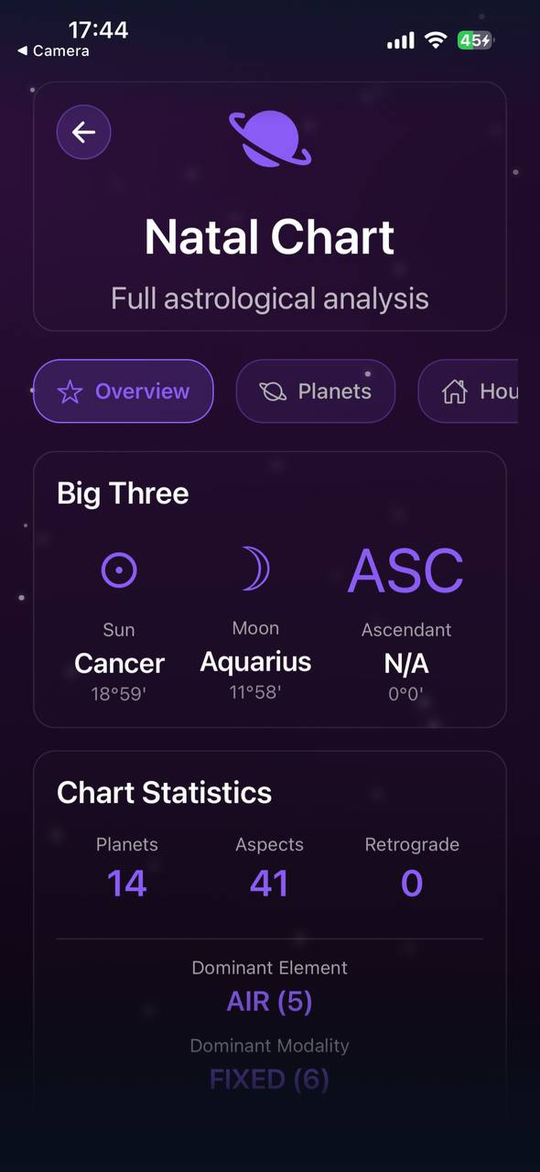
Yes, you can build a birth chart without a birth time. The date and place fix your Sun, Mercury, Venus, Mars and the outer planets, plus most aspects between them. You lose the rising sign, the house positions and, on some days, an exact Moon sign. A noon solar chart is the standard workaround.
Can you read a birth chart without a birth time?
Yes. A birth chart without a birth time is still a real chart — it is simply missing one layer. The date and place of birth are enough to place the Sun and almost every planet by sign, and to draw the aspects between them. What the clock time adds is the frame: which sign was rising in the east and where the twelve houses fall. Lose the time and you keep the planets; you lose the frame around them.
Think of it as a photograph of the sky. The date and city tell you which lights and planets were out and roughly where. The exact minute tells you which way the camera was pointed — the horizon line. You can learn a great deal from the photo without knowing the camera angle.
What a birth chart without a birth time still shows
More than most people expect. From the date and place alone you get:
- Your Sun sign — exact, unless you were born on the day the Sun changed sign, in which case the date still settles it within a few hours.
- Mercury, Venus and Mars by sign — these move sign every few weeks, so the date almost always pins them. This is your thinking style, how you love and what you value, and your drive and desire.
- Jupiter, Saturn, Uranus, Neptune and Pluto by sign — the slow planets barely move in a day, so their signs are certain.
- The Moon by sign, most days — the Moon changes sign every two and a half days, so on roughly two days in three the date alone fixes your Moon sign too. Your Moon sign is your emotional core, so this matters.
- The aspects between planets — trines, squares, oppositions and conjunctions hold regardless of time, because they depend on the planets' positions relative to each other, not on the horizon. Your Venus trine Mars, for example, is the same at 3am or 3pm.
That is a working chart. You can read your temperament, how you love, what drives you, and the major tensions and talents in your nature — all without a single house.
What you can't read without a birth time
Four things depend on the exact minute:
- Your rising sign (Ascendant). The horizon moves about one degree every four minutes and cycles through all twelve signs in a day, so each rising sign lasts only about two hours. Without a time it is genuinely unknown. The rising sign guide has a self-check based on how strangers describe you, which can narrow it.
- The houses. All twelve house cusps are built from the Ascendant and Midheaven, so no time means no houses — and the house is the "where in life" of every placement. Venus in Taurus tells you how you love; Venus in the 7th versus the 5th house tells you where it shows up.
- The angles and chart ruler. The Ascendant, Midheaven and their rulers organise a full reading. Without them, house-based sections stay blank.
- An exact Moon on about one day in three. When the Moon changes sign during your birth date, only the time settles which side you land on. If your Moon sign feels like a coin toss between two descriptions, this is usually why.
The Big Three: three layers of you
Sun, Moon and rising sign are where every chart reading starts.
How much does a missing birth time actually cost you?
Less than the panic suggests. Count what is time-independent: your Sun, Moon (usually), Mercury, Venus, Mars, all five outer planets, and every aspect between them. That is ten bodies and the entire aspect network — the bulk of what makes a chart feel like you. The time governs the rising sign and the house each planet sits in. Real, but one layer of several.
There is one honest asterisk. Because the rising sign colours first impressions and the houses tell you which area of life a placement plays out in, a date-only chart is better at describing who you are than where things happen. If your main question is temperament, love style or compatibility, you are in great shape. If it is timing, or "which part of my life does this land in," that is where the time earns its keep.
The solar chart: the standard workaround
Astrologers have read timeless charts for centuries, and the tool is the solar chart (also called a sunrise or whole-sign solar chart). Instead of leaving the wheel frameless, you put your Sun on the Ascendant and build whole-sign houses from there: your Sun sign becomes the 1st house, the next sign the 2nd, and so on. It will not match a timed chart's houses, but it gives an honest, usable structure that reads from your core identity outward.
The other common placeholder is the noon chart: set the time to 12:00 and accept the rising sign and houses as unknown. Noon has one practical virtue — it puts the Moon within about six degrees of its true position, the closest a single guess can get across a whole day, which is why it is the default for date-only readings.
Use either as scaffolding, not gospel. When you find your real time, the houses snap into place and the reading deepens.
Starting your chart with just a date
You do not have to wait until you find your time to begin. The free birth chart calculator accepts a date-only chart: enter your date and city, leave the time blank, and it returns your Sun, Moon (flagged when the day is ambiguous), inner and outer planets, and the aspects — then simply holds the rising sign and houses open. In the AstraLink app, the natal reading does the same at onboarding: it builds every section it can from your date, marks the house-based parts as pending a birth time, and fills them in the moment you add one. Nothing is wasted, and nothing is faked. If you would rather chase down the time first, our guide on how to find your birth time walks through every source. Early-access members get their full reading free when they join the waitlist.
Birth chart without a birth time: questions
Can you get a birth chart without a birth time?
Yes. Your date and city of birth are enough to place the Sun, Mercury, Venus, Mars and the outer planets by sign, plus the Moon on most days, and to draw every aspect between them. What you cannot get without a time is your rising sign and the twelve houses. Many astrologers read a solar or noon chart in the meantime, so a missing time never leaves you with nothing.
How accurate is a birth chart without the time?
The planetary signs are fully accurate — the Sun, Mercury, Venus, Mars and the slow planets don't depend on the clock, and neither do the aspects. The Moon's sign is right about two days in three; on the third it may sit between two signs. Only the rising sign and houses are truly unknown, and a noon chart keeps the Moon within roughly six degrees of its real spot.
What is a solar chart?
A solar chart is the classic workaround for a missing birth time. Instead of using the horizon to set the houses, you place your Sun on the Ascendant and count whole-sign houses from your Sun sign outward. It gives a full, readable house structure built from your core identity rather than the clock. It won't match a timed chart's houses, but it's an honest, centuries-old way to read a chart when the exact time is gone.
Will my Moon sign be wrong without a birth time?
Usually not. The Moon changes sign every two and a half days, so on about two days in three your birth date alone fixes it. The exception is being born on a day the Moon switched signs — then only the time tells you which side you're on. If two different Moon-sign descriptions both sound plausible, that boundary day is typically the reason, and a noon chart is the safest single guess.
Should I just enter noon if I don't know my time?
Noon is the standard placeholder, and it's a reasonable choice: it keeps the Moon within about six degrees of its true position, closer than any other single guess across a full day. Just remember that a noon chart's rising sign and houses are placeholders, not readings — treat them as blank until you find your real time. AstraLink flags them as pending rather than presenting a guess as fact.
Early access · US launch
Your whole chart, read by AI — free at launch
Cosmic archetype, chart ruler, strengths, karmic lesson and more, written for your exact placements. Join early access for the complete reading, free.
- Free full birth chart + cosmic archetype at launch
- First in line for chart-based matching in your city
- Founding-member pricing, forever
AstraLink content is written by our editorial team, reviewed for astrological accuracy, and refreshed as the sky moves. Interpretations are for reflection and entertainment; they are not medical, legal or financial advice.