 AstraLink
How to read your birth chart in 7 steps
A beginner's method that actually sticks: accurate data, Big Three, chart ruler, planets by sign and house, aspects, nodes and synthesis, with a worked example.
Journal
The Journal is AstraLink's long-form home: practical guides on reading your birth chart, understanding your relationship patterns and timing the things that matter, from the first text to the big decision. Every article is written to be useful without the app, and better with it.
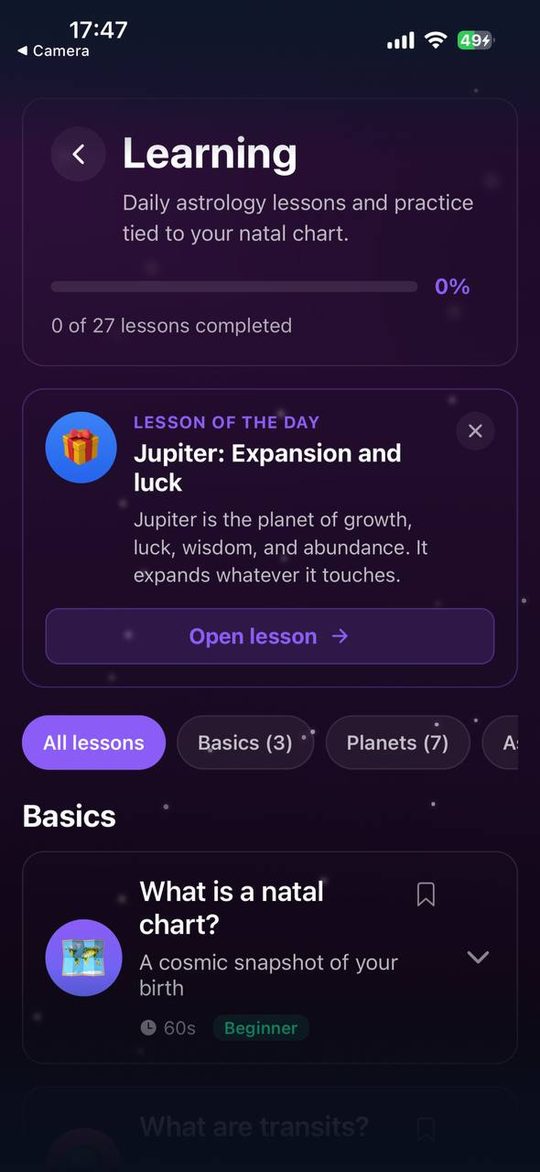
The AstraLink Journal is an astrology blog with two sections: how-to guides (reading your birth chart, using transits, planning by the Moon) and love and dating astrology (patterns, compatibility, timing). Articles are evergreen, written by the AstraLink Editorial Team under a published editorial policy, and connect to free tools and the in-app Academy.
Three guides to start with, each built around a method you can repeat.
A beginner's method that actually sticks: accurate data, Big Three, chart ruler, planets by sign and house, aspects, nodes and synthesis, with a worked example.
The astrology of the pattern: Venus, the 7th house ruler, Moon–Saturn, Venus–Neptune, Lilith and the nodes, and what to do about it without blaming yourself.
Moon sign and phase, Void-of-Course windows, Mercury and Venus retrograde, day rulers and the hour: a step-by-step timing method plus scripts.
Method pieces: read your chart, use transits, plan by the Moon. Numbered steps, worked examples, the free tool to follow along.
Relationship patterns, compatibility, dating by sign and by chart, and the timing of messages and decisions. Written for everyone.
Astrology articles online tend to fall into two piles: the daily horoscope that tells everyone born in the same month the same thing, and the dense reference page that assumes you already speak the language. The Journal sits between them. We write guides: pieces that take one question people actually ask (how do I read this chart? why does this keep happening in my love life? should I text them today?) and answer it with a method, an example and a next step.
The how-to section is about technique. Reading a birth chart in a fixed order so nothing gets missed. Using transits, retrogrades and the Moon to time a week without turning the calendar into a superstition. Understanding what the Academy lessons in the app are teaching, in longer form, with room to breathe.
The love and dating section is about relationships as people live them: the type you keep choosing, whether two charts fit, what Venus in Scorpio actually wants, how to read a Scorpio's texting silence, when a first message will land. It is inclusive by design: partners are partners, and nothing here assumes who you date.
What the Journal does not do is chase the sky. Time-sensitive pieces, from this week's Moon to the Venus retrograde in October 2026, live in News. Journal articles are evergreen and are revised, not replaced, when the astrology or our thinking improves. Key guides are also written natively in US Spanish; start at AstraLink en español.
Every article is written and reviewed by the AstraLink Editorial Team under our editorial policy. The short version:
Think of it as three depths of the same material. The free tools on this site, starting with the birth chart calculator and the compatibility calculator, give you the raw placements. The Journal teaches you what to do with them. The Academy inside the app takes the last step and personalizes the lessons to your own chart: Sun in Virgo, 1st house in Scorpio, your Saturn return, the Void-of-Course Moon on your calendar. The Learn hub and the glossary sit alongside as reference: every planet, sign, house, aspect and term, when you need the definition rather than the story. None of the three needs the others: you can read the Journal with a chart from any calculator, and the app explains itself without the Journal. But they are built to be used together, and the Journal is the cheapest place to start.
If you are new to astrology, read how to read your birth chart in 7 steps first, with your own chart open in another tab. If you came here because of a relationship, start with why you keep attracting emotionally unavailable partners and then run the two charts through the compatibility calculator. If you have a phone in your hand and a message half-written, the best time to text them will take you about nine minutes and may save you a week. Reading on a phone between things? Every article opens with a short answer capsule, then the method, then the FAQ, so you can get the point in a minute and the depth when you have ten.
And if you want all of this applied to your own chart, live, every day: that is what the app is for. Early-access members get the full birth chart free on day one. Join early access.
Evergreen guides in two sections: how-to (reading your birth chart, using transits, planning by the Moon) and love and dating astrology (relationship patterns, compatibility, timing messages and decisions). Each article is built around a method with a worked example and links to the free tool you need. Time-sensitive sky coverage lives separately in AstraLink News.
The AstraLink Editorial Team, a group of astrology writers and editors working under a published editorial policy. Astronomical dates are verified against ephemeris-grade positions, interpretations follow mainstream Western astrology with tropical signs and Placidus houses, and articles are revised with a visible modified date rather than quietly replaced.
Yes. Every article, tool and reference page on this site is free and needs no signup. The AstraLink app, which applies the same material to your own chart with personalized lessons, horoscopes and the Cosmic Simulator, is pre-launch; early-access members receive their full birth chart free when it opens.
The Journal is public and general: it teaches methods anyone can apply to any chart. The Academy lives inside the AstraLink app and personalizes the same material to your own placements, with 55 short lessons such as Sun in Virgo, your Saturn return or the Void-of-Course Moon. Read the Journal to learn the language; use the Academy to hear it spoken about you.
Early access · US launch
AstraLink reads your whole birth chart, times your moves and matches you with people your chart fits — not swipes. Join early access and get your full chart free the day we open in the US.
AstraLink content is written by our editorial team, reviewed for astrological accuracy, and refreshed as the sky moves. Interpretations are for reflection and entertainment; they are not medical, legal or financial advice.