 AstraLink
How to read your birth chart in 7 steps
Accurate data, Big Three, chart ruler, planets by sign and house, aspects and patterns, nodes and Chiron and Lilith, synthesis and timing. With a worked example and the mistakes beginners make.
Journal · How-to
The how-to section of the Journal is where we teach method: how to read astrology charts step by step, how to use transits without panic, and how to plan the week by the Moon. Every guide has numbered steps, a worked example and the free tool you need to follow along.
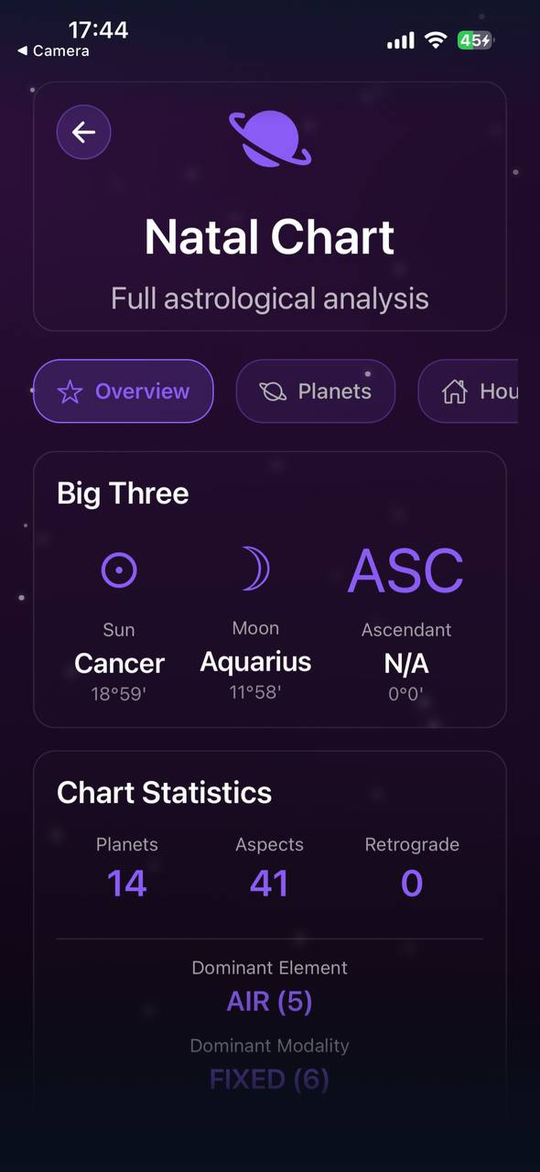
To read an astrology chart, start with accurate birth data, identify your Sun, Moon and rising sign, find the chart ruler, read each planet by sign and house, note the major aspects and patterns, add the nodes, Chiron and Lilith, then synthesize and check current transits. Our how-to guides walk through each step with examples and free tools.
Method pieces from the Journal, newest first.
Accurate data, Big Three, chart ruler, planets by sign and house, aspects and patterns, nodes and Chiron and Lilith, synthesis and timing. With a worked example and the mistakes beginners make.
A timing method for one small decision: Mercury and Venus retrograde, Moon phase and sign, the Void-of-Course Moon, day rulers and the hour. Filed under Love, built like a how-to.
A birth chart is a map of the sky at the minute you were born, drawn as a wheel: twelve signs around the outside, twelve houses inside, ten planets placed where they were, and lines between them for the aspects. It looks like a lot because it is a lot, and the reason most people give up is that they try to read everything at once. The fix is an order. Here is the one we teach, in one line each:
The full method, with an example chart carried through every step, is in how to read your birth chart in 7 steps.
Every guide in this section is built the same way, because method is the point. There is a numbered procedure you can follow with your own chart open. There is a worked example, usually a real placement combination rather than a vague archetype, so you can see what a reading sounds like. There is a common mistakes section, because knowing what to skip is half of learning to read. And there is a tool to follow along: the free birth chart calculator for placements, the rising sign calculator if you only need the Ascendant, today's sky for the Moon, and the Cosmic Simulator in the app for transits against your own chart.
We use the tropical zodiac and Placidus houses by default, traditional rulerships alongside modern ones, and we name our sources. When astrologers disagree about a technique, we tell you the options and which one we use. The guides are written by the AstraLink Editorial Team under our editorial policy.
Method is something you learn by repetition, and the Journal is the public half of a two-part system. Once you can read a chart in order, the Academy inside the AstraLink app runs the same lessons on your placements: your Sun sign, your 1st house, your Saturn return, the Void-of-Course Moon on your calendar. The Learn hub is the reference layer for every planet, house, aspect and pattern, and the glossary is where you go when a word in a reading, from dispositor to cazimi, stops you.
If timing is what you are after, the how-to approach extends naturally to electional astrology, which is just chart reading applied to the calendar: our guides to the best time to sign a contract and the Saturn return calculator use the same reading order with a date attached. Early-access members get the full chart free, plus the Academy; join here.
Your Sun, Moon and rising sign in seconds, plus a Big Three reading.
Just the Ascendant, if you are checking a birth time.
55 lessons on your own chart inside the app: planets, houses, aspects, transits, practice.
Follow a fixed order so nothing overwhelms you: accurate birth data first, then your Sun, Moon and rising sign, then the chart ruler, then each planet by sign and house, then the major aspects, then the nodes, Chiron and Lilith, and finally a short synthesis. Our seven-step guide carries one example chart through every stage so you can hear what a reading sounds like.
For a full reading, yes. The rising sign changes roughly every two hours and the houses move with it, so the time determines which areas of life each planet describes. Without it you can still read the Sun, most planets by sign, and usually the Moon sign. Birth certificates, hospital records and parents are the usual sources; the app can also work with an approximate time.
A birth chart is fixed: the sky at your birth, read for personality, patterns and potential. A horoscope is timing: today's planets compared with a sign or, in the AstraLink app, with your own chart. Learning to read your chart first makes horoscopes far more useful, because you know which transits are landing on something that matters to you.
You can read your own Big Three and chart ruler in an afternoon, and get through the seven-step method for one chart in about an hour. Fluency, reading a stranger's chart without notes, usually takes a few months of practice on charts you know. The Academy in the app shortens this by teaching each lesson on your own placements.
Early access · US launch
AstraLink reads your whole birth chart, times your moves and matches you with people your chart fits — not swipes. Join early access and get your full chart free the day we open in the US.
AstraLink content is written by our editorial team, reviewed for astrological accuracy, and refreshed as the sky moves. Interpretations are for reflection and entertainment; they are not medical, legal or financial advice.