
Glossary
Minor Aspects in Astrology: the Subtle Angles Explained
You have probably met the big five aspects — conjunction, sextile, square, trine and opposition. Minor aspects are the quieter signals underneath them: smaller angles, tighter orbs, subtler effects. Here is what minor aspects are in astrology, the seven you will meet most, the exact degree each one sits at, and how to read them without overthinking.
Minor aspects in astrology are the subtler angles between planets beyond the five major aspects — including the semisextile (30°), semisquare (45°), quintile (72°), sesquiquadrate (135°), biquintile (144°), quincunx (150°) and septile (51.4°). They use tighter orbs, carry quieter but more specific themes, and are read after the majors.
What are minor aspects in astrology?
In astrology, an aspect is the angle between two planets measured around the chart wheel — a geometric relationship that tells you how those two energies talk to each other. Most readings lead with the five major aspects: the conjunction (0 degrees), sextile (60 degrees), square (90 degrees), trine (120 degrees) and opposition (180 degrees). Minor aspects are the smaller, in-between angles that sit quietly underneath that big five. They are often called harmonic aspects, because they come from dividing the 360 degree circle by numbers like 5, 7 and 8 rather than by the tidy 2, 3 and 4 that produce the majors.
If the majors are the headlines of your chart, the minors are the footnotes — easy to skim past, but often where the interesting detail lives. A minor aspect will not define a whole relationship or a whole life. It adds a specific flavour instead: a flash of talent here, a nagging friction there, a connection that never quite resolves. Because they are so subtle, the golden rule is simple — read the major aspects first, then layer the minors on top. A minor aspect rarely overturns what the majors say; it shades and refines it. Think of it as a lens, not a verdict.
How do minor aspects work?
Two things set minor aspects apart from the majors: orb and harmonic.
The orb is the margin of error — how far from the exact angle two planets can sit and still count. Major aspects get generous orbs, often 6 to 8 degrees. Minor aspects get tight ones, usually just 1 to 2 degrees (a close quincunx is sometimes stretched to 3). That tightness is the whole point: a minor angle only registers when it is nearly exact, which is exactly what keeps it minor. If you are hazy on how orbs and degrees are measured, that primer is worth a look first.
The harmonic is the maths underneath. Divide the circle by 2 and its multiples and you get the hard, structural aspects. Divide it by other numbers and you get the minors: the fifth harmonic (360 divided by 5) produces the creative quintile family; the seventh harmonic produces the dreamy, fated septile family; the eighth harmonic produces the itchy, restless semisquare and sesquiquadrate. Each harmonic carries its own emotional signature, which is why the minors feel so different from one another even though they are all technically small angles.
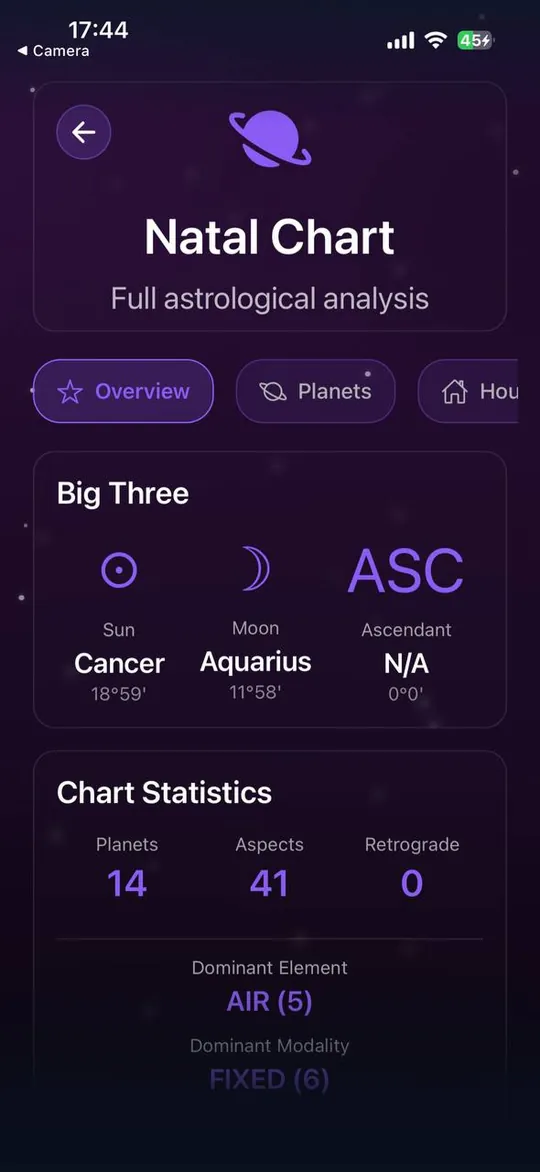
The Big Three: three layers of you
Sun, Moon and rising sign are where every chart reading starts.
The seven minor aspects, one line each
Here are the minor aspects you will actually run into, with the angle each one sits at and what it tends to mean:
- Semisextile — 30 degrees. The mild next-door-neighbour aspect, linking adjacent signs that share no element or mode; a gentle, low-key nudge to adjust and grow. See the full semisextile entry.
- Semisquare — 45 degrees. Half a square. Low-grade irritation and inner tension that prods you to act before it quietly boils over.
- Septile — about 51.4 degrees. One seventh of the circle (360 divided by 7). An irrational, fated, almost spiritual pull that resists logic and marks a sense of destiny or inspiration.
- Quintile — 72 degrees. One fifth of the circle, and the signature of a specific talent or creative gift — a knack you can sharpen with practice. Explore the quintile in depth.
- Sesquiquadrate — 135 degrees. A square and a half. Agitation and friction that keeps building until it demands an outlet, usually through sheer effort.
- Biquintile — 144 degrees. Two quintiles. A subtler creative aptitude that shows up as craftsmanship — talent expressed through patience rather than flash.
- Quincunx (inconjunct) — 150 degrees. Five signs apart with nothing in common; the aspect of constant adjustment, where two parts of you never quite mesh and have to be re-tuned on the fly. Read the quincunx in full.
A quick way to hold the mood of each: the fifth-harmonic aspects (quintile, biquintile) are about gifts; the seventh-harmonic septile is about fate and inspiration; and the eighth-harmonic pair (semisquare, sesquiquadrate), along with the semisextile and quincunx, are about friction and adjustment.
How do you read minor aspects in your chart?
You do not have to hunt these down with a protractor. Pull up your free birth chart and the aspect grid lists every angle, minor ones included — and if the glyphs look like hieroglyphics, the astrology symbols guide decodes them. From there, the app's AI reading can walk you through what a specific minor aspect means in the context of your majors, in plain language instead of jargon. Minor aspects matter in relationships too: in synastry, a partner's planet can light up one of yours at a quirky 72 or 150 degrees, adding a grace note — or a gentle snag — that the major contacts miss.
Two habits keep you honest. First, mind the orb: if a minor aspect is more than a couple of degrees from exact, treat it as background hum. Second, weight it correctly — a minor aspect is a pattern, not a prophecy, so let it colour your reading, never carry it. Want the whole picture mapped and ranked for you? Early-access members get the full chart reading that names every aspect, major and minor, and spells out what each one is actually asking of you.
The minor aspects at a glance
| Minor aspect | Angle | Harmonic | What it tends to mean |
|---|---|---|---|
| Semisextile | 30° | 12th | Mild adjustment between neighbouring signs; a gentle growth nudge |
| Semisquare | 45° | 8th | Low-grade irritation and tension that pushes you to act |
| Septile | ~51.4° | 7th | Fated, inspired, slightly irrational; a sense of destiny |
| Quintile | 72° | 5th | A specific talent or creative gift you can develop |
| Sesquiquadrate | 135° | 8th | Agitation and friction that builds until it needs an outlet |
| Biquintile | 144° | 5th | Subtler creative mastery; talent expressed through patience |
| Quincunx (inconjunct) | 150° | 12th | Constant fine-tuning between parts that never quite mesh |
Orbs are tight for minor aspects — usually 1 to 2°. Count them only when they are nearly exact, and always read them after the major aspects.
Frequently asked questions
What is the difference between major and minor aspects in astrology?
Major aspects — the conjunction, sextile, square, trine and opposition — come from dividing the chart circle by 2, 3 and 4, and they use wide orbs of roughly 6 to 8 degrees, so they shape the headline themes of your chart. Minor aspects come from dividing the circle by 5, 7, 8 and 12, use tight orbs of about 1 to 2 degrees, and add quieter, more specific detail. You read the majors first and layer the minors on top.
What are all the minor aspects and their degrees?
The commonly used minor aspects are the semisextile (30°), semisquare (45°), septile (about 51.4°), quintile (72°), sesquiquadrate (135°), biquintile (144°) and quincunx, also called the inconjunct (150°). The quintile and biquintile point to creative talent, the septile carries a fated, inspired quality, and the semisquare, sesquiquadrate, semisextile and quincunx all describe forms of friction or ongoing adjustment between two planets.
Do minor aspects really matter in a birth chart?
Yes, but in a supporting role. A minor aspect will not define your personality or a relationship on its own; it fine-tunes what the major aspects already say. A tight quintile can reveal a genuine knack, and a close quincunx can explain a nagging mismatch that the big aspects miss. The key is weighting: treat a minor aspect as a pattern that colours your reading, not a prophecy that carries it, and always interpret it against your majors first.
What orb do minor aspects use?
Minor aspects use tight orbs, usually just 1 to 2 degrees from the exact angle, with some astrologers allowing up to about 3 degrees for a quincunx or for aspects involving the Sun and Moon. That is much narrower than the 6 to 8 degrees often granted to major aspects. The reason is simple: a minor angle only produces a noticeable effect when it is nearly exact, so a wide minor aspect is usually treated as background noise.
Which minor aspect shows talent or creativity?
The quintile, an angle of 72 degrees, is the classic marker of talent and creativity — a specific, trainable gift such as an eye for design, a musical ear or a flair for problem-solving. Its relative, the biquintile at 144 degrees, points to a subtler version of the same thing: creative mastery expressed through patience and craft rather than obvious flair. Both belong to the fifth harmonic, the family of aspects astrologers link with skill and artistry.
Early access · US launch
Your whole chart, read by AI — free at launch
Cosmic archetype, chart ruler, strengths, karmic lesson and more, written for your exact placements. Join early access for the complete reading, free.
- First test wave: you’re in before the public launch on October 16
- 3 months of Premium free, then 80% off for a year*
- Free full birth chart + cosmic archetype at launch
- A say in what we build next
AstraLink content is written by our editorial team, reviewed for astrological accuracy, and refreshed as the sky moves. Interpretations are for reflection and entertainment; they are not medical, legal or financial advice.