 AstraLink
Wait to sign or commit
Postpone signing contracts, leases, or offers until the Moon changes sign. A void-Moon agreement is said to stall or need renegotiating, and waiting usually costs only a few hours.
Moon timing · updated for 2026
The void of course Moon is the oldest timing rule in Western astrology and the easiest to use: for a few minutes or a full day, roughly every two and a half days, the Moon makes no more aspects before changing sign. Things started then tend to drift. Here is what that means, what to avoid, what is fine, and how to check the sky right now.
A void of course Moon is the period after the Moon makes its last major aspect in its current sign and before it enters the next sign. It happens about every 2.5 days and lasts from minutes to over a day. Things begun during a void Moon are said to lose momentum, so astrologers avoid signing, launching and big purchases.
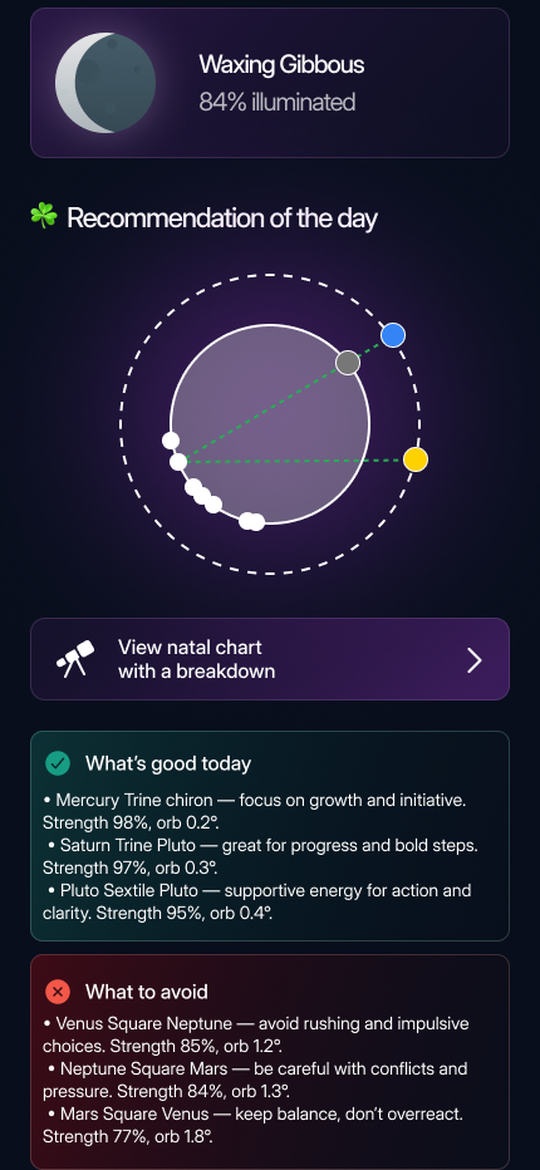
This widget shows today's Moon phase and sign. Exact void-of-course windows need aspect timing; the AstraLink moon calendar shows them to the minute.
The Moon moves through the zodiac faster than anything else in the chart, about 13 degrees a day, so it changes sign every two to two and a half days. As it moves through a sign it forms aspects (conjunctions, sextiles, squares, trines and oppositions) to the planets. At some point it makes the last aspect it will make in that sign. From that moment until it crosses into the next sign, the Moon is void of course: literally, without a course, with nowhere to go.
The definition comes from the 17th-century English astrologer William Lilly, whose Christian Astrology (1647) is still the reference. His rule: a planet is void of course when it separates from one aspect and applies to no other before leaving its sign. Lilly applied it to the Moon in horary astrology, the branch that answers questions from a chart cast for the moment the question is asked. A void Moon in a horary chart meant the matter would not proceed, or would come to nothing. Lilly added a useful exception: in Taurus, Cancer, Sagittarius and Pisces, where the Moon is strong or well-received, a void Moon still "performs somewhat". Modern electional astrologers keep both the rule and the exception.
The symbolic logic is simple. Aspects are the Moon's appointments. With no appointments left, the Moon is off duty, and so, traditionally, is the world's momentum. Things begun now tend to stall, get lost, need redoing, or turn out differently from what was intended. Not disastrously; just aimlessly.
The Moon goes void once in every sign, so about 13 times a month and roughly every 2.5 days. The length varies enormously because it depends on where the planets happen to sit:
Astrologers using only the seven traditional planets (Sun through Saturn) get longer and more frequent voids. Those who count Uranus, Neptune and Pluto get shorter ones, because the outer planets add extra appointments. AstraLink's moon calendar uses the traditional planets by default, which is the Lilly method and the one most electional astrologers use for decisions; the Academy lesson explains how to switch.
Below is a rough guide to what to expect.
| Void length | How common | What it means in practice |
|---|---|---|
| Under 30 minutes | Frequent | Barely noticeable; finish what you were doing and carry on. |
| 30 minutes – 3 hours | The most common kind | A natural pause: reply to emails, tidy up, do not schedule the signing. |
| 3 – 8 hours | Several times a month | Half a working day: plan, draft, research; hold launches and offers. |
| 8 – 24 hours | A few times a month | A 'nothing new' day. Routine, rest, maintenance, ending things. |
| Over 24 hours | A handful of times a year | Long voids cluster when slow planets sit early in signs; treat as a rest day plus. |
Lengths depend on where the planets sit relative to the Moon's sign and on whether outer planets are counted. The app's moon calendar lists each window with start and end time in your time zone.
The traditional list is about beginnings that need to lead somewhere. Avoid starting these while the Moon is void:
A void Moon is not a curse; it is an intermission. Use it for things that do not need momentum, or that you want to come to nothing:
There is also a contrarian use. Because void-Moon beginnings tend to go nowhere, some astrologers deliberately schedule things they want to fizzle under a void: the awkward meeting they want to be forgotten, the paperwork they hope no one follows up on. Use responsibly.
You need three pieces of information: the Moon's current sign and degree, the positions of the planets, and the aspects the Moon will make before it leaves its sign. Then:
A worked (hypothetical) example: the Moon is at 24° Virgo. Mercury sits at 28° Scorpio. The Moon will sextile Mercury when it reaches 28° Virgo, and no other planet sits at 28°–30° in the signs it can aspect. So the void starts at 28° Virgo, about eight hours later, and lasts until the Moon enters Libra two degrees on: roughly four hours.
Most people do not do this by hand. Options:
For today's sky, the cosmic calendar for today shows the Moon's sign and phase, and the wider cosmic calendar tracks the month.
People confuse the two because both come with a "do not sign" warning. They are different animals. Mercury retrograde is a three-week period, three times a year (in 2026: 26 February – 20 March, 29 June – 23 July, 24 October – 13 November), associated with miscommunication, revisions and delays. The void Moon is an hours-long window, every couple of days, associated with things not getting off the ground. Mercury retrograde says double-check. The void Moon says wait a bit. For a truly important signature, electional astrologers avoid both, and also check that the Moon is waxing and well-aspected. If you cannot avoid everything, avoid the void Moon: it is short, so waiting costs you hours rather than weeks.
Lilly's exception is the main one: voids in Taurus, Cancer, Sagittarius and Pisces are milder, because the Moon is exalted in Taurus, rules Cancer, and is well-received in Jupiter's signs. A void in Scorpio or Capricorn, where the Moon is in fall or detriment, is the one to take most seriously. Beyond that, the flavour of the sign colours the pause: a void Moon in Gemini feels like scattered messages and lost threads; in Virgo like fussing over details that will not matter; in Aries like false starts; in Libra like decisions that will not settle.
Because this is a dating app's site, the question we get most is about love. Two practical rules. First, do not start the important thing under a void: the first message, the DTR conversation, the apology you rehearsed. Wait for the Moon to change sign; it is usually a matter of hours. Second, use voids for the things that benefit from low stakes: a lazy Sunday together, deleting the ex's number, drafting the message you will send tomorrow. AstraLink's AI Advisor checks the void Moon automatically when you ask it about timing a conversation, alongside your own transits, so you get one answer instead of three calendars.
The app's moon calendar shows phase, percentage illumination, lunar day and every void-of-course window for the month in your time zone, with optional alerts before a void starts. The AI Advisor factors voids into its timing advice for contracts, meetings, negotiations and travel. And the Academy has a dedicated Void of Course Moon lesson so you understand the rule rather than just obeying it. Join early access to get all three at launch.
A void Moon is an intermission, not a curse. Here is how to spend one well.
Postpone signing contracts, leases, or offers until the Moon changes sign. A void-Moon agreement is said to stall or need renegotiating, and waiting usually costs only a few hours.
When you can choose the timing, hold off on launching a product, sending that first message, or starting a first date. First moves begun now tend to fizzle rather than land. Give it an hour.
Brainstorm, research, and write while nothing has to be decided; ideas flow freely when the stakes are off. Just save the send button for after the Moon shifts into its next sign.
Endings suit a void, so use it to close loops: declutter a drawer, return what does not fit, unsubscribe, clear the inbox, or finally delete the number you keep almost texting.
Long voids are made for rest and repetition: sleep, a bath, meditation, and the tasks you have done a hundred times, like laundry, invoicing, or the standing meeting. Nothing new needs to get off the ground.
A choice made under a void can feel certain now and quietly evaporate by Thursday. Sleep on the final call, and try not to let an interview or negotiation you control land in the window.
It means the Moon has made its last major aspect (conjunction, sextile, square, trine or opposition) to a planet in its current sign and will make no more before entering the next sign. The term comes from William Lilly's 1647 Christian Astrology. Symbolically the Moon is 'off duty', and traditional astrology says matters begun during the void do not proceed as planned.
No. A void Moon is not unlucky; it is a low-momentum window. Things started then tend to fizzle or need redoing rather than go wrong dramatically. Rest, routine and endings are actually favoured. The rule is about timing beginnings, not about fear, and Lilly himself noted that voids in Taurus, Cancer, Sagittarius and Pisces are mild.
Avoid starting things that need to lead somewhere: signing contracts or leases, launching products or job applications, making major purchases, sending a first message or going on a first date if you can choose the time, scheduling interviews or negotiations, and making final decisions. Everything routine, restful or ending-related is fine.
Anywhere from a few minutes to more than a day. Most voids last between half an hour and a few hours; several each month run eight hours or more; a handful each year exceed twenty-four hours. The length depends on where the planets sit relative to the Moon's sign and on whether outer planets are counted.
Once per sign, so about thirteen times a month and roughly every two and a half days. Because the Moon changes sign every 2.3 to 2.5 days, there is a void window before each ingress, though many are short enough to go unnoticed.
The widget at the top of this page shows the Moon's current sign and phase. Exact void windows require the timing of the Moon's last aspect, which the AstraLink moon calendar lists to the minute in your time zone. Today's calendar page shows the Moon's sign and the day's key aspects.
You can, but electional astrology advises against it: void-Moon agreements are said to come to nothing or need renegotiation. Since voids are short, waiting for the Moon to enter the next sign usually costs a few hours. If the signing cannot move, the tradition says it is less concerning when the Moon is void in Taurus, Cancer, Sagittarius or Pisces.
Early access · US launch
AstraLink reads every transit against your own chart and tells you when to act, wait or brace. Join early access — full chart free at launch.
AstraLink content is written by our editorial team, reviewed for astrological accuracy, and refreshed as the sky moves. Interpretations are for reflection and entertainment; they are not medical, legal or financial advice.