 AstraLink
Glossary
South Node in astrology: your comfort zone and inherited gifts, by sign
If the North Node is where you are headed, the South Node is where you have already been. It is the set of instincts that come so easily you barely notice them: your comfort zone, your reflexes under stress, the gifts you inherited without asking. Here is what the South Node is, how to find it in your chart, and how to use it well.
The South Node in astrology is the point exactly opposite the North Node, where the Moon's orbit crosses the ecliptic heading south. It is a calculated point, not a planet, and in a birth chart it marks ingrained habits, comfort zones and inherited gifts you already carry, and are meant to grow beyond.
What is the South Node in astrology?
The South Node (♋) is the point in your birth chart exactly opposite the North Node — your comfort zone in astrological form. It marks the instincts, habits and inherited gifts that come so naturally you barely notice them, and, in the end, the ones your chart is nudging you to lean on a little less. Older names for it are the descending node, the Dragon's Tail, and Ketu in Vedic astrology.
Astronomically, the two lunar nodes are where the Moon's orbit — tilted about 5° to the ecliptic — crosses the Sun's path. Where the Moon heads south is the South Node; where it heads north, the North Node (☊). They are always exactly 180° apart, so one always tells you the other. Eclipses only happen when a new or full Moon lands near this axis, which is why old astrologers drew the nodes as a dragon swallowing the Sun.
The nodes drift backwards through the zodiac, roughly 19° a year, taking about 18.6 years for a full circuit and around eighteen months per sign. That makes your South Node sign generational — shared by everyone born in the same year-and-a-half window — while the house it sits in and its aspects are yours alone.
How the South Node works, and how to find it
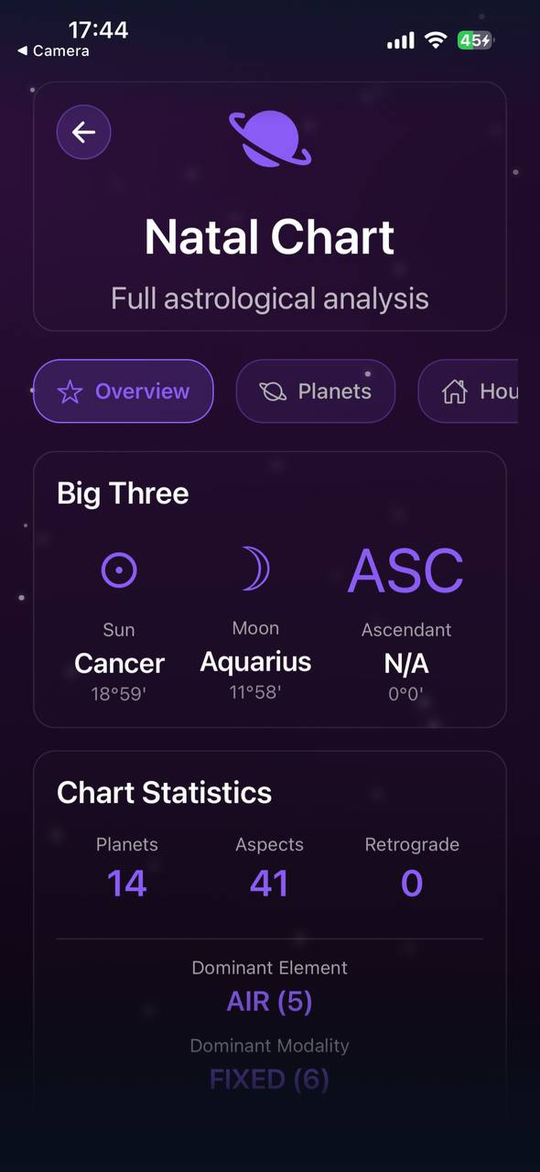
Every chart calculator plots the nodes, including the free birth chart here and the AI reading in the app, which describes the nodal axis alongside the chart ruler. Your birth date fixes the sign; your birth time fixes the house. Look for the upside-down horseshoe glyph (♋); the North Node is the same glyph the right way up, directly across the wheel.
One setting to note: True Node follows the Moon's real, slightly wobbling path, while Mean Node smooths it into a steady drift. They usually sit within a degree or two of each other — occasionally a different sign near a boundary — so check which one your calculator uses if you compare charts with a friend.
Interpretively, the South Node is your default setting. Under pressure you fall back to it; it holds genuine talent; and in past-life traditions it is the residue of who you have already been. It is never "bad." The skill is to use its gifts in service of the North Node's direction rather than hide inside them. Read the axis as one sentence: from the South Node's comfort toward the North Node's stretch, without throwing the gifts away.
Where the South Node is now. It has sat in Virgo (North Node in Pisces) since January 2025 and stays there until late July 2026, when it moves into Leo (North Node in Aquarius) until early 2028. Anyone with a Virgo or Pisces nodal axis is in a nodal return or reversal right now, and eclipses through 2026 and 2027 fall along these signs.
Why the South Node matters, with examples
Two quick examples. Someone with the South Node in Capricorn (North Node in Cancer) tends to default to control, achievement and self-reliance — the reflex to handle everything alone — and grows by letting themselves feel and be cared for. Someone with the South Node in the 7th house may over-rely on a partner to feel whole, with the growth edge in the 1st house: learning to stand on their own two feet.
The South Node also explains the "we've met before" feeling in synastry. When a partner's Sun, Moon or Venus lands on your South Node, they can feel instantly familiar and easy — lovely for comfort, riskier for growth, because the bond can settle straight into well-worn patterns. It is one mechanism behind attracting the same kind of partner on repeat: the South Node keeps choosing what it already knows.
The Big Three: three layers of you
Sun, Moon and rising sign are where every chart reading starts.
Frequently asked questions
What does the South Node mean?
The South Node represents your defaults: the skills, habits and instincts that come so naturally they can become a rut, and in past-life astrology the residue of who you have already been. It sits exactly opposite the North Node and is never negative — it holds real, inherited gifts. The work is to use those gifts in service of your North Node's direction rather than retreat into them. Its sign and house show where you tend to fall back.
How do I find my South Node?
Any birth chart calculator plots it, including the free birth chart here and the AI reading in the app. Your birth date sets the sign; your birth time sets the house. Look for the upside-down horseshoe glyph (♋) — the North Node is the same symbol the right way up, exactly opposite. Because the two nodes are always 180° apart, knowing one gives you the other, so a North Node in Pisces means a South Node in Virgo.
Is the South Node good or bad?
Neither. The South Node is your comfort zone and your inheritance — genuine talents and reflexes you can lean on. The catch is that leaning on them too hard keeps you from the growth your North Node describes. Abandoning the South Node entirely is just as unbalanced as never leaving it. The healthiest reading treats the axis as a single arc: draw on the South Node's gifts while stretching toward the North Node's less familiar territory.
What is my South Node if I know my North Node?
It is always the opposite sign, because the nodes sit exactly 180° apart. So a North Node in Aries means a South Node in Libra; North Node in Leo means South Node in Aquarius; North Node in Pisces means South Node in Virgo, and so on around the wheel. The house is opposite too: a North Node in the 10th house puts your South Node in the 4th. One glance at either node hands you the other.
What does the South Node mean in synastry?
When someone's Sun, Moon, Venus or another planet lands on your South Node, they tend to feel instantly familiar, as if you already know them. That makes for deep comfort and easy recognition, which is why South Node contacts show up in long, fated-feeling relationships. The risk is that the bond settles into old, well-worn patterns fast. Astrologers read it as a comfort-and-karma signature rather than a straightforward attraction score.
What sign is the South Node in right now?
The South Node has been in Virgo, with the North Node in Pisces, since January 2025, and it moves into Leo (North Node in Aquarius) in late July 2026, staying there until early 2028. It shifts signs roughly every eighteen months, travelling backwards through the zodiac. If you want the exact degree on a specific date, check the live calendar in the app rather than relying on a fixed table.
Early access · US launch
Your whole chart, read by AI — free at launch
Cosmic archetype, chart ruler, strengths, karmic lesson and more, written for your exact placements. Join early access for the complete reading, free.
- Free full birth chart + cosmic archetype at launch
- First in line for chart-based matching in your city
- Founding-member pricing, forever
AstraLink content is written by our editorial team, reviewed for astrological accuracy, and refreshed as the sky moves. Interpretations are for reflection and entertainment; they are not medical, legal or financial advice.