
Glossary
Juno in astrology: the marriage asteroid, by sign, house, and synastry
Juno is the placement couples' astrologers reach for when the question is not who you fancy but who you marry. Named for the Roman goddess of marriage, this little asteroid tracks your terms for commitment: the partner you keep, the vows that actually hold you, and the dealbreakers you discover the hard way. Here's Juno by sign, house and synastry.
Juno in astrology is asteroid 3 Juno, named for the Roman goddess of marriage. In a birth chart it describes your signature of commitment: the kind of long-term partner you're drawn to, the terms on which you'll settle down, and what you need to feel secure in marriage. It's an asteroid, so read it as nuance, not a headline.
What is Juno in astrology?
Juno is one of the four large asteroids astrologers read alongside the planets — Ceres, Pallas, Juno and Vesta — and it was the third to be discovered, spotted in 1804. In the sky it's a rock circling the Sun in the asteroid belt between Mars and Jupiter, taking a little over four years to go around. In a chart it is small, so read it as nuance and fine detail, not as a headline the way you'd read your Sun, Moon or Venus.
What makes Juno worth finding is its name. Juno was the Roman queen of the gods and the goddess of marriage (the Greek Hera) — famously the wife of a famously unfaithful husband, which is the whole myth in one line. So astrologers read Juno as the signature of commitment: the kind of long-term partner you're drawn to, the terms on which you'll actually settle down, and what you need to feel secure once the honeymoon wears off. Where Venus shows what attracts you and who you flirt with, Juno shows who you stay with — the difference between the spark and the vow.
Because Juno carries Hera's story, it also flags the shadow side of commitment: jealousy, power imbalance, fear of betrayal, and the fairness you'll insist on in a partnership. None of that is a verdict. Juno is a lens on how you do "us," not a prophecy about who you'll end up with.
How Juno works in your chart
Juno speaks through three things, in order: its sign, its house, and its aspects.
- The sign describes what you look for in a spouse and the qualities that make a bond feel like home.
- The house shows the area of life where committed partnership turns up — where you tend to meet "the one," or what the relationship is really about.
- Aspects to your personal planets (within about 3°) show how loudly Juno speaks. Juno touching your Sun, Moon, Venus or Mars pulls the theme of commitment to the front of the chart.
Most modern software includes the big four asteroids. The free birth chart here lists Juno, and the AI reading in the app folds it into the relationships section alongside your 7th house and Venus. Your birth time and place fix the house; the sign you'll usually get from the date alone. Look for the glyph that resembles a star-topped sceptre (⚵).
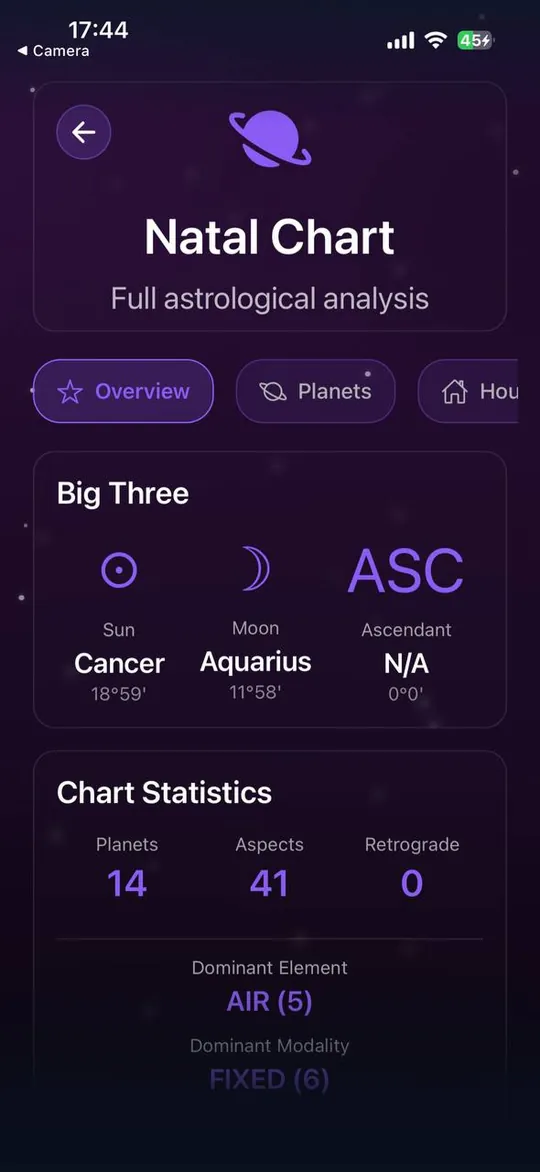
The Big Three: three layers of you
Sun, Moon and rising sign are where every chart reading starts.
Juno by sign: what you want in a spouse
Your Juno sign is the flavour of commitment — the qualities that make you feel safely, lastingly partnered.
- Juno in Aries: a partner with fire and independence. You commit to someone who keeps their own spark and lets you keep yours; passivity is the dealbreaker.
- Juno in Taurus: loyalty you can feel. You want steadiness, sensuality and a shared life you can build on. Security is non-negotiable.
- Juno in Gemini: a partner you never stop talking to. Mental connection and variety keep the bond alive; boredom is the real threat.
- Juno in Cancer: home, tenderness and emotional safety. You commit to someone who feels like family and wants to build one with you.
- Juno in Leo: warmth, loyalty and a partner who's proud of you. You want devotion out loud, not love kept quiet.
- Juno in Virgo: a partner who shows up in the small acts. Reliability, shared routines and being genuinely useful to each other.
- Juno in Libra: fairness and true partnership. You commit to equality and a balanced "we"; lopsided effort ends it.
- Juno in Scorpio: all-in intimacy. You want depth, loyalty and total honesty; half-in isn't commitment to you. Jealousy is the edge to watch.
- Juno in Sagittarius: a partner who's also an adventure. Freedom, shared beliefs and room to grow keep you married in spirit, not just on paper.
- Juno in Capricorn: a partner you can build something lasting with. You take commitment seriously, value loyalty over time, and mean the vows.
- Juno in Aquarius: a best friend and an equal who respects your independence. You commit on your own, unconventional terms.
- Juno in Pisces: a soul-deep, tender bond. You want compassion, imagination and a partner who meets you in the feelings — with boundaries, so it stays mutual.
Juno by house: where the bond lives
Juno's house points to where committed partnership shows up in your life and what the relationship is really about.
- 1st–3rd houses: you meet partners through who you are (1st), what you value and earn (2nd), or everyday contact — neighbours, siblings, short trips, conversation (3rd).
- 4th–6th houses: the bond centres on home and family (4th), romance, creativity and children (5th), or daily life, work and mutual care (6th).
- 7th house: Juno's home turf. Marriage is a headline theme and a committed partner is central to your story. Juno and the 7th house of partnership are the two main significators of marriage in a chart.
- 8th–9th houses: deep intimacy, shared resources and transformation (8th), or a partner met through travel, study, or a different culture or worldview (9th).
- 10th–12th houses: partnership tied to career and public life (10th), friendship and community (11th), or a private, spiritual, behind-the-scenes bond (12th).
Juno in synastry: the commitment signature
In synastry — comparing two charts side by side — Juno contacts are the ones that quietly say marriage material. When your Juno sits on a partner's Sun, Moon, Venus or Mars (or theirs on yours) within about 3°, there's often a sense that this relationship could be permanent. Juno conjunct their Venus tends to feel like being genuinely cherished; Juno on the Sun can feel like meeting a spouse rather than a date. Harmonious aspects (trine, sextile) make commitment feel easy; squares and oppositions bring the Hera themes — jealousy, control, fairness to be negotiated — which a couple can absolutely work with once it's named out loud.
Juno is a supporting actor, though, not the lead. Read it after the Sun, Moon, Venus, Mars and the angles, the way we do in a full synastry reading. A single Juno hit doesn't make a marriage, and its absence doesn't rule one out. It's one more piece of evidence about how two people might build an "us" — a pattern to explore, not a promise to bank on.
Finding your Juno match
This is exactly where chart-based matching earns its keep. Cosmic Dating compares your whole chart with a potential partner's — Juno included — instead of a bio and a few photos, so the compatibility you see reflects how you actually bond, not just who looks good on a grid. The app weighs commitment signatures like Juno alongside your Sun, Moon and Venus; you can read how the matching works under the hood. If you'd rather test one specific person, the AI reading will run your Juno and the rest of your synastry for any birthday you enter. AstraLink is in US early access now, with founding-member perks for people who join the early-access list.
Common misconceptions about Juno
- "Juno predicts who I'll marry." It describes the kind of commitment you seek and the terms that feel secure — a pattern, not a prophecy. Timing, free will and the other person all matter more.
- "Juno is a planet." It's an asteroid, one of four astrologers commonly use. Treat it as fine detail layered over the planets, not a core placement.
- "Juno only matters if you want a wedding." Read it as your template for any committed, long-term bond, married or not.
- "A hard Juno aspect means a doomed relationship." Squares and oppositions flag themes to handle — jealousy, fairness, power — not a sentence. Named and shared, they're workable.
Frequently asked questions
What does Juno mean in astrology?
Juno is asteroid 3 Juno, named for the Roman goddess of marriage, and astrologers read it as your signature of commitment. It describes the kind of long-term partner you're drawn to, the terms on which you'll settle down, and what makes a bond feel secure. As an asteroid it's a fine detail in the chart — a lens on how you do "us," not a prediction of exactly who you'll marry.
What does my Juno sign say about my ideal partner?
Your Juno sign is the flavour of commitment you seek in a spouse: fire and independence for Aries, steady loyalty for Taurus, constant conversation for Gemini, emotional safety for Cancer, out-loud devotion for Leo, fairness for Libra, all-in intimacy for Scorpio, shared adventure for Sagittarius, and a soul-deep bond for Pisces. The house shows where partnership turns up in your life; aspects show how central the theme is.
What does Juno mean in synastry?
In synastry, Juno contacts are the "marriage material" signatures. When your Juno lands on a partner's Sun, Moon, Venus or Mars within about 3 degrees, there's often a sense the relationship could last. Trines and sextiles make commitment feel easy; squares and oppositions raise Hera's themes — jealousy, control and fairness — that a couple can work through once named. Read Juno after the personal planets, never before them.
Is Juno more important than Venus for marriage?
No — they do different jobs. Venus governs attraction, romance and what you find beautiful; it's the spark. Juno governs commitment, loyalty and the terms you'll marry on; it's the vow. For a long-term match, read them together: Venus shows the chemistry, Juno shows whether you'll build a life on it. The 7th house and Saturn round out the marriage picture.
How do I find my Juno sign?
Run a birth chart that includes the major asteroids — AstraLink's free birth chart does — and look for Juno, whose glyph resembles a star-topped sceptre. Your birth date alone usually fixes the sign; your exact birth time and place pin down the house and any aspects. For the full story, the app's AI reading interprets your Juno alongside your 7th house, Venus and the rest of your relationship chart.
Early access · US launch
Your whole chart, read by AI — free at launch
Cosmic archetype, chart ruler, strengths, karmic lesson and more, written for your exact placements. Join early access for the complete reading, free.
- First test wave: you’re in before the public launch on October 16
- 3 months of Premium free, then 80% off for a year*
- Free full birth chart + cosmic archetype at launch
- A say in what we build next
AstraLink content is written by our editorial team, reviewed for astrological accuracy, and refreshed as the sky moves. Interpretations are for reflection and entertainment; they are not medical, legal or financial advice.