
Glossary
Hellenistic astrology: where Western astrology began
Nearly every technique in a modern birth chart reading has an ancestor, and most of them trace back to one place: Hellenistic astrology, the ancient Greek-Egyptian tradition that built the Western chart. Here's what it is, how its core techniques work, how it differs from modern psychological astrology, and why it's having a quiet revival.
Hellenistic astrology is the ancient Greek-Egyptian tradition, practiced roughly from the 2nd century BCE to the 7th century CE, that forms the root of Western astrology. It uses whole-sign houses, the seven classical planets, sect (day and night charts), the lots, and time-lord techniques like profections and zodiacal releasing.
What is Hellenistic astrology?
Hellenistic astrology is the ancient Greek-Egyptian tradition that developed across the Greco-Roman world between roughly the 2nd century BCE and the 7th century CE. It is the root system of Western astrology — nearly every technique you meet in a modern birth chart reading descends from it, even when the modern version has drifted a long way from the original.
It was born in Hellenistic Egypt, where Babylonian star-lore, Egyptian calendar craft and Greek philosophy collided. Practitioners wrote in Greek, cast charts for ordinary people rather than only kings, and assembled a strikingly complete toolkit for reading a life from the exact moment of birth. Think of it less as fortune-telling and more as a structured language for describing a pattern, not a prophecy.
At its core, Hellenistic astrology rests on a handful of load-bearing ideas: whole-sign houses, the seven classical planets, the concept of sect, the lots, and a family of time-lord techniques that tell you when a part of the chart gets switched on. It shares deep roots with Vedic astrology, which preserved many parallel ancient techniques in the Indian tradition.
The Big Three: three layers of you
Sun, Moon and rising sign are where every chart reading starts.
How does Hellenistic astrology work?
Whole-sign houses
The oldest and simplest house system, whole-sign houses, gives each of the twelve houses one entire zodiac sign. Your rising sign becomes the whole 1st house, the next sign the 2nd, and so on around the wheel — no uneven cusps, no houses of wildly different sizes. Most people reviving the tradition treat it as the house system Hellenistic astrology was actually built on.
The seven classical planets
Hellenistic charts use only what the naked eye can see: the Sun, Moon, Mercury, Venus, Mars, Jupiter and Saturn. Uranus, Neptune and Pluto had not been discovered, so they play no part. Each planet is also graded by essential dignity — how at-home or out-of-place it is in a given sign, which shapes how smoothly it can do its work.
Sect: day charts and night charts
One of the tradition's most distinctive ideas is sect — whether you were born during the day or at night. A daytime birth favours the Sun, Jupiter and Saturn; a nighttime birth favours the Moon, Venus and Mars. The same planet can behave like a gracious guest or a difficult houseguest depending on this one factor, a nuance modern astrology often drops entirely.
The lots (Arabic parts)
The lots are calculated points derived from the positions of planets and the ascendant. The Lot of Fortune (tied to the body and circumstance) and the Lot of Spirit (tied to mind and career) are the headliners, but there are dozens more, each a specialised lens on one area of life.
Time-lord techniques
This is where Hellenistic astrology really stands apart. Instead of only reading transits, it uses time-lord systems that hand rulership of a chapter of your life to different planets in turn. Annual profections advance one house each year of life, spotlighting a fresh area every birthday. Zodiacal releasing maps longer chapters and peak periods, especially around career and relationships. Together they turn a static birth chart into a timeline.
Hellenistic vs. modern psychological astrology
If you have mostly met astrology through horoscope columns and social media, you have met its modern, psychological descendant. Psychological astrology — shaped by 20th-century thinkers who folded in Jungian ideas — reads the chart as a map of the inner self: archetypes, growth, personality, healing. It is introspective and client-centred, and it uses all ten planets plus points like Chiron, reaching well beyond the big three of sun, moon and rising.
Hellenistic astrology is more concrete and more external. It asks what and when: which areas of life are emphasised, which years get activated, how the pieces fit together. Neither approach is more "real" than the other — they are different tools for different questions, and plenty of practitioners happily mix them, borrowing Hellenistic timing while keeping a modern, psychologically literate tone. Horary astrology, the art of answering a specific question from the chart of the moment it is asked, also descends from this same lineage. It is a lens, not a verdict.
The modern revival of Hellenistic astrology
Hellenistic astrology nearly disappeared. Its Greek texts sat untranslated for centuries, cut off from practitioners who had no idea how much had been lost. That changed in the 1990s, when Project Hindsight and a wave of translators began rendering the surviving sources — Vettius Valens, Dorotheus, Ptolemy and others — into modern languages. What came back was a tradition far richer and more systematic than the pop-astrology most of us grew up with.
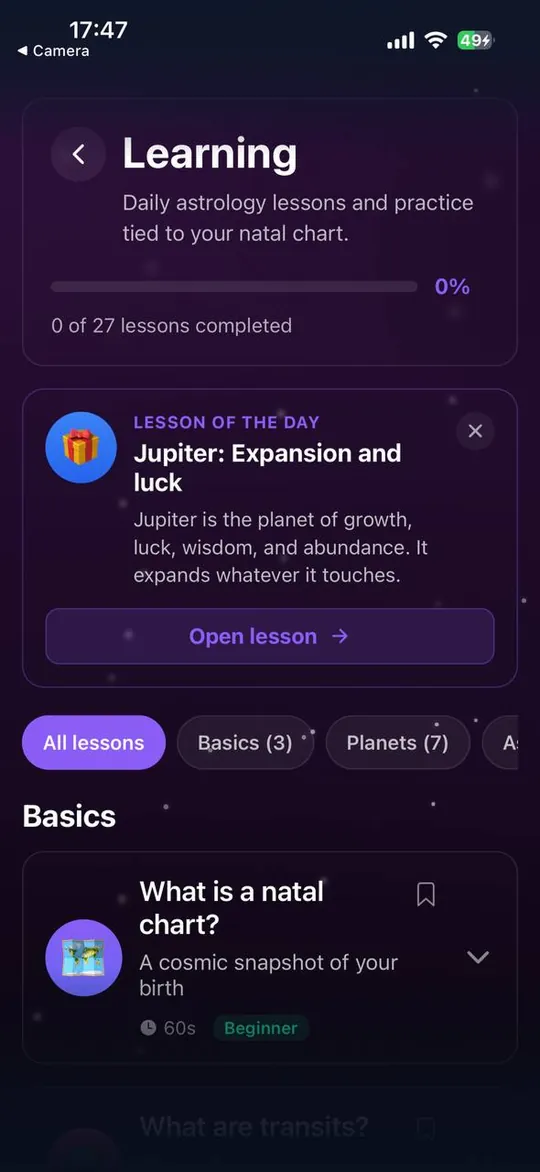
That revival is now in full swing, and you no longer need ancient Greek to learn it. If you want to actually practise these techniques — casting a whole-sign chart, finding your profection year, reading your sect — rather than only reading about them, the AstraLink Academy breaks them into plain-language lessons you can work through at your own pace. Early-access members get first access as new lessons roll out, with founding-member pricing for early-access members.
For context, the old craft is riding a genuine cultural wave: Pew Research finds about 27% of US adults believe in astrology, rising to 43% of women aged 18 to 49. Curiosity about the serious, historical end of the subject has grown right alongside the memes.
Hellenistic vs. modern psychological astrology at a glance
| Dimension | Hellenistic astrology | Modern psychological astrology |
|---|---|---|
| Era | ~2nd c. BCE – 7th c. CE | 20th century onward |
| Houses | Whole-sign houses | Often Placidus or other quadrant systems |
| Planets | Seven classical (Sun–Saturn) | All ten, plus Chiron and points |
| Core question | What and when (timing) | Who and why (psychology) |
| Signature tools | Sect, lots, profections, zodiacal releasing | Archetypes, aspects, personal growth |
| Tone | Concrete, external, structured | Introspective, reflective, client-centred |
Most working astrologers today blend both — Hellenistic timing with a modern, psychologically literate voice.
Hellenistic astrology FAQ
Is Hellenistic astrology the same as Western astrology?
Not quite — Hellenistic astrology is the ancient source, and modern Western astrology is its descendant. The Western tradition inherited the zodiac, the planets, the houses and the aspects from Hellenistic practice, then evolved over two thousand years, absorbing medieval, Renaissance and 20th-century psychological ideas. So all Hellenistic astrology is Western, but not all Western astrology is Hellenistic.
What is the difference between Hellenistic and Vedic astrology?
Both grew from a shared ancient root and use similar tools, but they split early and developed separately. Hellenistic astrology uses the tropical zodiac, tied to the seasons, and became the base of Western astrology. Vedic astrology, from India, mainly uses the sidereal zodiac, tied to the fixed stars, along with its own dasha timing systems. The overlap in method is striking, but the two zodiacs differ.
What are time-lord techniques in Hellenistic astrology?
Time-lord techniques are timing systems that assign rulership over a chapter of your life to a specific planet, then move that rulership on over time. Annual profections shift one house per year, highlighting a new theme each birthday. Zodiacal releasing maps longer periods and peak chapters, often for career and relationships. They tell you when parts of your chart become active, not just what they mean.
How do I start learning Hellenistic astrology?
Begin with the fundamentals the tradition is built on: whole-sign houses, the seven classical planets, essential dignity and sect. Once those click, add the timing tools — profections first, then zodiacal releasing. Reading your own chart with each concept makes it stick far faster than theory alone. The AstraLink Academy sequences these lessons for beginners and lets you apply each one to your own chart.
Is Hellenistic astrology more accurate than modern astrology?
There is no reliable evidence that any astrological system predicts the future accurately, and we never claim one does. What Hellenistic astrology offers is a more structured, timing-focused framework. Many people find its concrete approach clarifying, while others prefer the introspective tone of modern psychological astrology. Think of accuracy here as usefulness for reflection, not proof of prophecy — it is a tool, not a verdict.
Sources
The checkable facts on this page come from these external sources. The astrological interpretation is our own.
- 30% of Americans Consult Astrology, Tarot Cards or Fortune Tellers · Pew Research CenterPew Research finds about 27% of US adults believe in astrology, rising to 43% of women aged 18 to 49.
- Hellenistic astrology · WikipediaTradition from the late 2nd/early 1st century BCE to the 6th–7th century CE, centred on Egypt, written in Greek
- Astrology: Astrology in the Hellenistic period · Encyclopaedia BritannicaBirth-chart astrology (genethlialogy) developed in the Hellenistic period alongside Babylonian planetary omens
Early access · US launch
Your whole chart, read by AI — free at launch
Cosmic archetype, chart ruler, strengths, karmic lesson and more, written for your exact placements. Join early access for the complete reading, free.
- First test wave: you’re in before the public launch on October 16
- 3 months of Premium free, then 80% off for a year*
- Free full birth chart + cosmic archetype at launch
- A say in what we build next
AstraLink content is written by our editorial team, reviewed for astrological accuracy, and refreshed as the sky moves. Interpretations are for reflection and entertainment; they are not medical, legal or financial advice.