
Glossary
Planetary returns: the life-cycle timeline of your chart
Your chart runs on cycles, and the loudest moments arrive when a planet finishes a full lap and lands back where it started. That is a planetary return — a cosmic odometer rolling over. Some happen monthly, some once or twice in a lifetime. Here is the whole timeline, and roughly when each chapter opens for you.
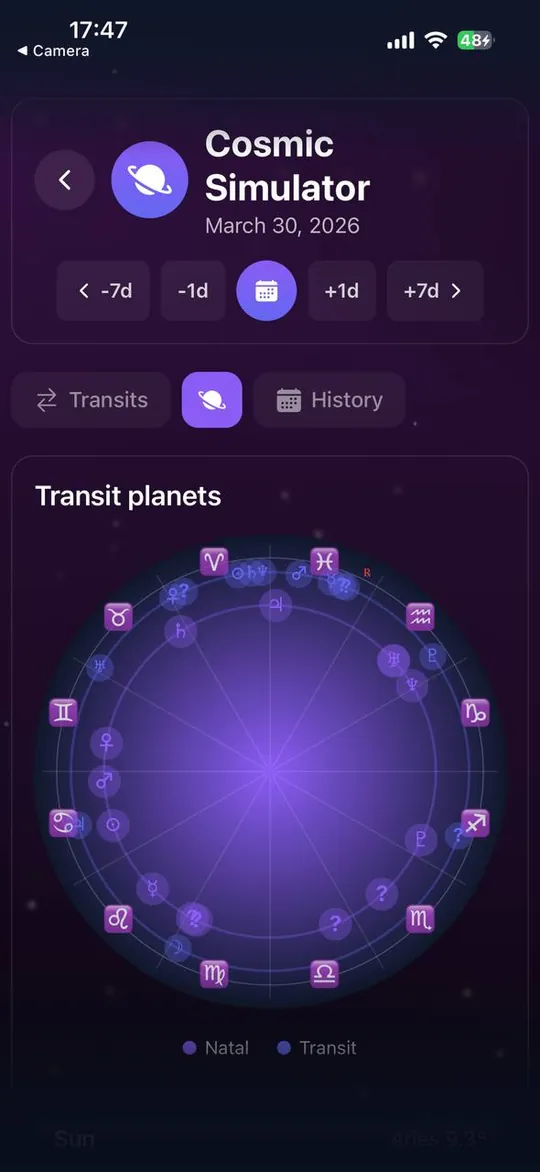
A planetary return is the moment a transiting planet comes back to the exact position it held when you were born, resetting that planet's cycle. Your Jupiter, Saturn, nodal and Chiron returns — plus the Uranus opposition at midlife — mark the big life-cycle chapters: windows of invitation that arrive at predictable ages, not fate.
Life-cycle timeline: when your returns land
Enter your birth date for approximate windows by age. The app pins the exact dates from your full chart.
The Big Three: three layers of you
Sun, Moon and rising sign are where every chart reading starts.
What are planetary returns?
A planetary return is the moment a transiting planet comes back to the exact degree, sign and minute it occupied at your birth. The planet has finished one complete orbit relative to your natal chart, and its personal clock resets to zero. Astrologers read that reset as the opening of a new chapter in whatever that planet governs — not a verdict handed down, but an invitation to begin the cycle again with everything you have learned since the last one.
Every planet has a return, but the ones worth tracking are the slow, structural ones that land at roughly the same ages for everyone. Because orbital periods are fixed, the timing is astronomy, not opinion: your first Saturn return really does arrive near age 29, your nodal return near 18 and 37, and so on. What the moment means is yours to write. The calculator above sketches the windows from your birth date; your full birth chart and the Cosmic Simulator pin the exact degrees and dates.
The planetary returns, from monthly to once-in-a-lifetime
Think of these as nested cycles — a fast one spinning inside a slow one — each resetting a different layer of your life.
Lunar return (about every 27–28 days)
The Moon laps your chart roughly once a month, returning to its natal position. A lunar return resets your emotional and instinctive rhythm; some astrologers cast a lunar return chart as a month-ahead mood forecast. It is the quiet heartbeat under all the bigger cycles. See the lunar return for how to use it.
Solar return (yearly — your birthday)
Your solar return is the instant the Sun comes back to its exact natal degree, which is essentially your astrological birthday. A solar return chart is the classic year ahead reading: the themes, the rising sign of your year, and where the spotlight falls next.
Jupiter return (about every 11.9 years — ages ~12, 24, 36, 48, 59)
A Jupiter return comes around every twelve years and tends to feel like a door opening: growth, opportunity, a bigger frame for your life. People often start something, move, or expand right around it. Read the themes through Jupiter's placement in your chart, and dig deeper in the Jupiter return entry.
Nodal return (about every 18.6 years — ages ~18–19, 37–38, 55–56)
When the lunar nodes return, the relationship-and-direction axis of your chart resets. A nodal return often coincides with fated-feeling meetings, relationship turning points, and a renewed pull toward your path. The nodal return entry has the full picture.
Saturn return (about every 29.5 years — ages 29–30, 58–59)
The big one. A Saturn return is astrology's rite of passage: commitment, maturity, and pruning what no longer holds weight. The first lands near 29, the second near 58. Because Saturn entered Aries on February 14, 2026, anyone born with natal Saturn in Aries is moving into a Saturn return now — find your exact window with the Saturn return calculator.
Uranus opposition (midlife — ages ~40–42)
Not a return but a halfway point: transiting Uranus opposes its own natal spot, roughly halfway through its 84-year orbit. The Uranus opposition is the classic midlife awakening — the urge to break a pattern, tell the truth, and change the shape of your life. See the Uranus opposition for what it asks.
Chiron return (about age 50)
Around 49 to 51, Chiron comes back to its birth position once in a lifetime. The Chiron return is a reckoning with an old core wound and, for many, the moment a healing or mentoring role becomes explicit.
Your planetary returns at a glance
| Return | How often | Typical ages | What it resets |
|---|---|---|---|
| Lunar return | ~27–28 days | Monthly | Emotional rhythm, the month ahead |
| Solar return | 1 year | Every birthday | Your year-ahead themes |
| Jupiter return | ~11.9 years | 12, 24, 36, 48, 59 | Growth, opportunity, expansion |
| Nodal return | ~18.6 years | 18–19, 37–38, 55–56 | Relationships, direction, fated resets |
| Saturn return | ~29.5 years | 29–30, 58–59 | Maturity, commitment, structure |
| Uranus opposition* | Once, mid-orbit | 40–42 | Freedom, authenticity, the midlife awakening |
| Chiron return | Once, ~50 years | 49–51 | Healing the core wound |
*The Uranus opposition is a half-cycle, not a true return, but it belongs on the same midlife timeline. Ages are approximate — your exact dates depend on your chart.
How to read a return chart (without the doom)
An astrology return chart is simply a chart cast for the exact moment the planet comes home — the sky at that instant, laid over your natal wheel. A solar return chart reads the year; a lunar return chart reads the month; the slow returns don't need a separate chart so much as a sense of the window, because their effects build over many months on either side of the exact hit.
Two things to hold onto. First, a return is a pattern, not a prophecy — a lens for understanding a season, never a fixed outcome you are powerless to shape. The timing is predictable; the story is yours. Second, these windows overlap. Your Saturn return can sit near a nodal return; a Jupiter return can brighten an otherwise heavy Saturn year. The calculator at the top is the fastest way to see which cycles are live for you right now.
Curious what is actually opening for you this year? AstraLink's early-access reading maps your returns onto real dates and plain-language guidance, with founding-member pricing for early-access members — join the early-access list to get yours, or start with the full glossary to keep exploring the vocabulary.
Frequently asked questions
What is a planetary return in astrology?
A planetary return is the moment a transiting planet comes back to the exact position it held in your birth chart, completing one full orbit and resetting that planet's cycle. Astrologers read it as the start of a new chapter in whatever the planet governs — growth for Jupiter, maturity for Saturn, healing for Chiron. The timing is fixed by astronomy; the meaning is an invitation, not a fate.
At what age is each planetary return?
Your solar return is every birthday and your lunar return is roughly monthly. The slow ones land at predictable ages: Jupiter return around 12, 24, 36, 48 and 59; nodal return near 18–19, 37–38 and 55–56; Saturn return at 29–30 and 58–59; the Uranus opposition at 40–42; and the Chiron return around age 50. Exact dates depend on your chart, so check the calculator at the top of this page.
What is a return chart?
An astrology return chart is a chart cast for the precise moment a planet returns to its natal position — the whole sky at that instant, read over your birth chart. Solar return charts forecast the year ahead; lunar return charts sketch the month. The slower returns, like Saturn or Jupiter, are usually read as windows that build over many months rather than a single-day event.
Is the Saturn return the only important return?
No — it is the most famous, but it is one stop on a longer timeline. The Jupiter return every twelve years brings growth and opportunity, the nodal return reshuffles relationships and direction, the Uranus opposition drives the midlife awakening, and the Chiron return around 50 handles old wounds. Each one resets a different layer of life, and they often overlap, which is why some seasons feel especially loaded.
Are planetary returns good or bad?
Neither on their own. A return is a pattern, not a prophecy — a predictable window that invites a new cycle, not a verdict about what will happen. A Saturn return can feel heavy because it asks for commitment; a Jupiter return often feels expansive. What matters is how you meet the season. Astrology here is a lens for reflection, never a guarantee of events.
Early access · US launch
Your whole chart, read by AI — free at launch
Cosmic archetype, chart ruler, strengths, karmic lesson and more, written for your exact placements. Join early access for the complete reading, free.
- First test wave: you’re in before the public launch on October 16
- 3 months of Premium free, then 80% off for a year*
- Free full birth chart + cosmic archetype at launch
- A say in what we build next
AstraLink content is written by our editorial team, reviewed for astrological accuracy, and refreshed as the sky moves. Interpretations are for reflection and entertainment; they are not medical, legal or financial advice.