
Glossary
Jupiter return: your ~12-year luck-and-growth reset
Every twelve years or so, Jupiter — astrology's planet of luck, growth and possibility — finishes a lap of the zodiac and lands back where it sat the day you were born. That homecoming opens a Jupiter return: a roughly year-long window of expansion and opportunity. Here is what it means, what to do with it, and where to watch for overreach.
A Jupiter return is when transiting Jupiter circles back to the exact zodiac position it held at your birth, roughly every 11.9 years — around ages 12, 24, 36, 48, 60 and 72. Each one opens a year of expansion, opportunity and growth in the life area ruled by your natal Jupiter.
Find your next Jupiter return
Enter your birth date to estimate your Jupiter, Saturn and nodal return windows by age. The app pins the exact dates from your full chart.
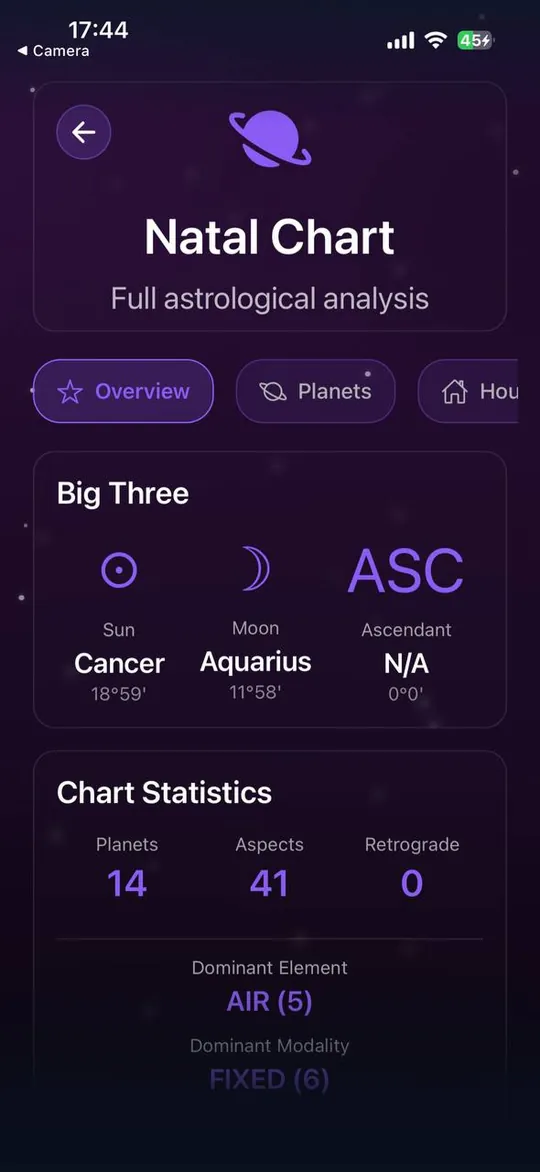
The Big Three: three layers of you
Sun, Moon and rising sign are where every chart reading starts.
What is a Jupiter return?
A Jupiter return is the moment transiting Jupiter completes a full circuit of the zodiac and arrives back at the exact degree and sign it occupied in your birth chart. Because Jupiter takes about 11.9 years to orbit the Sun, this homecoming repeats on a roughly 12-year rhythm — most people meet it around ages 12, 24, 36, 48, 60 and 72. Astrologers read the year that follows as a season of expansion: more opportunity, more optimism, and more room to grow in whatever part of life your natal Jupiter governs.
It belongs to a wider family of planetary returns — the same idea behind the yearly solar return and the once-in-a-generation Saturn return. Where Saturn's return tests and consolidates, Jupiter's tends to open doors. Think of it as a lens for where to lean in this year, not a prophecy that luck will simply be handed to you.
How a Jupiter return works
Jupiter is the largest planet in the solar system and, in astrology, the "greater benefic" — the significator of growth, faith, higher learning, travel and good fortune. You can read its full meaning on our Jupiter planet guide. Its 11.9-year orbit means Jupiter spends roughly a year in each sign, so when it loops back to your natal placement it returns to the same sign and house it held at birth, reactivating that chapter of your chart.
That timing is predictable enough to map in advance. The calculator above estimates your personal return windows by age; for the exact degree-to-degree hit against your real chart, AstraLink's Cosmic Simulator plays the transits forward so you can watch Jupiter actually reach your natal point. One thing to keep straight: a Jupiter return is personal — it depends on your birth position, not on which sign Jupiter happens to be transiting for everyone right now.
What to do in your Jupiter return year
A Jupiter return rewards action, not waiting. The classic read is "luck you participate in" — doors open, but you still have to walk through them. Practical ways to work with the year:
- Plant seeds in the themes of your natal Jupiter's house. If it sits in your 9th house, think study, publishing or travel; in the 2nd, income and resources; in the 7th, partnership.
- Say yes to growth that scares you a little — a course, a move, a bigger role, a new city.
- Expand your circle. Jupiter years tend to widen your network and surface mentors.
- Keep some margin. Jupiter's generosity is easiest to use when you are not already overcommitted.
Pairing the return with your yearly solar return chart gives you both the long cycle and the birthday-to-birthday forecast in one view.
Jupiter by house: where your luck grows
The house your natal Jupiter occupies points to the arena most likely to expand during a return year. (See the full houses overview for how these twelve life areas work.) The table below is a starting map, not a verdict — a pattern to work with, never a promise.
Jupiter return by natal house
| Natal Jupiter house | Where your luck tends to grow in a return year |
|---|---|
| 1st house | You, your body and how you show up — confidence, reinvention, a bigger presence. |
| 2nd house | Money, values and self-worth — income streams and resources often widen. |
| 3rd house | Communication, learning and local life — writing, ideas, courses, short trips. |
| 4th house | Home, family and roots — moves, property, deepening your base. |
| 5th house | Romance, creativity and play — dating, art, fun, fertility of ideas. |
| 6th house | Work, health and routines — a better job, stronger habits, service that pays off. |
| 7th house | Partnership and close allies — relationships and collaborations open up. |
| 8th house | Shared resources and intimacy — loans, investments, deep bonds, transformation. |
| 9th house | Travel, study and belief (Jupiter's home turf) — horizons visibly widen. |
| 10th house | Career and reputation — promotions, recognition, public ambition. |
| 11th house | Friends, networks and hopes — community, allies and long-range goals expand. |
| 12th house | Rest, spirit and the unseen — retreat, healing and behind-the-scenes luck. |
A lens, not a verdict. Your whole chart shapes how any one Jupiter return actually feels.
The shadow: overcommitment and excess
Jupiter's gift is expansion — and its shadow is too much of it. The same energy that opens opportunities can tip into overcommitment, overspending, overconfidence, saying yes to everything, or quietly assuming a good run will never end. A Jupiter return year can inflate plans beyond what is sustainable, so the real skill is aiming the growth rather than chasing all of it at once. Choose the one or two doors that matter and let the rest go.
Jupiter is a pattern to work with, not a guarantee to bank on. Treat a lucky-feeling stretch as momentum to direct, not a reason to skip the fundamentals — and remember astrology here is a lens for reflection, never a fixed script. If you want the long view, a Jupiter return reads best alongside your other big-cycle markers: the Saturn return, the nodal return and the midlife Uranus opposition.
Ready to track yours? Join AstraLink's early-access list to get your full chart and a map of your upcoming Jupiter, Saturn and nodal returns when we launch — with founding-member pricing for early-access members.
Frequently asked questions
What is a Jupiter return?
A Jupiter return is when transiting Jupiter completes its orbit and returns to the exact zodiac degree it held when you were born. Because Jupiter takes about 11.9 years to circle the Sun, this happens roughly every twelve years. Astrologers read the following year as a season of expansion, opportunity and growth in the area of life your natal Jupiter sits in. It is a lens for where to grow, not a promise of handed-down luck.
How often does a Jupiter return happen, and at what age?
A Jupiter return happens about every 11.9 years, so most people experience one around ages 12, 24, 36, 48, 60 and 72. The exact timing depends on your personal birth chart, because Jupiter has to return to your specific natal position, not just enter a new sign. The life-cycle calculator on this page estimates your windows by age, and the app pins the precise dates from your real chart.
Is a Jupiter return lucky?
A Jupiter return is often called a lucky year, but it works best as luck you participate in. Jupiter is astrology's planet of growth and opportunity, so doors tend to open — new roles, connections, travel, learning — yet you still have to walk through them. It is a pattern of expansion to act on, never a guarantee that good things arrive on their own. The shadow is overreach, so aim the growth rather than chasing all of it.
What should you do during your Jupiter return year?
Plant seeds in the themes of your natal Jupiter's house — study, income, partnership or career, whichever it governs. Say yes to growth that stretches you a little, widen your network, and look for mentors. Keep some margin so you are not overcommitted when opportunities land. Pairing your Jupiter return with your yearly solar return chart gives you both the long cycle and the birthday-to-birthday forecast in one view.
What is the difference between a Jupiter return and a Saturn return?
Both are planetary returns, but they run on very different clocks and carry opposite flavours. A Jupiter return comes roughly every twelve years and tends to open doors — growth, opportunity, optimism. A Saturn return comes only about every 29 years, around ages 29 and 58, and tends to test, mature and consolidate what you have built. Jupiter expands; Saturn structures. Many people feel both as turning points, just in very different keys.
Early access · US launch
Your whole chart, read by AI — free at launch
Cosmic archetype, chart ruler, strengths, karmic lesson and more, written for your exact placements. Join early access for the complete reading, free.
- First test wave: you’re in before the public launch on October 16
- 3 months of Premium free, then 80% off for a year*
- Free full birth chart + cosmic archetype at launch
- A say in what we build next
AstraLink content is written by our editorial team, reviewed for astrological accuracy, and refreshed as the sky moves. Interpretations are for reflection and entertainment; they are not medical, legal or financial advice.