
How matching works
How Do Dating Apps Work, and How Is Chart Matching Different?
Open any dating app and something is quietly deciding who you see. This page breaks down how that machinery actually works — the collaborative filtering, desirability scores and engagement loops behind the swipe — and how AstraLink's chart-based matching takes a different starting point: comparing two birth charts, not two photos. No hype, just the mechanics.
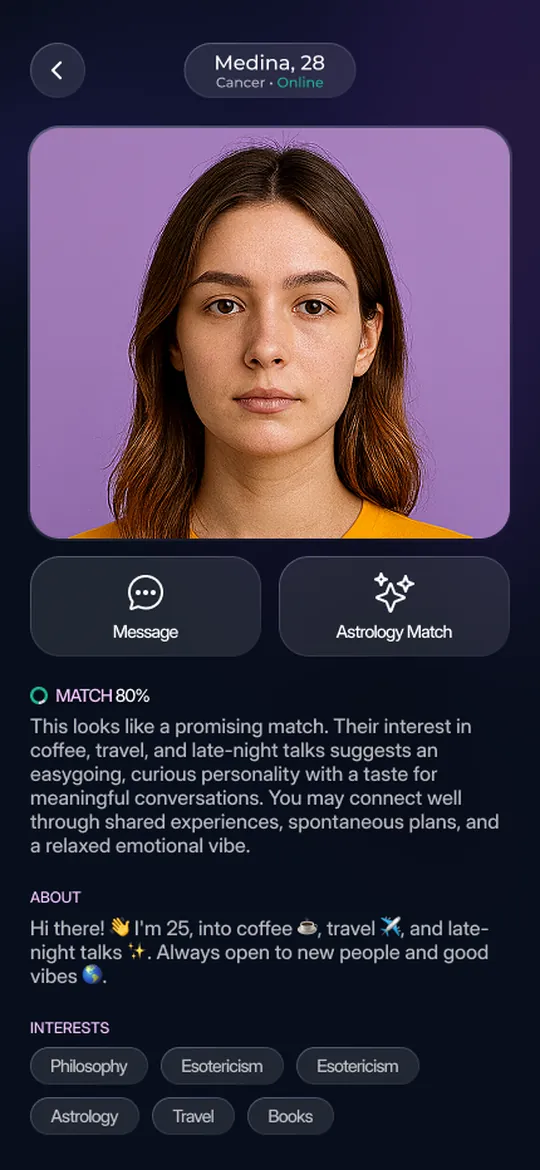
Most dating apps work like recommendation engines: they track your swipes, messages and profile taps, then use collaborative filtering and an internal "desirability" score to predict who you'll like and who's likely to like you back. The queue is tuned to maximize engagement, ranking people mainly by photos and behavior rather than deeper compatibility.
How do dating apps work?
Under the hood, most dating apps are recommendation engines — closer to a streaming queue than a phone book. They watch what you do (who you swipe right on, who you message, how long you linger on a profile) and use that behavior to predict who you'll like next. Three ideas do most of the work:
- Collaborative filtering. "People whose taste resembles yours also liked these profiles." Your swipes are compared against everyone else's to guess your next yes.
- Desirability scoring. Many apps compute an internal popularity or "attractiveness" rank and tend to show similarly-ranked people to each other. Tinder publicly described an ELO-style desirability score years ago, then said in 2019 it had retired it.
- Engagement optimization. A dating app earns its keep by keeping you on it, so the queue is tuned for attention — new matches, near-misses, a reason to open the app again — not necessarily for the fastest exit into a good relationship.
Some apps go further. Hinge has said its "Most Compatible" picks use a version of the Gale–Shapley stable-matching algorithm, the Nobel-winning idea for pairing people so no two would both rather swap partners. That's genuinely smart. But nearly all of it still starts from the same raw material: photos, distance, and a few prompts.
How two charts are compared
The five connections that carry the most weight in a compatibility reading, scored and explained.
What a swipe actually optimizes for
A swipe is a three-second decision, and an algorithm trained on three-second decisions gets very good at predicting who you'll tap — and much weaker at predicting who you'll still want to text three weeks later. "Attractive in a photo" and "good for you over time" are different variables, and a photo-first feed mostly measures the first one.
It also runs on a feedback loop. When everyone rewards the same handful of looks, the system learns to serve more of them, and the pool quietly narrows around appearance instead of compatibility. None of this is a conspiracy — it's just what you get when the inputs are images and the target is engagement. It's one reason so many matches drift into a situationship: they were optimized for the swipe, not for what happens after it.
How chart-based matching works
Cosmic Dating starts from a different input. Instead of ranking faces, it compares two full birth charts and reads the contacts between them — the technique astrologers call synastry. A few relationships carry most of the weight:
- Venus to Mars — the pull: attraction, chemistry, how desire and affection actually meet.
- Moon to Moon — emotional safety, or whether two nervous systems relax around each other.
- Saturn contacts — weight and staying power: the difference between a spark and a structure.
- Seventh-house overlays — how each person's planets land in the other's house of committed partnership.
Then there's intent. You tell the app what you're actually looking for, so a match isn't just "these charts fit" but "these charts fit and you both want the same thing." You can run the raw comparison yourself with the compatibility calculator, and the exact positions and house system behind every score are written up in our methodology.
How to read a chart-based match
A score on its own ("88%") is the least interesting part. What makes chart matching useful is the breakdown underneath it, because a connection built on Venus–Mars reads very differently from one built on Saturn. One is instant heat; the other is the kind of steadiness that shows up on a Tuesday. Neither is "better" — they're different relationships, and seeing which one you're looking at before you message changes how you show up.
The reasons also double as a first line. Instead of "hey," you can open with "apparently our Moons are in a trine, so we probably relax around the same things" — specific, a little playful, and true to the chart. If you want to understand the pieces behind the score, the synastry reading and our compatibility guides walk through each aspect in plain language, and the compatibility calculator lets you test any two charts before you ever turn dating on.
Why chart matching surfaces what swipes miss
A photo can tell you whether someone is your type. It can't tell you whether your Moons sit in an easy aspect, whether Venus–Mars creates real pull, or whether Saturn gives the connection enough gravity to outlast the honeymoon. Those are precisely the layers that decide whether a third date happens — and none of them appear in a feed ranked by desirability.
Chart matching doesn't replace attraction; you still see people and you still choose. What changes is the pool. Instead of starting from "who photographs well near me," you start from "who my chart genuinely fits," and let chemistry take it from there. About 27% of US adults believe in astrology — and 43% of women 18–49, per Pew — so for a lot of people a chart is already part of how they read a new connection. Chart matching just moves it to the front of the line. When you want to try it, it's in free US early access — any gender, any orientation.
Chart matching vs swiping: which is right for you?
Honestly, it depends on what you're after. Swiping is fast, familiar, and genuinely good at one thing: surfacing a lot of people you'll find attractive at a glance. If you like volume and trust your own read on a first photo, it works. The cost is that the signal is shallow — you learn whether you'd tap, not whether you'd last.
Chart matching asks for more up front (your birth date, ideally your exact time and place) and gives back a deeper first filter: emotional safety, real pull, and staying power, scored and explained. It's a slower start and a smaller, sharper pool. Plenty of people run both — they let the chart decide who they meet and let attraction and real life decide the rest. Whichever you choose, the same rule applies: an algorithm can introduce you, but only you can tell whether someone's kind, honest and actually available. If you'd rather start from compatibility than from a camera roll, that's exactly what Cosmic Dating is built for.
How each system decides who you see
| Typical swipe app | Chart-based matching | |
|---|---|---|
| Main input | Photos, distance, in-app behavior | Two full birth charts + your stated intent |
| Core method | Collaborative filtering + desirability ranking | Synastry: Venus–Mars, Moon–Moon, Saturn, house overlays |
| First thing you judge | A face | Why you fit, scored and explained |
| Optimized for | Engagement and swipe volume | Compatibility you can read before you message |
| Honest weak spot | Great at the tap, blind to the long game | Needs birth data; attraction is still on you |
Describes the common swipe-app pattern from public sources, not any single competitor.
How dating apps work: common questions
How do dating apps work?
Most dating apps work like recommendation engines. They track your behavior — swipes, messages, how long you view a profile — and feed it to an algorithm that predicts who you'll like and who's likely to like you back. Collaborative filtering compares you to similar users, an internal desirability score ranks profiles, and the queue is tuned to keep you engaged. The first thing you judge is almost always a photo.
What algorithm do dating apps use?
There's no single algorithm, but a few patterns repeat. Collaborative filtering uses other people's swipes to predict yours. Desirability or popularity scoring ranks profiles and shows similarly-ranked people to each other — Tinder publicly described an ELO-style version before saying it retired it in 2019. Hinge has said its "Most Compatible" feature uses the Gale–Shapley stable-matching algorithm. Most still begin with photos, distance and prompts.
What is an astrology dating app?
An astrology dating app matches people by their birth charts instead of photos first. Rather than ranking faces, it compares two full charts using synastry — Venus–Mars, Moon–Moon, Saturn and house overlays — scores how the connection holds up across attraction, communication and long-term fit, and explains the score. AstraLink's Cosmic Dating works this way, for any gender or orientation, and is in US early access.
Do astrology dating apps actually work?
It depends on what you want them to do. A chart can't guarantee chemistry or a relationship — people still have to show up and be kind. What chart matching does well is change your starting pool: instead of filtering strangers by appearance, it filters by genuine compatibility and tells you why you were introduced, which tends to make first conversations more specific than "hey." It's a lens, not a verdict.
Is chart matching better than swiping?
Better is the wrong frame — they optimize for different things. Swiping is fast and great at surfacing people you'll find attractive at a glance. Chart matching is slower to set up (it needs your birth data) but filters for the layers a photo can't show, like emotional safety and staying power. Many people use both: let the chart choose who you meet, and let attraction and real life do the rest.
Sources
The checkable facts on this page come from these external sources. The astrological interpretation is our own.
- 30% of Americans Consult Astrology, Tarot Cards or Fortune Tellers · Pew Research CenterAbout 27% of US adults believe in astrology, and 43% of women aged 18-49.
Early access · US launch
See your real compatibility — free at launch
AstraLink reads both whole charts — Venus, Mars, Moon, Saturn, house overlays — and matches you by chart, not by swipe. Join early access and get your compatibility profile the day we open.
- First test wave: you’re in before the public launch on October 16
- 3 months of Premium free, then 80% off for a year*
- Free full birth chart + cosmic archetype at launch
- A say in what we build next
AstraLink content is written by our editorial team, reviewed for astrological accuracy, and refreshed as the sky moves. Interpretations are for reflection and entertainment; they are not medical, legal or financial advice.