
Glossary
Lunar return chart: your monthly Moon reading, explained
Roughly every 27.3 days, the Moon loops all the way around the zodiac and lands back on the exact degree it held when you were born. Freeze that instant into a chart and you get your lunar return — a monthly forecast for your emotional weather. Here is what a lunar return chart is, how it is read, and how it differs from your yearly solar return.
A lunar return chart is cast for the moment the transiting Moon returns to its exact natal degree, which happens about every 27.3 days. Read by its ascendant, the house holding the Moon, and its aspects, it forecasts the emotional tone and focus of the coming month.
When are your big planetary returns?
Lunar returns come around monthly; the bigger ones are rarer. Enter your birth date to see the approximate windows for your Jupiter, nodal, Saturn, Uranus and Chiron returns. The AstraLink app pins them from your exact chart and tells you what is active now.
The Big Three: three layers of you
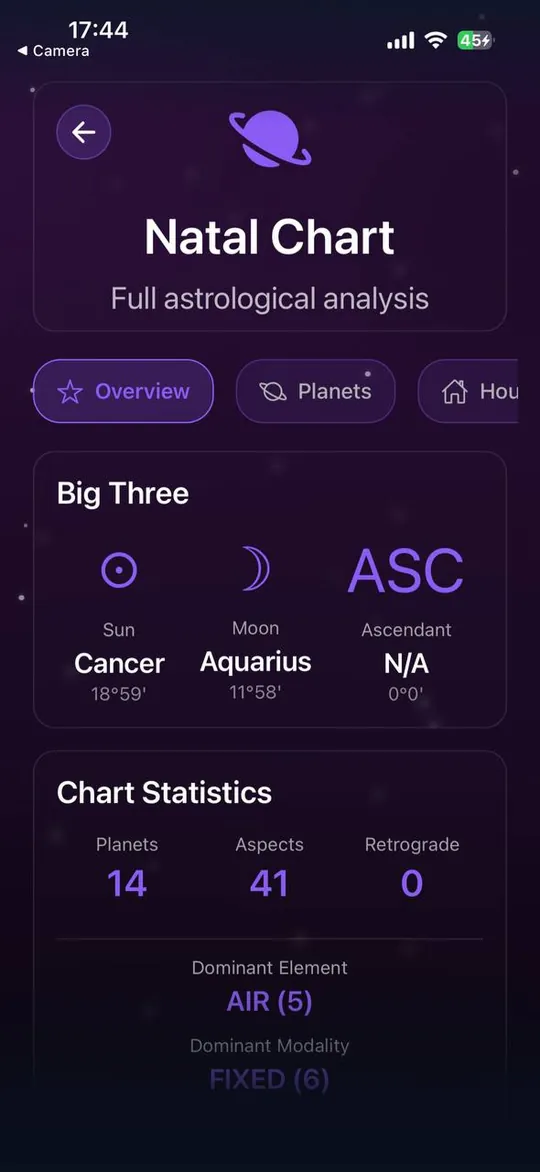
Sun, Moon and rising sign are where every chart reading starts.
What is a lunar return chart?
A lunar return chart is a chart cast for the exact moment the transiting Moon circles back to the precise degree and minute it held when you were born. Because the Moon is the fastest-moving body in astrology, this homecoming happens roughly every 27.3 days — about thirteen times a year — so you get a fresh lunar return chart almost every month. Astrologers read it as a short-range forecast: the emotional tone, mood and focus of the coming four weeks, laid over the permanent foundation of your birth chart.
Think of it as a monthly weather report for your inner life. Your natal chart is the climate you were born into and never changes; the lunar return is this month's forecast. And like any forecast, it is a lens, not a verdict — it points to where your feelings may gather, never a fate you are stuck with.
How does a lunar return chart work?
The calculation is precise. Software scans an ephemeris for the instant, in the current month, when the Moon's zodiac longitude matches its natal longitude down to the degree and minute. That moment becomes the chart's "zero hour," and a full chart is drawn for it — an ascendant, twelve houses, and all the planets exactly where they sit in the sky at that second.
Three things carry the most weight when you read it:
- The lunar return ascendant — the rising sign of the chart sets the overall mood and which area of life steps forward this month.
- The house holding the Moon — this is where your emotional energy and attention naturally pool for the coming weeks.
- The Moon's aspects — the aspects between the return Moon and the other planets flag the month's easy flows and friction points.
Location matters. A lunar return chart is usually cast for wherever you are living at the time, not your birthplace, so the ascendant and house emphasis can shift noticeably if you have moved or are traveling. Same Moon degree, different framing.
Lunar return vs solar return
They work on the same principle — a body returning to its natal degree — but on wildly different clocks. A lunar return recurs about every 27.3 days and previews roughly a month; a solar return recurs once a year on your birthday and previews the whole year ahead. The solar return sets the year's big theme; the lunar return zooms in on each month inside it. Both belong to the wider family of planetary returns — the idea that any planet coming home to its birth position opens a new cycle, from the monthly Moon to the slow, decades-long nodal return of the lunar nodes.
How to use your lunar return month to month
Most people treat the lunar return as a monthly check-in. Around the date the Moon comes home, you cast the chart, note the rising sign, the Moon's house and its tightest aspects, and set a loose intention for the next four weeks — where to pour energy, where to go gently. Pair it with your natal Moon phase and the live moon calendar for extra texture.
This is exactly the kind of layered, personal timing AstraLink's Cosmic Simulator is built to show: your fixed natal Moon, this month's return, and the transits moving over both, translated into a plain-language daily focus instead of a wall of symbols. Read it as a pattern, not a prophecy — insight to act on thoughtfully, never a prediction to obey. Want your monthly reading first? Join the early-access list for founding-member pricing.
Lunar return vs other planetary returns
| Return | How often | What it forecasts |
|---|---|---|
| Lunar return | ~Every 27.3 days | The emotional tone and focus of the coming month |
| Solar return | Once a year, on your birthday | The themes and mood of the year ahead |
| Jupiter return | ~Every 11.9 years | A chapter of growth, confidence and expansion |
| Nodal return | ~Every 18.6 years | A reset of your lunar-node (destiny) axis |
| Saturn return | ~Every 29.5 years | A rite of passage around structure and maturity |
Every return works the same way — a body circling back to its exact natal degree — only the clock changes. The Moon's is the quickest; Saturn's the rarest in a single lifetime.
Frequently asked questions
How often does a lunar return happen?
A lunar return happens roughly every 27.3 days — the time the Moon takes to travel all the way around the zodiac and arrive back at its exact natal degree. That works out to about thirteen lunar returns a year, so you get a fresh monthly chart almost every four weeks. The precise date drifts a little each cycle because the Moon's speed varies, so check the live calendar in the app for your exact return moment.
What does a lunar return chart tell you?
A lunar return chart sketches the emotional tone and focus of your coming month. Astrologers read three things first: the chart's ascendant, which sets the overall mood; the house holding the Moon, which shows where your attention and feelings gather; and the Moon's aspects, which flag the month's smooth and sticky spots. It is a reflective lens for the weeks ahead, not a fixed prediction of events.
Is a lunar return the same as a new moon?
No. A new moon is the moment the Sun and Moon meet in the sky, and it falls in whatever sign that conjunction lands in for everyone at once. A lunar return is the moment the Moon comes back to your own natal Moon degree, which can happen in any sign and at any lunar phase. The new moon is a shared sky event; your lunar return is personal to your birth chart.
Does my location change my lunar return chart?
Yes. A lunar return chart is usually cast for wherever you are living at the moment of the return, not your birthplace. The Moon still returns to the same natal degree, but your location sets the ascendant and the houses the planets fall into, so moving or traveling can shift the month's emphasis. Some astrology fans even relocate on purpose to reframe a given month's chart.
What is the difference between a lunar return and a solar return?
Both are returns — a body circling back to its natal degree — but on different clocks. A lunar return recurs about every 27.3 days and previews the coming month; a solar return recurs once a year on your birthday and previews the whole year ahead. Use the solar return for the year's big theme and the lunar return as a monthly check-in inside it.
Early access · US launch
Your whole chart, read by AI — free at launch
Cosmic archetype, chart ruler, strengths, karmic lesson and more, written for your exact placements. Join early access for the complete reading, free.
- First test wave: you’re in before the public launch on October 16
- 3 months of Premium free, then 80% off for a year*
- Free full birth chart + cosmic archetype at launch
- A say in what we build next
AstraLink content is written by our editorial team, reviewed for astrological accuracy, and refreshed as the sky moves. Interpretations are for reflection and entertainment; they are not medical, legal or financial advice.