
Glossary
Horary astrology: the chart that answers a question
Lost your keys? Waiting to hear about a job? Wondering if they'll text back? Horary astrology is the traditional branch built for exactly these moments — a chart cast for the instant a sincere question is asked, then read by strict old rules to find an answer. Here's how it works, and where its limits are.
Horary astrology is a traditional branch that answers a single, specific question by casting a chart for the exact time and place it's asked. The astrologer assigns the querent to the first house and the subject to its natural house, then reads the aspects between their ruling planets for the answer.
What is horary astrology?
Horary astrology is the branch that answers a single, specific question by casting a chart for the exact moment and place the question is asked — or, in the strictest tradition, the moment the astrologer fully understands it. No birth data required. The clock starts when you genuinely need to know something: Will I get the job? Where are my keys? Will they call?
Astrology draws real curiosity — Pew Research finds about 27% of US adults say they believe in it — but horary is one of its most rule-bound corners. It grew out of Hellenistic and medieval practice, and its canonical English handbook is William Lilly's Christian Astrology (1647). The promise is narrow and old-fashioned: ask a real question, cast the moment, read the symbols, get an answer. Treat that answer as a lens, not a verdict — a reading of a single moment, never a fixed prophecy about your life.
The Big Three: three layers of you
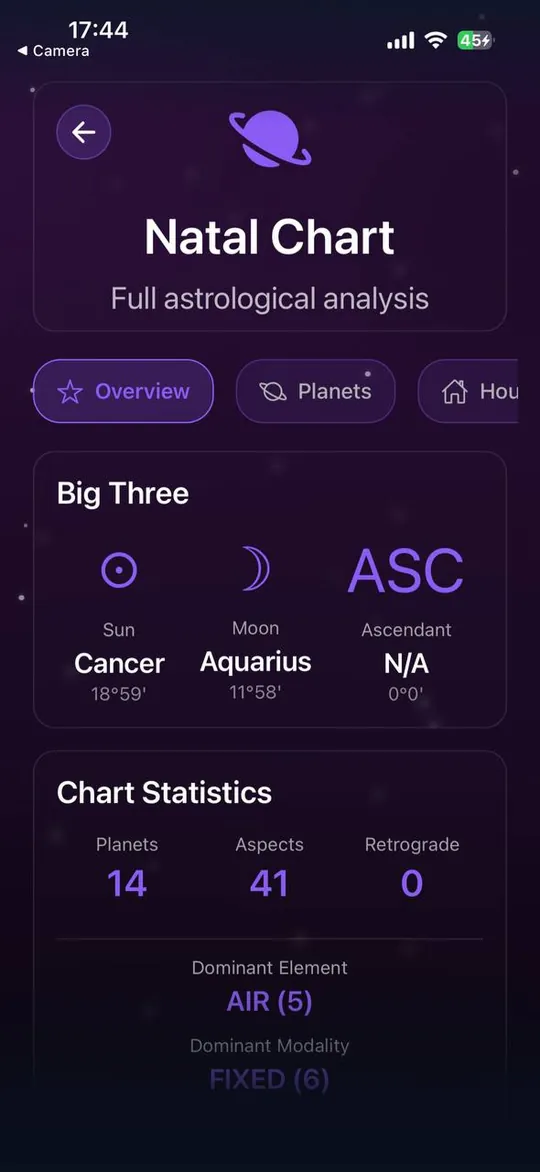
Sun, Moon and rising sign are where every chart reading starts.
How does horary astrology work?
Horary runs on a handful of strict conventions. Learn these four and you can follow most readings:
- You are the first house. The person asking (the querent) is assigned the first house, and the planet that rules the sign on the first-house cusp becomes your significator. The Moon is a co-significator too, tracking the flow of the matter.
- The subject gets its natural house. The thing you're asking about (the quesited) is assigned the house that naturally governs it — a job to the tenth, a lost possession to the second, a love interest to the seventh. The ruler of that house is the quesited's significator.
- The answer lives in the aspect between the two rulers. The astrologer checks whether your significator and the quesited's significator form an applying aspect — a conjunction, sextile or trine leaning yes; a square or opposition making it harder — before either planet changes sign.
- Dignity and reception color it. How strong each planet is by sign, and whether the two planets welcome or "receive" one another, tells you how the matter resolves — willingly, grudgingly, or not at all.
Timing comes from counting the degrees between the applying planets and converting them to days, weeks or months, depending on the signs and houses involved. There are subtler moves too — translation of light, where a third planet carries the connection between two that can't quite meet, and collection, where a slower planet gathers them both — but the querent–quesited–aspect spine is the heart of it.
Common questions and the house that answers them
| The question you're asking | House that answers it | What the astrologer reads |
|---|---|---|
| Will I get the job? | 10th house | Your ruler versus the 10th-house ruler |
| Where is my lost phone or keys? | 2nd house | The 2nd ruler and the Moon, with the sign's element hinting at the setting |
| Will they call or commit? | 7th house | Your ruler and the 7th ruler, plus whether they receive each other |
| Is this the right home or move? | 4th house | The 4th ruler and the Moon's condition |
| Will the pregnancy or child go well? | 5th house | The 5th ruler and any benefic planets on the fifth |
| Will I recover from this illness? | 6th and 1st houses | You as the patient (1st) against the illness (6th) |
| Will I get the money I'm owed? | 2nd or 8th house | Your 2nd house, or the 8th for someone else's money |
| Will I win the dispute? | 1st versus 7th house | You against the other party, with the 10th for the verdict |
These are the natural houses. For a third party — a friend's job, a sibling's partner — astrologers "turn the chart" and count the houses from that person's house instead.
Considerations before judgement
Before reading a word of the answer, a traditional astrologer checks whether the chart is even fit to judge. These safeguards, which Lilly called the considerations before judgement, flag a question that's unripe, badly framed, or not really yours to ask:
- Too early or too late. An ascendant in the first few degrees suggests the matter isn't ripe yet; in the last few degrees, that it's already decided or out of your hands.
- A void-of-course Moon. If the Moon will make no more aspects before leaving its sign, the classic verdict is that "nothing will come of the matter" — the question often simply fizzles.
- The Via Combusta. The Moon traveling between the middle of Libra and the middle of Scorpio (15° Libra to 15° Scorpio) was treated as a corrupted, caution-flag zone.
- Saturn in the seventh. Traditionally the seventh house stands for the astrologer, so Saturn there warns that the reader may get it wrong.
None of these is a curse. They're honesty checks — reminders that some moments aren't the right time to ask, and that a careful practitioner says "ask again later" rather than forcing an answer out of an unwilling chart.
How is horary different from natal astrology?
Your birth chart is cast for the moment you were born and describes lifelong patterns — temperament, strengths, the themes you keep meeting. Horary throws all of that out. It needs no birth time at all, because it's cast for the moment of the question, and it answers only that question: yes, no, when, or where. Natal astrology is a self-portrait; horary is a snapshot taken to settle one thing.
Horary also has a close cousin, electional astrology — instead of reading a moment that already happened, electional chooses a favorable future moment to begin something, like picking a time to sign a contract. Related traditional timing tools include planetary hours, which hand each hour of the day to a different planet.
AstraLink doesn't cast traditional horary charts, but the AI Advisor works in that electional spirit: it reads timing questions against your chart and the current sky — when's a good window to have the talk, send the message, make the move? — and walks you through the trade-offs in plain language. It's a conversation about your pattern, not a prophecy. Curious to try it? Join early access, bring your real question, and keep exploring the rest of the astrology glossary.
Frequently asked questions
What is horary astrology in simple terms?
Horary astrology answers one specific question by casting a chart for the exact moment and place you ask it — no birth details needed. The astrologer links you to the first house and your subject to its natural house, then reads the aspects between the planets that rule those houses. If the rulers connect favorably before changing sign, the tradition leans yes; if they don't, it leans no.
What is the difference between the querent and the quesited?
The querent is the person asking the question, always assigned to the first house, with the ruler of the first-house cusp as their significator and the Moon as a co-significator. The quesited is whatever you're asking about — a job, a lover, a lost object — assigned to the house that naturally governs it. The astrologer then watches how those two significators relate to each other.
Can horary astrology really find lost objects?
It's one of horary's classic uses. The astrologer reads the second house of possessions, or the house matching the item, using the ruling planet's sign and the Moon to suggest where it might be — the element hints at the setting, like earth for the ground or water near a sink. Treat it as a structured prompt for your own memory and search, not a locator. It's a lens, not a GPS.
Do I need my birth time for a horary reading?
No — and that's what makes horary distinct. Unlike a natal reading, horary ignores your birth data entirely. The only moment that matters is when the question is sincerely asked and understood, because that is the chart being cast. This makes it useful for people who don't know their exact birth time but still want to explore a pressing, specific question.
Is horary astrology accurate?
Horary has devoted practitioners and a long, detailed rulebook, but no branch of astrology is a proven forecasting tool, and it shouldn't replace medical, legal, or financial advice. Think of a horary chart as a structured way to reflect on a decision — it externalizes the question, names the players, and surfaces considerations you might have rushed past. Read it as a pattern to think with, not a prophecy to obey.
Sources
The checkable facts on this page come from these external sources. The astrological interpretation is our own.
- 30% of Americans Consult Astrology, Tarot Cards or Fortune Tellers · Pew Research CenterPew Research finds about 27% of US adults say they believe in astrology.
- Horary astrology · WikipediaHorary answers a question from a chart for the moment it is asked; William Lilly, Christian Astrology (1647)
Early access · US launch
Your whole chart, read by AI — free at launch
Cosmic archetype, chart ruler, strengths, karmic lesson and more, written for your exact placements. Join early access for the complete reading, free.
- First test wave: you’re in before the public launch on October 16
- 3 months of Premium free, then 80% off for a year*
- Free full birth chart + cosmic archetype at launch
- A say in what we build next
AstraLink content is written by our editorial team, reviewed for astrological accuracy, and refreshed as the sky moves. Interpretations are for reflection and entertainment; they are not medical, legal or financial advice.