 AstraLink
Glossary
Benefic and malefic planets: the traditional classification
Traditional astrology sorts the planets into helpers and challengers: benefics and malefics. Venus and Jupiter are the benefics, Mars and Saturn the malefics, with the Sun, Moon and Mercury in between. Here is what the labels really mean, where they came from, why sect changes everything — and why a malefic is a teacher, not a curse.
In traditional astrology, benefic planets — Venus and Jupiter — are associated with ease, growth and pleasure, while malefic planets — Mars and Saturn — are associated with difficulty, discipline and limitation. The Sun, Moon and Mercury are treated as neutral. The labels describe a planet's typical style, not good or bad outcomes.
What are benefic and malefic planets?
Long before modern psychology reached astrology, ancient astrologers sorted the planets by how they tend to behave in a chart. Two were called benefics — the helpers, associated with ease, pleasure and growth. Two were called malefics — the challengers, associated with hardship, limitation and discipline. The rest were treated as neutral. The words survive today as useful shorthand, as long as you remember they describe a planet's style, not a guarantee of good or bad luck.
The classic line-up is:
- Jupiter — the Greater Benefic. Expansion, opportunity, generosity, faith, growth. Jupiter says yes and more. In 2026–27 it moves through Leo (from 30 June 2026 to late July 2027), broadly widening the arena of the house it visits in your chart.
- Venus — the Lesser Benefic. Love, harmony, beauty, pleasure, connection. Venus smooths, attracts and reconciles. (See the full Venus lesson for how she behaves by sign and house.)
- Mars — the Lesser Malefic. Heat, conflict, cutting, haste, raw drive. Mars separates, forces and accelerates.
- Saturn — the Greater Malefic. Time, limit, duty, delay, hard consequence. Saturn restricts, tests and demands maturity. Saturn is currently in Aries (since February 2026), asking the house it occupies to earn its independence the hard way — the mechanism behind the Saturn return.
Why the neutral planets sit in the middle
The Sun, Moon and Mercury are usually left out of the benefic/malefic split, and each for a good reason. The Sun and Moon are the two "lights" — the core of the chart itself — too fundamental to reduce to helpful or harmful; their effect depends entirely on condition and context. Mercury is the true chameleon: traditional astrology calls it convertible, meaning it takes on the nature of whatever planet it most closely aspects or sits beside. Mercury next to Venus warms; Mercury next to Saturn hardens and sobers. So Mercury is neither benefic nor malefic on its own — it borrows.
In traditional systems the far outer planets (Uranus, Neptune, Pluto) were unknown, so they have no classical label. Modern astrologers who use them often treat Uranus and Pluto as malefic-leaning (disruptive, transformative) and Neptune as ambiguous, but this is interpretation layered on top of the original scheme, not part of it.
Sect: why a malefic can be the good guy
Here is the nuance most beginners miss. Traditional astrology grades benefics and malefics by sect — whether you were born in the day or at night. In a day chart (Sun above the horizon), Jupiter is the benefic of sect, at its most helpful, while Mars is the malefic of sect, meaning its harm is softened and its drive turned more constructive. In a night chart (Sun below the horizon), the roles shift: Venus becomes the benefic of sect and Saturn the malefic of sect, its discipline made more workable.
The practical upshot is striking: a well-placed, in-sect Saturn can be one of the steadiest, most rewarding forces in a chart, while an out-of-sect, poorly placed benefic can overdo, indulge or promise more than it delivers. Essential dignity — whether a planet sits in a sign it rules or is weakened in — bends the outcome further. A malefic in strong dignity builds; a benefic in poor condition can turn slack. The label is a starting point, never the verdict.
How to read benefics and malefics in your chart
Used well, this old framework is genuinely practical. Find your Venus and Jupiter: their houses show where life tends to open up, flow and reward you — natural places to lean in. Find your Mars and Saturn: their houses show where you meet friction, effort and the slow work of mastery — the areas that build real strength precisely because they are not easy. A challenging Saturn placement is not a life sentence; it is the muscle the chart asks you to train.
That reframing is the whole point. Astrology here is a lens for self-knowledge, not a scorecard of fortune. "Malefic" names a planet that grows you through difficulty; some of the most valuable chapters of a life run on exactly that energy. To see where your own benefics and malefics fall — and whether Saturn is in or out of sect for you — run the free birth chart or open the full planet-by-planet reading through early access.
The Big Three: three layers of you
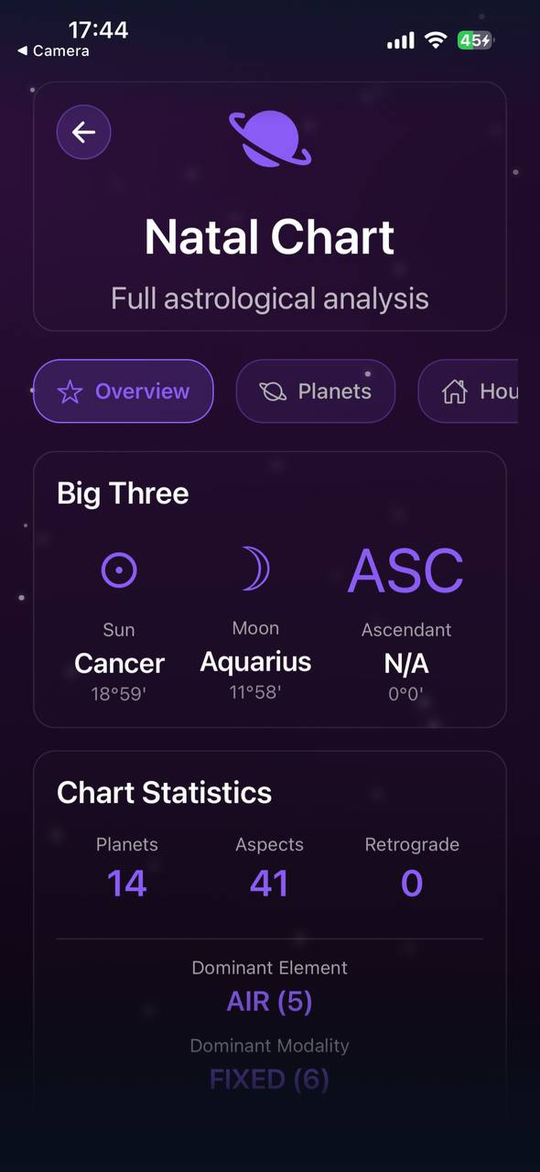
Sun, Moon and rising sign are where every chart reading starts.
Frequently asked questions
Which planets are benefic and which are malefic?
In traditional astrology, the benefics are Jupiter, the Greater Benefic, and Venus, the Lesser Benefic — planets associated with growth, ease and pleasure. The malefics are Saturn, the Greater Malefic, and Mars, the Lesser Malefic — associated with limitation, difficulty and conflict. The Sun, Moon and Mercury are treated as neutral. Mercury in particular is called convertible, taking on the nature of whichever planet it most closely aspects or sits beside.
Does malefic mean bad or unlucky?
No. A malefic planet is not bad or unlucky in itself; the label describes a planet whose style involves challenge, effort, discipline or friction rather than ease. Mars and Saturn push you to grow through difficulty, and a well-placed malefic can be one of the most constructive forces in a chart. Modern astrology treats all planets as neutral energies, and the healthiest reading sees a malefic as a teacher, not a punishment or a fixed fate.
Why are the Sun, Moon and Mercury neutral?
The Sun and Moon are the two lights, the central core of the chart, so they are considered too fundamental to reduce to simply helpful or harmful — their effect depends on their overall condition. Mercury is neutral because it is convertible: it absorbs the quality of whatever planet it is closest to, warming beside Venus and hardening beside Saturn. Because none of the three has a fixed benefic or malefic nature, traditional astrology leaves them out of the split.
What is sect and how does it affect benefics and malefics?
Sect is whether you were born during the day, with the Sun above the horizon, or at night, with it below. It changes how strongly each planet expresses. In a day chart Jupiter is the benefic of sect and Mars the malefic of sect, so Mars behaves more constructively. In a night chart Venus is the benefic of sect and Saturn the malefic of sect, so Saturn becomes more workable. Sect is why a malefic can act like the helpful planet in a chart.
What about Uranus, Neptune and Pluto?
The outer planets were unknown to the astrologers who created the benefic and malefic scheme, so they have no traditional label. Modern astrologers who use them often read Uranus and Pluto as malefic-leaning because they disrupt and transform, and Neptune as ambiguous, dissolving and idealising. This is a modern interpretation layered onto the classical system rather than part of it, so different astrologers handle the outer planets in different ways.
Early access · US launch
Your whole chart, read by AI — free at launch
Cosmic archetype, chart ruler, strengths, karmic lesson and more, written for your exact placements. Join early access for the complete reading, free.
- Free full birth chart + cosmic archetype at launch
- First in line for chart-based matching in your city
- Founding-member pricing, forever
AstraLink content is written by our editorial team, reviewed for astrological accuracy, and refreshed as the sky moves. Interpretations are for reflection and entertainment; they are not medical, legal or financial advice.