
Glossary
Nodal return: your 18.6-year invitation to course-correct
Every so often the lunar nodes complete their long loop and land back where they began in your chart. That is a nodal return, and it has a habit of arriving at life's big thresholds, around 18, 37 and 55. Here is what it means, how each return feels, and the half-return crossroads in between.
A nodal return is when the transiting lunar nodes come back to the exact zodiac positions they held at your birth, which happens roughly every 18.6 years, around ages 18-19, 37-38 and 55-56. It reactivates your natal nodal axis, foregrounding themes of direction, relationships and course-correction.
Find your nodal return years
Instant preview computed in your browser from your birth date. The AstraLink app uses your exact birth time and place for a precise chart.
The Big Three: three layers of you
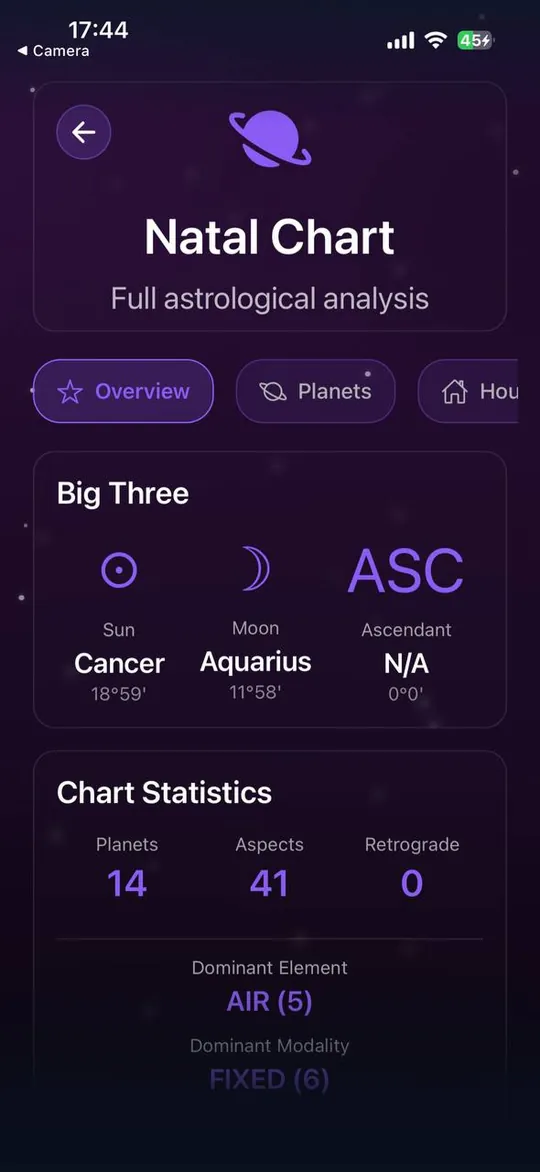
Sun, Moon and rising sign are where every chart reading starts.
What is a nodal return?
A nodal return is the moment the transiting lunar nodes (the North Node and South Node) circle all the way back to the exact zodiac positions they held when you were born. Because the nodes drift backward through the zodiac and take about 18.6 years to complete one full loop, that homecoming arrives on a remarkably steady schedule: roughly at ages 18-19, 37-38 and 55-56. When it lands, your natal nodal axis lights up again, and with it the chart's language of direction, fate and relationships.
The nodes are not planets. They are the two points where the Moon's tilted orbit crosses the ecliptic, explained in full in the lunar nodes entry, so a nodal return is really the return of an axis, not a single body. Treat it as a pattern that recurs, not a prophecy that descends: the sky hands you familiar themes again, a little older and, ideally, a little wiser.
How does a nodal return work?
One orbit of the nodes is about 18.6 years, and because they move retrograde, they linger roughly 18 months in each sign before stepping back into the previous one. Everyone born within that year-and-a-half window shares a nodal sign, which makes the sign generational; your house placement and the planets the nodes touch are what make your return personal.
The nodes moved out of Pisces–Virgo in July 2026; right now the North Node is in Aquarius and the South Node in Leo, and they hold this axis through early 2028. If you were born with a Pisces-Virgo or Aquarius-Leo nodal axis, you are near a return or a reversal as these shifts happen, which makes it a good moment to pull your birth chart and see exactly where your nodes live. The North Node entry unpacks what the growth-facing end of that axis is asking for.
The nodal return by age
Each pass has its own texture, because you meet it at a different stage of life:
- Ages 18-19 (first nodal return): the threshold of adulthood. It often coincides with leaving home, first serious relationships and the first real "which way now?", when direction becomes a live question rather than a given.
- Ages 37-38 (second nodal return): the recalibration. You have enough road behind you to see whether you have been living toward your North Node or coasting on South Node defaults. Careers pivot, relationships deepen or dissolve, and purpose gets honest.
- Ages 55-56 (third nodal return): the reorientation. With a long chapter often closing, the axis asks what the next, freer phase is for, from legacy and meaning to long-deferred callings.
These are invitations, not verdicts. The same transit that nudges one person to change careers moves another to deepen exactly where they already are.
The nodal reversal (half-return)
Halfway through each 18.6-year loop, about every 9.3 years, near ages 9, 27-28 and 46, the nodes swing to the opposite point and sit exactly across from your natal axis. This is the nodal reversal, or half-return, and it tends to feel like a crossroads: the transiting South Node presses on your natal North Node (tempting you back toward old comfort) while the transiting North Node pulls on your natal South Node (daring you to grow). Many people describe a reversal as a pivotal fork in the road, a test of whether you keep walking toward your North Node or slip back into the familiar.
How to work with your nodal return
Treat it as a lens, not a leash. Note the sign and house of your natal North Node, name the habit your South Node leans on, and watch which doors open around the return year. A nodal return belongs to a wider family of planetary returns, including Saturn, Jupiter and the Sun, each with its own clock, so layering them gives you timing rather than fate. AstraLink's Cosmic Simulator runs the live nodes against your natal chart so you can see when your axis is being touched and what it tends to activate, in plain language. When the timing feels significant, join the early-access list to get your full nodal reading first.
Frequently asked questions
What is a nodal return?
A nodal return is when the transiting lunar nodes return to the exact zodiac positions they held at your birth, completing their roughly 18.6-year cycle. It reactivates your natal nodal axis, the North Node of growth and the South Node of ingrained habits, and tends to foreground questions of life direction, relationships and course-correction. It is read as an invitation to realign, never a fixed destiny.
At what age is your nodal return?
Because the lunar nodes take about 18.6 years to circle the zodiac, your nodal return lands near ages 18-19, 37-38 and 55-56. The first often arrives with the threshold of adulthood, the second with a mid-life recalibration of purpose, and the third with a reorientation toward a freer, more meaningful chapter. The exact year depends on your natal nodes, so check your chart to be sure.
How often does a nodal return happen?
A full nodal return happens about every 18.6 years, the time the lunar nodes take to travel backward through all twelve signs and come home to their natal degree. Midway through each cycle, roughly every 9.3 years, the nodes reach the opposite point for a nodal reversal, or half-return. So across an average lifetime you can expect three to four returns and several reversals in between.
What is a nodal reversal or half-return?
A nodal reversal, or half-return, happens about every 9.3 years, near ages 9, 27-28 and 46, when the transiting nodes sit exactly opposite your natal nodal axis. The transiting South Node presses on your natal North Node while the transiting North Node pulls on your natal South Node. Many people experience it as a pivotal crossroads: a test of whether you keep growing or retreat to the familiar.
Is a nodal return the same as a Saturn return?
No. A nodal return recurs about every 18.6 years, when the lunar nodes come back to their birth positions, and it speaks to direction, fate and relationships. A Saturn return happens roughly every 29 to 30 years, around ages 29, 58 and 87, and is about maturity, responsibility and structure. Both are planetary returns, but they run on different clocks and carry different themes, and can stack up in your late fifties.
Early access · US launch
Your whole chart, read by AI — free at launch
Cosmic archetype, chart ruler, strengths, karmic lesson and more, written for your exact placements. Join early access for the complete reading, free.
- First test wave: you’re in before the public launch on October 16
- 3 months of Premium free, then 80% off for a year*
- Free full birth chart + cosmic archetype at launch
- A say in what we build next
AstraLink content is written by our editorial team, reviewed for astrological accuracy, and refreshed as the sky moves. Interpretations are for reflection and entertainment; they are not medical, legal or financial advice.