 AstraLink
Glossary
Sect in astrology: day charts and night charts
One of the oldest questions in astrology is also one of the simplest: were you born during the day or at night? That single fact, called sect, quietly reshapes how the whole chart is read. Here is what sect is, how to tell which one you are, and why it changes which planets tend to help you and which ask more of you.
Sect is whether you were born by day or by night. If the Sun was above the horizon at birth you have a day (diurnal) chart; if it was below, a night (nocturnal) chart. Sect changes which benefic and malefic planets act more helpfully, a core idea in traditional astrology.
What is sect in astrology?
Sect is the division of a chart into day (diurnal) or night (nocturnal), based on whether the Sun was above or below the horizon at the moment of birth. It is one of the foundations of traditional and Hellenistic astrology, and though many modern readings skip it, it is enjoying a strong revival because it adds nuance without adding complexity. Sect does not change where your planets are — it changes the tone in which you read them.
The core idea is that the same planet behaves a little differently by day than by night. A planet that is "in sect" — in the chart type it prefers — tends to express its more constructive, better-behaved side, while the same planet "out of sect" runs hotter and rougher. Nothing here is a verdict on your character; sect is simply a lens that helps interpretation land more precisely.
How to tell if you have a day or night chart
The rule is refreshingly concrete. Picture the horizon line across your chart — the axis from the Ascendant (eastern horizon) to the Descendant (western horizon):
- If the Sun is above that line — anywhere in houses 7 through 12, i.e. the Sun had risen and not yet set — you have a day chart.
- If the Sun is below the line — in houses 1 through 6, between sunset and sunrise — you have a night chart.
In plain terms: born while the Sun was up, day chart; born after dark, night chart. Twilight births right on the horizon are the only tricky cases, and that is precisely where an accurate birth time matters — a few minutes can flip your sect. Any chart calculator states it for you; the app's extended natal reading labels your chart sect directly.
Why sect matters: benefics and malefics in and out of sect
Sect earns its keep through the benefic and malefic planets. Traditional astrology sorts the classical planets into two teams, and each team has a "day" and a "night" member whose helpfulness depends on your sect:
- The two benefics are Jupiter and Venus. Jupiter is the day benefic; Venus is the night benefic. In a day chart, Jupiter's luck and growth flow most freely; in a night chart, Venus's warmth and ease do.
- The two malefics are Saturn and Mars. Saturn is the day malefic; Mars is the night malefic. Here the twist is important: the malefic that matches your sect is the more manageable one, because it is in sect and better disciplined. The malefic that is out of sect is the one that tends to cause more friction.
So in a day chart, Saturn (in sect) often works as constructive structure and patience, while Mars (out of sect) is the hotter, more disruptive force to handle with care. In a night chart it reverses: Mars (in sect) is more usefully assertive, while Saturn (out of sect) can feel heavier and more restrictive. This is a genuinely sect-specific fact — the exact same Saturn placement is read more gently in a day chart than in a night one. It is guidance for working with a planet, not a warning that anything is doomed.
The sect light and the planets of each sect
Every chart has a sect light: the luminary that rules its sect. In a day chart the Sun is the sect light; in a night chart the Moon is. Astrologers give the sect light extra weight as a leading indicator of the person's path and vitality.
The full traditional grouping is tidy: the diurnal (day) team is the Sun, Jupiter and Saturn; the nocturnal (night) team is the Moon, Venus and Mars. Mercury is the flexible one — counted as diurnal when it rises before the Sun and nocturnal when it rises after. You do not need to memorise all of this to benefit from it: knowing simply whether you are a day or night chart already tells you which benefic supports you most and which malefic to partner with rather than fight. To see your own sect spelled out alongside your rulers and nodes, start with your birth details or explore the fundamentals in the Academy.
The Big Three: three layers of you
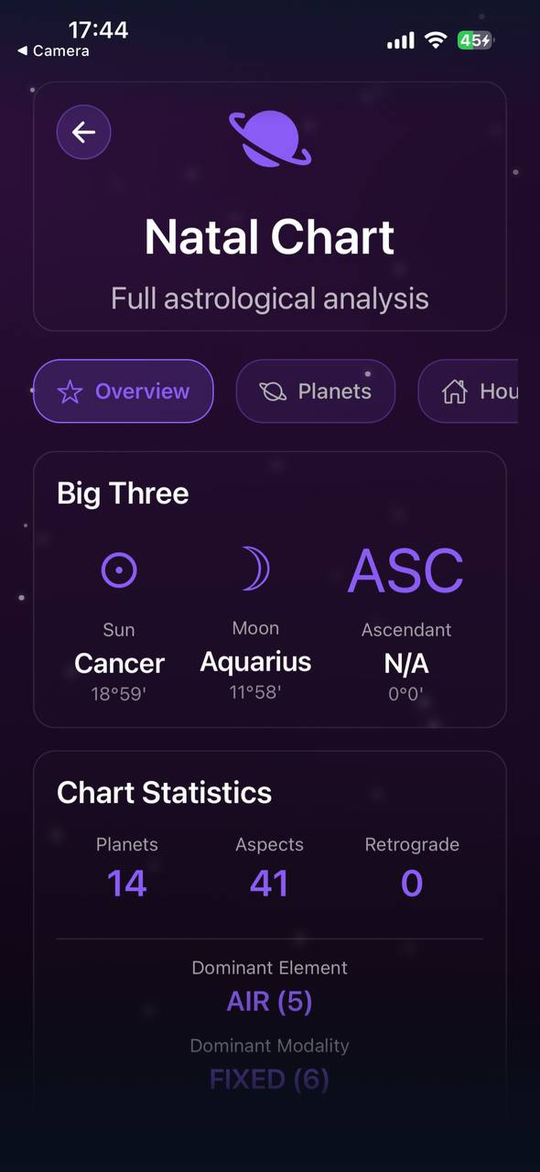
Sun, Moon and rising sign are where every chart reading starts.
Frequently asked questions
What is sect in astrology?
Sect is whether a chart is a day chart or a night chart, decided by whether the Sun was above or below the horizon at birth. It is a foundation of traditional astrology. Sect does not move any planets; it sets the tone for reading them, especially which benefic planet supports you most and which malefic planet tends to cause more friction.
How do I know if I have a day or night chart?
Look at where the Sun sits relative to the horizon in your chart. If the Sun is above the horizon — in houses 7 to 12, meaning it had risen and not yet set — you have a day chart. If it is below, in houses 1 to 6, you have a night chart. Put simply: born in daylight is a day chart, born after dark is a night chart. An exact birth time matters for twilight births.
Why does sect matter for benefic and malefic planets?
Each benefic and malefic favours one sect. Jupiter is the day benefic and Venus the night benefic, so each helps most in its matching chart. Saturn is the day malefic and Mars the night malefic — and the malefic that matches your sect is the more manageable one, while the out-of-sect malefic runs rougher. So a day chart handles Saturn more easily and a night chart handles Mars more easily.
What is a sect light?
The sect light is the luminary that governs a chart's sect. In a day chart the Sun is the sect light; in a night chart the Moon is. Traditional astrologers give the sect light added importance as a key marker of the person's direction, vitality and overall life theme, reading it as one of the most significant points in the whole chart.
Is a day chart better than a night chart?
No — neither is better. Sect is not a ranking; it simply changes which planets express their easier side and which ask for more skill. Every chart has one benefic working at full strength and one in-sect malefic that is easier to work with. Day and night charts each have their own gifts and their own growth edges, and one is not luckier than the other.
Early access · US launch
Your whole chart, read by AI — free at launch
Cosmic archetype, chart ruler, strengths, karmic lesson and more, written for your exact placements. Join early access for the complete reading, free.
- Free full birth chart + cosmic archetype at launch
- First in line for chart-based matching in your city
- Founding-member pricing, forever
AstraLink content is written by our editorial team, reviewed for astrological accuracy, and refreshed as the sky moves. Interpretations are for reflection and entertainment; they are not medical, legal or financial advice.