 AstraLink
Glossary
Solar return: your yearly birthday chart, explained
Every year, on or near your birthday, the Sun returns to the exact spot it held the moment you were born. Astrologers freeze that instant into a chart and read it as a preview of your coming year. Here is what a solar return actually is, how it is calculated, what it can and cannot tell you, and why it is not the same thing as your Saturn return.
A solar return is a chart cast for the exact moment each year when the Sun comes back to the precise degree it held at your birth — around your birthday. Astrologers read it as a forecast for the year ahead. It is not the Saturn return, which recurs roughly every 29 years.
What is a solar return?
A solar return is a chart cast for the precise moment, each year, when the transiting Sun comes back to the exact degree, minute and second it occupied when you were born. That instant is your astrological "return" of the Sun, and it falls on or within a day of your birthday. The chart drawn for that moment — usually set for wherever you are living at the time — is your solar return chart, and astrologers read it as a snapshot of the themes, moods and opportunities of the coming year, from one birthday to the next.
It is worth being clear about what a solar return is not. It does not replace your birth chart; your natal chart is fixed for life and remains the foundation. The solar return is a forecasting tool laid over that foundation — a yearly weather report, not a new identity. And astrology here is a lens for reflection, not a fixed script: a solar return highlights where the year may ask something of you, never a fate that is sealed.
How a solar return chart is calculated
The method is precise. Astrology software scans an ephemeris — the table of planetary positions — for the moment in your birthday season when the Sun's zodiac longitude matches its natal longitude to the exact degree and minute. Because the Sun does not move at a perfectly even pace, that return can land the day before or after your calendar birthday, and at a specific clock time.
The chart is then usually cast for your current location, not your birthplace, which is why the solar return ascendant and house placements can shift dramatically from one year to the next — and why some people deliberately travel for their birthday to "relocate" the chart. Once it is drawn, astrologers read the same features they would in any chart: the rising sign of the year, which house the Sun falls in, the aspects between the return planets, and how the whole thing overlays your natal placements.
What a solar return can tell you
Read well, a solar return sketches the flavour of your year:
- The house of the solar return Sun suggests where your focus and vitality go — the 10th house year leans toward career and public life, the 7th toward partnership, the 4th toward home and family.
- The solar return ascendant colours how you meet the year and which chapter of life feels foregrounded.
- Return planets aspecting your natal planets flag the year's growth edges and easy wins.
- The overall balance of elements and modalities hints at whether the year favours starting, building or adapting.
Astrologers often combine the solar return with ongoing transits for a fuller picture, since the return sets the year's theme while transits mark its timing. That layered, month-by-month view is exactly what AstraLink's Cosmic Simulator is built to show against your own chart. Treat any reading as insight to act on thoughtfully — never as a prediction to obey.
Solar return vs Saturn return: don't confuse them
These two get mixed up constantly, so here is the clean distinction. A solar return happens every single year, on your birthday, when the fast-moving Sun laps back to its natal degree. A Saturn return happens roughly every 29 to 30 years, when slow-moving Saturn completes a full orbit and comes back to its natal degree — landing around ages 29, 58 and 87. The solar return is an annual preview; the Saturn return is a rare, defining rite of passage about maturity and structure. Same idea (a planet returning home), wildly different clock. Other returns exist too — a lunar return recurs monthly as the Moon comes back to its natal spot — but the Sun's yearly return is the one people mean by "solar return."
Want both layers — your fixed natal chart and your year-ahead outlook? Join the early-access list to get your full reading first.
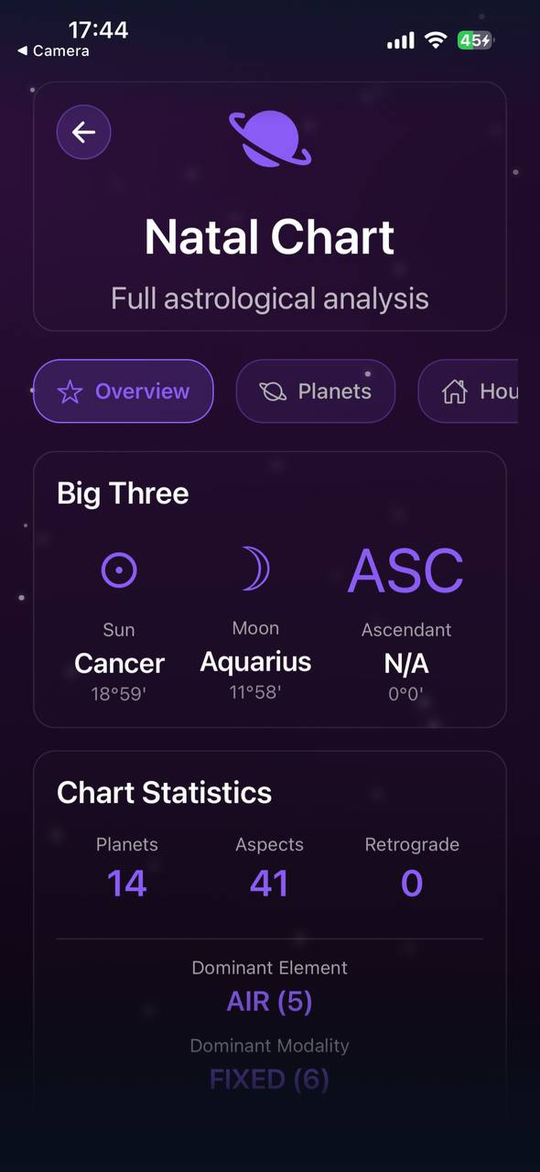
The Big Three: three layers of you
Sun, Moon and rising sign are where every chart reading starts.
Frequently asked questions
What is a solar return in astrology?
A solar return is a chart cast for the exact moment each year when the Sun comes back to the precise degree it held at your birth, which falls on or near your birthday. It is used as a forecasting tool: astrologers read the solar return chart as a preview of the themes, focus and opportunities of your coming year, laid over the permanent foundation of your natal birth chart.
How is a solar return chart calculated?
Software searches an ephemeris for the instant, in your birthday season, when the Sun's zodiac position exactly matches its natal position down to the degree and minute. Because the Sun moves slightly unevenly, that return can land a day before or after your calendar birthday. The chart is then usually drawn for your current location, which sets the solar return ascendant and houses for the year. Those placements are read alongside your natal chart.
Is a solar return the same as a Saturn return?
No, and it is a common mix-up. A solar return happens every year on your birthday, when the fast Sun returns to its natal degree, and previews the year ahead. A Saturn return happens only about every 29 to 30 years, when slow Saturn completes an orbit back to its natal degree, around ages 29, 58 and 87. Both involve a planet returning home, but one is annual and the other is a rare, life-defining passage.
Does the solar return change if I travel for my birthday?
Yes, and some people do it on purpose. A solar return chart is usually cast for wherever you are located at the moment of the return, so changing your location changes the rising sign and the houses the planets fall into, even though the Sun still returns to the same natal degree. This is why the same year can be framed very differently depending on where you spend your birthday. It is a lens on emphasis, not a guarantee of events.
When exactly does my solar return happen?
It happens at the specific clock time, on or within about a day of your birthday, when the Sun reaches the exact zodiac degree and minute it held when you were born. Because that depends on your precise natal Sun position and the Sun's slightly variable speed, it rarely falls at midnight on your birthday. If you are unsure of the exact moment for a given year, check the live calendar in the app rather than guessing.
Early access · US launch
Your whole chart, read by AI — free at launch
Cosmic archetype, chart ruler, strengths, karmic lesson and more, written for your exact placements. Join early access for the complete reading, free.
- Free full birth chart + cosmic archetype at launch
- First in line for chart-based matching in your city
- Founding-member pricing, forever
AstraLink content is written by our editorial team, reviewed for astrological accuracy, and refreshed as the sky moves. Interpretations are for reflection and entertainment; they are not medical, legal or financial advice.