 AstraLink
Glossary
Draconic chart: your soul-level chart, explained
Your natal chart shows the personality you were born with. A draconic chart is a second, hidden layer read on top of it, spun from the position of the Moon's nodes. Here is what a draconic chart actually is, how it is calculated, what astrologers claim it reveals about your deeper self, and how to compare it with the natal chart you already know.
A draconic chart is your birth chart recalculated so the North Node sits at 0 degrees Aries, with every planet shifted by the same amount. Astrologers read it as the soul-level or intended self: your deeper motivations and purpose, layered over the everyday personality shown by your standard natal chart.
What is a draconic chart?
A draconic chart is a version of your birth chart that has been rotated so the North Node sits at exactly 0 degrees of Aries — the very start of the zodiac. Every planet, angle and point is moved by the same number of degrees, keeping all the relationships between them intact. The word draconic comes from draco, the dragon: an old name for the lunar nodes, the Dragon's Head and Dragon's Tail where the Moon's path crosses the Sun's.
Astrologers treat the draconic chart as a soul-level portrait: the intended self, your deeper motivations, and what you came in wanting to work on — as opposed to the here-and-now personality your standard natal chart describes. Think of it as a second exposure laid over the same negative. It is a symbolic lens for reflection, not a hidden verdict about your life, and nothing in it overrides the free, ordinary you.
How a draconic chart is calculated
The method is pure arithmetic, which is why any chart engine can produce one instantly:
- Find the exact zodiac position of your natal North Node.
- Work out how far that node is from 0 degrees Aries.
- Subtract that same distance from every planet, house cusp and angle in the chart.
Because the whole wheel shifts by one fixed amount, your draconic planets keep the identical aspects they have natally — a natal Sun–Moon trine is still a trine draconically. What changes is the sign and, in some house systems, the placement each planet falls in. So a natal Venus in Capricorn might become a draconic Venus in Pisces, giving the same planet a very different flavour to interpret. The South Node lands at 0 degrees Libra by the same logic, opposite the reset North Node.
How to read your draconic chart (versus your natal chart)
Read the draconic chart the way you read the natal one — planets in signs, planets in houses, aspects — but frame every placement as a motivation or soul-intention rather than a behaviour. Natal Mars in Libra says how you assert yourself; draconic Mars in Scorpio hints at what your drive is ultimately for.
The richest technique is comparison. Lay the draconic chart beside the natal chart and look for conjunctions between the two: a draconic planet landing on a natal planet (or angle) is the headline of the whole reading. It suggests a place where your inner intention and your outer personality are pointing the same way — a talent or theme that feels deeply, almost uncannily you. When your draconic Sun sits close to your natal Ascendant, for instance, people tend to say your presence matches your purpose.
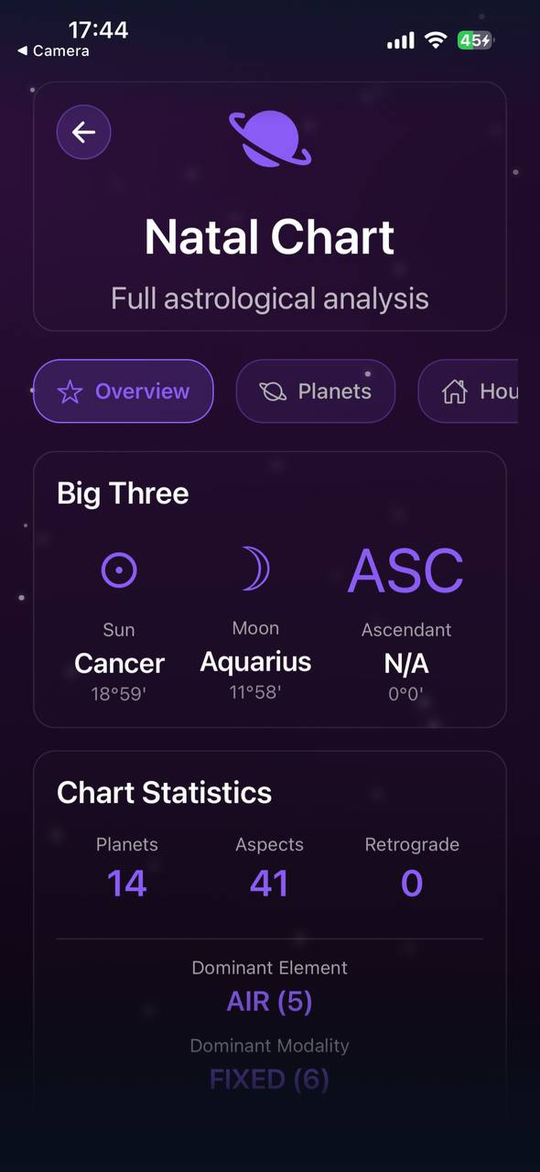
Where the two charts differ sharply, you get useful tension to reflect on, not a problem to fix. A grounded earth-sign natal Moon paired with a restless fire-sign draconic Moon simply names two real needs to balance. The app's extended natal reading already surfaces your nodes by sign and house and your karmic lesson, which is the same territory the draconic chart explores from another angle.
Draconic contacts in synastry and timing
Draconic charts are popular in relationship work. In synastry, astrologers compare one person's draconic planets against a partner's natal planets, reading tight contacts as a sense of soul-level recognition — the "I feel like I already know you" effect people describe. It is a reflective framework for understanding a bond, never a promise that a relationship is fated or guaranteed to last.
Transits and progressions can also be run against the draconic chart, so a slow transit hitting a draconic angle can mark a season that feels quietly meaningful. If you are curious how current sky movements touch both your charts, the Cosmic Simulator tracks live transits to your placements and explains them in plain language. Start with your accurate birth time — the draconic chart, like the natal one, is only as precise as the minute you were born, so an exact time matters most for the angles.
The Big Three: three layers of you
Sun, Moon and rising sign are where every chart reading starts.
Frequently asked questions
What is a draconic chart in astrology?
A draconic chart is your natal chart recalculated so the North Node is placed at 0 degrees Aries, with every planet and angle shifted by that same amount. All the aspects stay the same, but planets change sign. Astrologers read it as a soul-level or intended-self layer that describes your deeper motivations, sitting underneath the everyday personality your ordinary birth chart shows.
How is a draconic chart different from a natal chart?
They use the same birth data but a different starting point. The natal chart is anchored to the real zodiac and describes your outward personality and life. The draconic chart is anchored to the North Node at 0 Aries and is read as your inner intention or soul purpose. The most telling reading comes from comparing the two and noting where draconic and natal planets fall on each other.
How do I calculate my draconic chart?
Measure how far your natal North Node sits from 0 degrees Aries, then subtract that distance from every planet, cusp and angle in your chart. Because the whole wheel moves by one fixed amount, the aspects are unchanged while the signs shift. In practice you never do this by hand: any chart calculator, including the birth chart tool here, will draw the draconic version from your birth date, time and place.
Is the draconic chart your soul chart?
Many astrologers describe it that way, calling it the soul chart or the chart of the intended self. It is a symbolic lens for reflecting on your deeper motivations and purpose, not a literal map of a past life or a fixed destiny. Treat it as one more perspective on who you are, always read alongside your natal chart rather than in place of it.
Why does an accurate birth time matter for a draconic chart?
The node's exact degree depends on your birth moment, and the draconic angles — the Ascendant and Midheaven — move quickly, so a wrong time shifts them noticeably. Planet signs are more forgiving because they change slowly. If you know your birth time to the minute, both your natal and draconic angles will be reliable; if not, focus on the planets and aspects rather than the houses.
Early access · US launch
Your whole chart, read by AI — free at launch
Cosmic archetype, chart ruler, strengths, karmic lesson and more, written for your exact placements. Join early access for the complete reading, free.
- Free full birth chart + cosmic archetype at launch
- First in line for chart-based matching in your city
- Founding-member pricing, forever
AstraLink content is written by our editorial team, reviewed for astrological accuracy, and refreshed as the sky moves. Interpretations are for reflection and entertainment; they are not medical, legal or financial advice.