 AstraLink
Birth chart basics
How to find my birth time
Your birth time sets your rising sign and all twelve houses, so it is worth tracking down. In the US it is usually recorded somewhere: on the long-form birth certificate, in hospital records, or in a family baby book. Here is how to find your birth time step by step, who to ask, and what rectification does when no record survives.
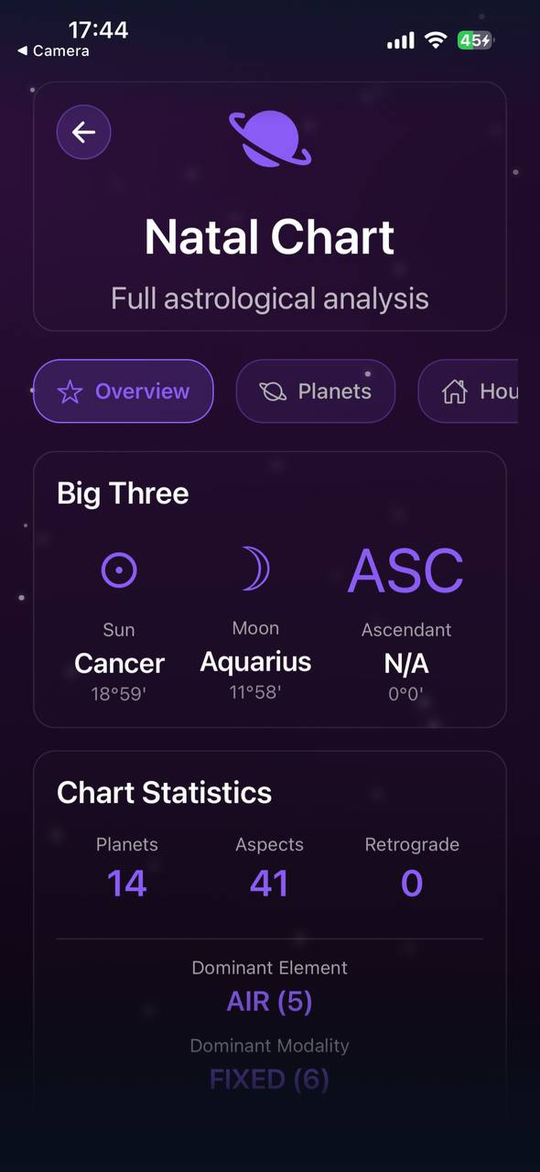
To find your birth time, start with your long-form (not short-form) birth certificate, which usually prints the hour of birth. If it does not, request your hospital or state vital-records file, ask family members, and check baby books or albums. When no record exists, an astrologer can estimate it through chart rectification.
How do I find my birth time?
Your birth time was almost certainly written down somewhere — the trick is knowing where to look, in the right order. Start with official documents, move to the people who were there, and treat estimation as a last resort. Here is the full search, from most reliable to least.
1. Your long-form birth certificate
There are two kinds of US birth certificate, and only one usually carries the time. The short-form (also called an abstract or computer certificate) is the wallet-sized version most of us have; it often lists just name, date and place. The long-form (the full, certified copy of the original hospital record) is the one that typically prints the hour and minute of birth, along with the hospital and attending details.
If your short-form has no time, request the long-form from the vital records office in the state or county where you were born. Most states let you order online, by mail or in person; you'll need ID and usually a small fee. A handful of states historically didn't record time of birth, so if the long-form comes back blank, move to the next source rather than assuming an error.
2. Hospital and medical records
Hospitals keep their own labor-and-delivery records and birth logs, separate from the certificate, and these frequently note the exact minute. Contact the health-information or medical-records department of the hospital where you were born. Retention rules vary by state and hospital — some keep records for decades, others purge older files — so this works best for more recent births, and you'll usually need to prove identity.
3. Family memory and keepsakes
The people who were in the room are a real source, and so are the things they saved:
- Ask directly — parents, grandparents, aunts, older siblings. "Was it day or night? Before or after a meal? During a TV show?" Anchoring questions jog memory better than "what time exactly?"
- Baby books and birth announcements often have a fill-in-the-blank time.
- Hospital bracelets, footprint cards and discharge papers tucked in albums.
- Old photos with a timestamp, or a diary, calendar or datebook entry from the week.
- Baptism or naming certificates — some religious records note the birth time.
Even a rough answer helps enormously. "Early morning" or "just after dinner" narrows your rising sign to one or two possibilities instead of twelve.
The Big Three: three layers of you
Sun, Moon and rising sign are where every chart reading starts.
4. When there's no record: birth-time rectification
If every source runs dry, an astrologer can estimate your time through rectification — working backward from your life instead of forward from the clock. Using dated turning points (a house move, a marriage, a big career change, a major loss) plus how people tend to describe you, they test candidate birth times to see which rising sign and house pattern best fits the events that already happened, then propose a likely time or a narrow window.
Treat rectification as an informed estimate, not proof. It's a professional technique with real logic behind it, but two astrologers can land on slightly different times. While you wait, a date-only chart already gives you your Sun, Moon, planets and aspects, so you lose nothing by starting now.
How precise does the time need to be?
More precise is better, but you don't need atomic accuracy. The rising sign changes about every two hours, so a time known to the nearest half hour usually locks it in. Within about four minutes you've pinned the Ascendant to the degree, which matters for tight timing work. If all you have is "morning" or "evening," you've still eliminated most of the wheel — enter your best estimate, note that it's approximate, and refine it if a better source turns up. An approximate time beats noon, and noon beats nothing.
Why your birth time is worth the hunt
Finding the time upgrades your chart from who you are to who you are and where it all plays out. It unlocks:
- Your rising sign and the way you meet the world — the lens the whole birth chart is read through. See the rising sign guide.
- The twelve houses, which sort every planet into an area of life — love, money, career, home.
- The chart ruler and angles, which organise a full reading and anchor timing techniques.
- A named archetype from your complete Big Three once the rising sign is set.
In AstraLink, you can start onboarding with only your date, and the app fills in the rising sign and houses the instant you add a time — nothing to redo. Early-access members get the full reading free when they join the waitlist.
Finding your birth time: questions
Is my birth time on my birth certificate?
Sometimes — it depends which version you have. The short-form or abstract certificate most people carry often omits the time, while the long-form, the full certified copy of the original hospital record, usually prints the hour and minute. If your copy has no time, order the long-form from the vital records office in the state or county where you were born; that's the version to ask for.
What's the difference between a long-form and short-form birth certificate?
The short-form (or abstract) is a summary — typically name, date, place and parents — and frequently leaves out the birth time. The long-form is a certified copy of the complete original record filed by the hospital, and it usually includes the time of birth, the hospital and attending staff. For astrology, always request the long-form, since it's the one most likely to carry the exact minute.
How can I find my birth time if my parents don't remember?
Go around memory to the paper trail. Request your long-form birth certificate and, separately, your hospital's labor-and-delivery records from its medical-records department. Check baby books, birth announcements, hospital bracelets and old photos or diaries. Baptism certificates sometimes note the time too. If nothing surfaces, an astrologer can estimate your time through rectification, and a date-only chart works well in the meantime.
What is birth time rectification?
Rectification is an astrologer's method for estimating an unknown birth time by reasoning backward from your life. Using dated events — moves, marriages, career changes, losses — plus your appearance and manner, they test candidate times to find the rising sign and houses that best match what actually happened. It produces an informed estimate or a narrow window, not certainty, so treat the result as a strong hypothesis rather than a fact.
How accurate does my birth time need to be for a birth chart?
Closer is better, but you have room. The rising sign turns over roughly every two hours, so a time known to the nearest half hour usually settles it, and four-minute accuracy pins the Ascendant to the exact degree. Even 'early morning' or 'late evening' removes most of the wheel. Enter your best estimate, flag it as approximate, and refine it if a better record appears.
Can I get a birth chart without my birth time?
Yes. A date-only chart still gives you your Sun, Mercury, Venus, Mars and outer planets by sign, your Moon on most days, and every aspect between them — enough to read temperament, love style and compatibility. You simply lose the rising sign and houses until you find the time. A solar or noon chart is the usual stand-in while you search.
Early access · US launch
Your whole chart, read by AI — free at launch
Cosmic archetype, chart ruler, strengths, karmic lesson and more, written for your exact placements. Join early access for the complete reading, free.
- Free full birth chart + cosmic archetype at launch
- First in line for chart-based matching in your city
- Founding-member pricing, forever
AstraLink content is written by our editorial team, reviewed for astrological accuracy, and refreshed as the sky moves. Interpretations are for reflection and entertainment; they are not medical, legal or financial advice.