
Glossary
Davison chart: the relationship's real chart in time and space
Two people meet, and astrology says the bond itself has a chart. A Davison chart is one way to draw it, not an average of your planets, but a real chart cast for the moment and place exactly halfway between your two births. Here is what it means, how it differs from a composite, and how to read it.
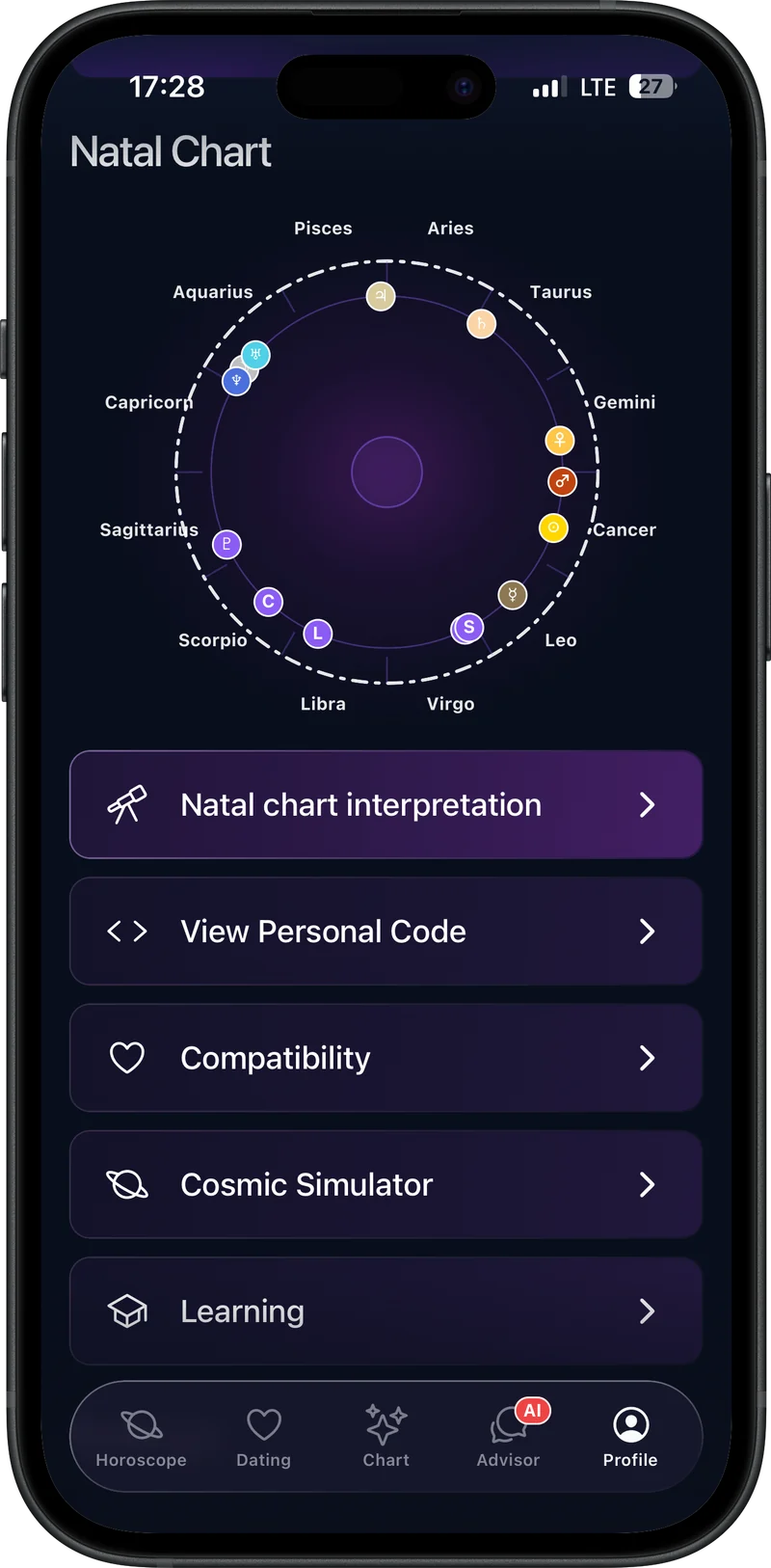
A Davison chart is a relationship chart cast for the exact midpoint in time and space between two people's births, the halfway date, time and geographic location. Unlike a composite chart, which averages planetary positions, a Davison is a real chart with genuine placements, so it can be transited and progressed like a natal chart.
What is a Davison chart?
A Davison chart — also called a Davison relationship chart or a time-space midpoint chart — is a single chart that represents a relationship instead of a person. You build it by finding the exact midpoint between two people's births in both time and space: the calendar moment halfway between the two birth dates and times, and the geographic point halfway between the two birthplaces. Then you cast an ordinary chart for that one midpoint moment and location.
Here is the part that makes it special. Because that midpoint is a real date, time and place, the Davison chart is a genuine snapshot of the sky — its planets actually sat where it says they did at that instant. It has a real Sun sign, Moon sign, rising sign, houses and aspects, exactly like a birth chart for a person. The bond, in other words, gets a chart as concrete as your own. The method was popularized by the British astrologer Ronald Davison, which is where the name comes from.
The Big Three: three layers of you
Sun, Moon and rising sign are where every chart reading starts.
Davison chart vs composite chart: what is the real difference?
This is where people get tangled, because both are midpoint methods and both produce a single relationship chart. The difference is what you take the midpoint of.
A composite chart averages positions. It places the composite Sun exactly halfway between your two natal Suns, the composite Moon halfway between your two Moons, and so on, point by point. The result is a useful symbolic picture, but it does not match any real moment in the sky — no planet was ever actually arranged that way.
A Davison chart averages the birth data itself — the date, the time, the place — and then casts a chart. So every planet in a Davison chart was genuinely overhead at that midpoint instant. That one difference has a real payoff: because a Davison chart is an actual moment, you can transit and progress it like a natal chart. You can ask what this year's Saturn is doing to the relationship's Venus, or run the bond's progressions, in a way that is shakier with a composite.
Neither of these is synastry, by the way. Synastry keeps your two charts separate and measures the aspects between them — the chemistry flowing back and forth. Davison and composite both fold the two of you into one chart that describes the relationship as its own entity. Plenty of astrologers read all three side by side.
How to read a Davison chart
Read a Davison chart much as you would a natal chart, with the big three carrying the headline story about the relationship as a living thing:
- The Davison Sun is the relationship's core identity and purpose — what the bond is fundamentally about and what it is growing toward.
- The Davison Moon is its emotional climate — how safe, nourished and understood the two of you feel together, and what the relationship needs to feel at home.
- The Davison Ascendant is its face — how the partnership comes across to the outside world and the vibe people pick up when you arrive as a pair.
From there, read Venus and Mars for affection and desire, the houses each planet falls in for the life areas the bond emphasizes, and the tight aspects for its easy flows and its friction. If you already know your own big three, meeting the relationship's own big three is a genuinely clarifying moment.
One caveat worth keeping close: a Davison chart is a lens, not a verdict. A tense aspect is a pattern to understand and work with, not a sentence passed on your love life. No chart decides whether two people make it — you and your partner do that, together, with everything you each bring.
This layered way of reading is exactly what Cosmic Dating is built around: it weaves synastry between two full charts with relationship-level views like this one, so a match means more than a guess. If you want your own relationship charts drawn and interpreted, you can add your birth details through early access and compare with someone who matters.
Davison vs composite vs synastry at a glance
| Method | What it averages | A real moment in the sky? | Can you transit it? | Best for |
|---|---|---|---|---|
| Synastry | Nothing — it compares two separate charts | Yes, both birth charts are real | Each chart on its own | Chemistry and dynamics between you |
| Composite | Planetary positions (midpoints) | No | Not reliably | The bond's purpose, tone and direction |
| Davison | The birth data: time and place | Yes | Yes, like a natal chart | The relationship as a real, trackable chart |
All three read best together — each answers a different question about the same relationship.
Frequently asked questions
Is a Davison chart the same as a composite chart?
No, though they are easy to confuse because both are midpoint methods that produce one relationship chart. A composite chart averages the two people's planetary positions, so it never matches a real sky. A Davison chart averages the birth data — the date, time and place — then casts a genuine chart for that midpoint. Because the Davison is a real moment, it can be transited and progressed in a way a composite cannot.
How do you calculate a Davison chart?
You find the midpoint in time and the midpoint in space between two births. For time, take the exact moment halfway between the two birth dates and times. For space, take the geographic point halfway between the two birthplaces, by latitude and longitude. Then you cast an ordinary chart for that single moment and location. Astrology software does this instantly, and apps like AstraLink draw it for you from both sets of birth details.
Can you read transits on a Davison chart?
Yes, and this is one of its biggest advantages. Because a Davison chart is cast for a real date, time and place, its planets occupy genuine positions, so current transits and progressions apply to it just as they do to a natal chart. You can watch how a passing planet contacts the relationship's Venus or Moon. Read these as timing patterns to reflect on, never as fixed predictions about what the relationship must do.
What do the Sun, Moon and Ascendant mean in a Davison chart?
They describe the relationship as its own being. The Davison Sun is the bond's core identity and purpose — what it is fundamentally about. The Davison Moon is its emotional climate — how cared for and at home the two of you feel together. The Davison Ascendant is its public face — how the partnership comes across and the first impression it gives. Together they sketch the character of the relationship, not either individual.
Should I use a Davison chart, a composite, or synastry?
Ideally you read them together, because each answers a different question. Synastry compares your two separate charts to show the chemistry between you. A composite and a Davison each collapse the two of you into one chart that describes the relationship as an entity, with the Davison adding real positions you can transit. Think of them as layers of one picture. Cosmic Dating blends these views so a match is more than a single data point.
Early access · US launch
Your whole chart, read by AI — free at launch
Cosmic archetype, chart ruler, strengths, karmic lesson and more, written for your exact placements. Join early access for the complete reading, free.
- First test wave: you’re in before the public launch on November 16
- 3 months of Premium free, then 80% off for a year*
- Free full birth chart + cosmic archetype at launch
- A say in what we build next
AstraLink content is written by our editorial team, reviewed for astrological accuracy, and refreshed as the sky moves. Interpretations are for reflection and entertainment; they are not medical, legal or financial advice.