
Enjoy the story, hold it loosely
Let the invisible string make your meet-cute feel magical. Just keep the plot open — a good origin story is a bonus, not a reason to ignore red flags.
Dating glossary
You keep hearing it after a chance meeting or a reunion years in the making: "it was the invisible string." Invisible string theory is the comforting idea that an unseen thread ties you to the people you're meant to find. Here's where it really comes from, why it feels so true, and how astrology reads a "fated" connection.
Invisible string theory is the romantic idea that an unseen thread connects you to the people you're destined to meet, so every near-miss and detour was quietly pulling you together. Popularised by a Taylor Swift song and TikTok, it reworks the East Asian "red thread of fate" myth as modern meaning-making.
Invisible string theory is the romantic idea that an unseen thread connects you to the people you are destined to meet — and that every near-miss, wrong turn and odd coincidence was really the string slowly reeling you toward each other. Found the love of your life at a party you almost skipped? Invisible string. Matched with someone who grew up three streets over and you never crossed paths until now? Invisible string.
The name comes from two places. The modern one is pop culture: Taylor Swift's 2020 song invisible string on her album folklore, which pictured fate as a golden thread quietly tying two people together long before they ever met, followed by a wave of TikTok videos tagging their own uncanny origin stories #invisiblestring. The older, deeper root is the East Asian "red thread of fate" — a myth from Chinese and Japanese folklore in which an invisible red cord ties together people who are meant to meet, no matter the distance, timing or detours in between. Invisible string theory is that ancient image in a 21st-century outfit.
A gentle caveat up front: this is meaning-making, not mechanics. There is no measured thread, and no study has found a literal cord of destiny. What the theory really offers is a warm, hopeful way of telling the story of how you met — and that has its own quiet value.
The five connections that carry the most weight in a compatibility reading, scored and explained.
In dating, the invisible string is the lens you reach for when a connection feels written. A few of its most common forms:
It is a deliberately inclusive idea — the string does not care about gender, orientation or geography; it is simply whoever your person turns out to be, whether that is a they, a she or a he. That openness is part of its charm, and part of why it travels so well across our dating glossary of modern love terms. Just notice the flip side: the same story that makes a good match feel fated can keep you tethered to someone who is not good for you, which is where a term like soul tie starts doing heavier lifting.
Our brains are superb pattern-finders — sometimes too superb. Psychologists call the tendency to see meaningful connections between unrelated events apophenia, a term coined by psychiatrist Klaus Conrad in 1958. When two people's timelines happen to overlap, we notice the overlaps and quietly forget the thousands of strangers whose paths also crossed ours and meant nothing. That is confirmation bias at work: the hits get remembered, the misses get deleted.
There is an attachment layer, too. The founders of attachment theory, psychiatrist John Bowlby and psychologist Mary Ainsworth, showed how deeply humans are wired to seek secure bonds. A story that says this connection was meant to be soothes the anxiety of not knowing whether a relationship will last — it borrows certainty from fate. (If you want to go deeper on that, see our primer on attachment style and astrology.)
Finally, we are narrative creatures. Researcher Dan McAdams describes how people build a sense of self out of the stories they tell, and "we were tied together all along" is simply a lovely story to live inside. None of this makes the feeling fake — it makes it human. For context, Pew Research finds about 27% of US adults believe in astrology, rising to 43% of women aged 18–49: meaning-making about love is mainstream, not fringe.
Astrology has its own vocabulary for the feeling the invisible string describes — and it treats it as a pattern to reflect on, never a cause or a diagnosis. Think of it as a lens, not a verdict; a tendency, not a prophecy.
The closest astrological cousin of the red thread is the lunar nodes — the karmic axis of the chart. When one person's North or South Node lands on another's Sun, Moon or angles in synastry (the technique of comparing two birth charts), astrologers read it as a "nodal" or growth-flavoured connection: a bond that feels oddly familiar or significant. Add the classic relationship markers — Venus (how you love), Mars (desire and spark), the Moon (emotional safety), the 7th house / Descendant (the kind of partner you reach for) and the asteroid Juno (commitment) — and you have astrology's rich way of describing why a particular person feels like the one the string was pulling toward.
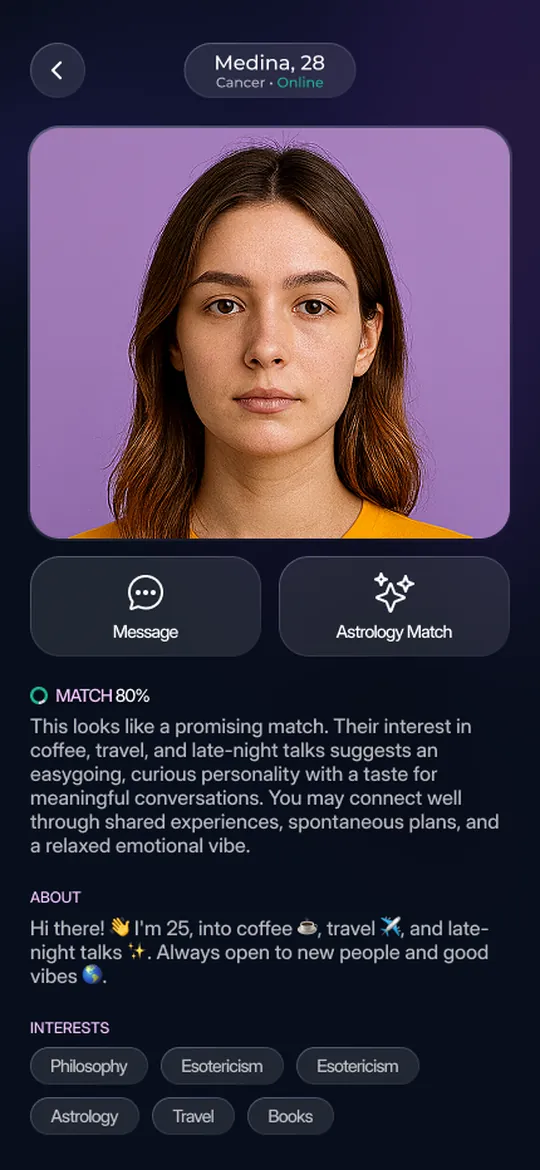
Crucially, none of this predicts a soulmate or guarantees a happy ending. A strong nodal contact describes a pull, not a promise; the relationship still runs on how two real people treat each other. This is exactly the thinking behind AstraLink's Cosmic Dating, which matches people on birth-chart compatibility and shows you where a connection is strong and where it needs work — a conversation starter, not a crystal ball. You can read a karmic relationship the same honest way.
| Chart factor | What it describes | How to read it |
|---|---|---|
| Lunar nodes (nodal contacts) | A familiar, growth-oriented pull between two charts | A direction to explore, not destiny locked in |
| Venus | How each person gives and receives affection | A style of love, not a compatibility score |
| Mars | Desire, drive and physical spark | Chemistry, which still needs care to last |
| Moon | Emotional needs and sense of safety | Where you feel at home — or need to communicate |
| 7th house / Descendant | The kind of partner you are drawn to | A tendency in taste, not a fixed type |
| Juno (asteroid) | What you look for in commitment | A theme to reflect on, never a rule |
Astrology here is a mirror for reflection, not a prediction or a diagnosis.
Let the invisible string make your meet-cute feel magical. Just keep the plot open — a good origin story is a bonus, not a reason to ignore red flags.
A connection can feel destined and still be wrong for you. Ask how someone treats you on an ordinary Tuesday, not just how dramatic the meeting was.
If "we were meant to be" is the main reason you're staying, that's a cue to check in — not a cord you're obligated to honour. Limerence can disguise itself as fate.
Run a chart comparison for insight and better questions, not a yes/no verdict. Cosmic Dating is built to spark that conversation, not end it.
Confirmation bias makes the string look obvious in hindsight. The way to find your person is to keep showing up — join early access and let the matching do some of the work.
Invisible string theory is the idea that an unseen thread connects you to the people you're destined to meet, so every near-miss and detour was secretly guiding you toward each other. It blends Taylor Swift's 2020 song invisible string with TikTok culture and the older East Asian red thread of fate. Treat it as a warm way of telling your love story, not a literal force.
The modern name took off with Taylor Swift's 2020 track invisible string on her album folklore, then spread on TikTok as people tagged their own uncanny backstories. Its deeper root is the East Asian red thread of fate, a Chinese and Japanese myth in which an invisible red cord ties destined people together across any distance or delay. Invisible string theory is essentially that ancient idea rediscovered online.
It depends what you mean by real. The feeling is absolutely real, and the stories are often true. But there's no measured thread and no scientific evidence of a literal cord of destiny. Psychologists point to pattern-seeking (apophenia) and confirmation bias: we remember the meaningful coincidences and forget the countless ones that led nowhere. Enjoy invisible string theory as comfort and meaning, just don't mistake a lovely story for a mechanism.
The red thread of fate is an East Asian legend — strongest in Chinese and Japanese folklore — that an invisible red cord connects people who are meant to meet, often imagined tied around the finger or ankle. The thread may stretch or tangle, but it never breaks. Invisible string theory is the modern, pop-culture descendant of this myth, swapping the red cord for a golden thread and a hashtag.
Astrology describes fated-feeling connections through the lunar nodes and synastry, the comparison of two birth charts. A North or South Node touching your partner's Sun, Moon or angles reads as a familiar, growth-oriented bond, while Venus, Mars, the Moon, the 7th house and Juno flesh out the chemistry. Read it as a pattern and a prompt for reflection, never a guarantee — a strong contact shows a pull, not a promise.
The checkable facts on this page come from these external sources. The astrological interpretation is our own.
Early access · US launch
AstraLink reads both whole charts — Venus, Mars, Moon, Saturn, house overlays — and matches you by chart, not by swipe. Join early access and get your compatibility profile the day we open.
AstraLink content is written by our editorial team, reviewed for astrological accuracy, and refreshed as the sky moves. Interpretations are for reflection and entertainment; they are not medical, legal or financial advice.