
Tarot & numerology
How do tarot cards work? A clear, honest guide to reading the 78 cards
Tarot cards don't predict the future — they work as a mirror. This guide explains, honestly, how a 78-card deck actually works: what's inside it, how a reading goes from question to spread to interpretation, the psychology behind why it feels accurate, whether tarot is real, and how its symbols overlap with your astrology birth chart.
Tarot cards work as a mirror for reflection, not as fortune-telling. A 78-card deck, 22 Major Arcana for life themes and 56 Minor for daily life, is drawn into a spread and interpreted against your question. The meaning comes from the images and your own pattern-recognition, not from supernatural prediction.
How do tarot cards work?
Tarot cards work as a structured mirror, not a crystal ball. You hold a question, draw cards from a shuffled 78-card deck into a layout called a spread, and interpret the images in relation to what you asked. The cards don't know anything, and the shuffle is random. What makes a reading useful is the interpretation: the pictures give you a prompt, and you supply the meaning by noticing which hopes, fears and half-formed decisions the images pull to the surface.
In other words, tarot is a tool for reflection and pattern-recognition, closer to journaling with pictures than to fortune-telling. That is also why it pairs so naturally with astrology, which this site treats the same way: a lens for self-knowledge, never a verdict about your fate.
What's actually inside a tarot deck
A standard deck has 78 cards split into two groups. The Major Arcana is 22 cards (The Fool, numbered 0, through The World, numbered 21) that stand for the big life themes: beginnings, love, crisis, faith, transformation, completion. When several Majors land in a spread, the reading is about something that matters. The 56 Minor Arcana describe daily life and come in four suits of fourteen:
- Wands (fire) — drive, work, creativity, passion.
- Cups (water) — emotion, love, intuition, relationships.
- Swords (air) — thought, conflict, truth, worry.
- Pentacles (earth) — money, body, home, practical results.
Each suit runs Ace through Ten plus four court cards (Page, Knight, Queen, King). The numbers echo numerology: Ace begins, Five disrupts, Ten completes. Learn the element of a suit and the stage of a number and most Minor cards read themselves. For a gentle, no-pressure start, our tarot for beginners guide walks through the first week.
How a tarot reading actually works
Every reading, whether a one-card pull or the ten-card Celtic Cross, follows the same three steps. First, ask a clear, open question — "What do I need to understand about this job?" beats "Will I get the job?" Second, choose a spread and shuffle while holding the question in mind: one card for a daily focus, three for past–present–future or situation–obstacle–advice, more for a fuller picture. Third, interpret — read the picture before the book, notice repeated suits or Majors, then land on one thing you'll actually do. A quick yes/no reading is the fastest version of the same loop.
Are tarot cards real?
Yes and no, and the honest answer is the interesting one. The cards are real — illustrated paper with a 600-year history that began as a fifteenth-century Italian card game and was adapted for divination much later. What is not real is the idea that the cards supernaturally predict a fixed future. No study has shown tarot forecasts events, and reputable readers don't claim it does. What is real is the effect a good reading has on you: it makes you say out loud what you hope, fear and already suspect. If you've wondered the same thing about the zodiac, our piece on whether astrology is real reaches a similar conclusion through a different door.
Why a reading feels so accurate
The sense of being "read" has a few well-understood psychological roots, and knowing them makes tarot more useful, not less. Projection: ambiguous images invite you to see your own situation in them, so a card becomes a screen for what's already on your mind. Narrative sense-making: humans are wired to turn scattered details into a story, and a spread hands you a ready-made structure to do exactly that. The Barnum effect: open-ended statements feel personal because almost everyone can find themselves in them. None of this is a trick being played on you — it's the mechanism by which a prompt helps you think. The same cognitive habits are why a well-written horoscope lands; how astrology works covers the overlap in depth.
Intuitive reading vs the Rider-Waite-Smith tradition
There are two broad schools. The Rider-Waite-Smith (RWS) tradition, built on the 1909 deck illustrated by Pamela Colman Smith, gives every card a fairly settled set of meanings drawn from its imagery; most books, apps and this site describe it. Intuitive reading leans on the picture and your gut in the moment, using the standard meanings as a floor rather than a rulebook. Neither is more "correct." Beginners usually start with RWS meanings and grow their intuition from there; experienced readers blend both without thinking about it.
How tarot and astrology overlap
Tarot borrowed a full set of astrological correspondences from the Hermetic Order of the Golden Dawn in the 1890s, and they're consistent enough to be genuinely useful. Each Major Arcana card maps to a planet or sign: The Sun to the Sun, The Moon to Pisces, The Empress to Venus, The Emperor to Aries, Death to Scorpio, The Star to Aquarius. Each suit maps to an element, and each numbered Minor card to a decan — a ten-degree slice of the zodiac. That means a reading can be cross-checked against your birth chart: if you keep drawing The Tower during a hard transit, the two systems are describing the same season in different pictures.
Where AstraLink fits in
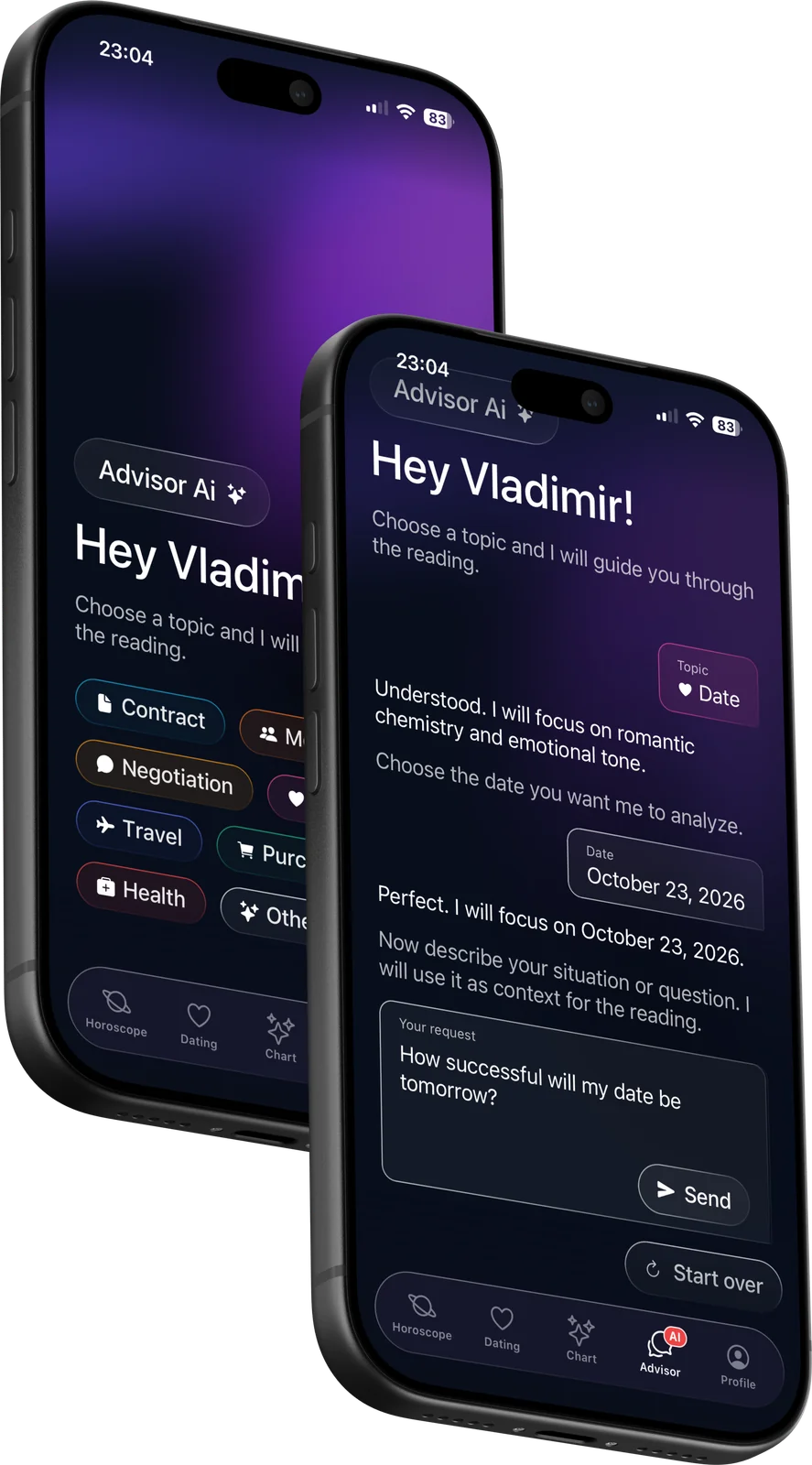
AstraLink has no tarot deck — and that's deliberate. Your birth chart is your deck: a fixed, personal set of symbols you can read for a lifetime. And the question you'd normally bring to the cards — is this a good week to have the conversation, sign the thing, book the trip? — is exactly what the AI Advisor is built to answer, reading your chart against the current sky instead of a shuffle. It's reflection and timing, minus the fortune-telling. If that's the kind of honest, pattern-not-prophecy tool you want, you can join the early-access list.
How tarot really works vs what people assume
| Common belief | How tarot actually works |
|---|---|
| The cards predict a fixed future | They surface the patterns and feelings you already carry, so you can decide what to do next. |
| A magic force chooses the cards | The shuffle is random; the meaning comes from how you read the image against your question. |
| You need psychic powers to read | You need a question, a deck and honest reflection; the system is learnable by anyone. |
| A reversed card means doom | A reversed card is usually the same energy blocked, delayed or turned inward — not a curse. |
| Tarot and astrology are unrelated | Each Major Arcana card maps to a planet or sign, so a reading and a birth chart often tell the same story. |
Correspondences follow the Golden Dawn system used by the Rider-Waite-Smith deck.
How tarot works: frequently asked questions
How do tarot cards work?
Tarot cards work as a structured prompt for reflection, not as a predictive device. You pose a question, shuffle and draw cards into a spread, then interpret the images in relation to what you asked. The shuffle is random; the meaning comes from how the pictures connect to your own situation. A good reading surfaces what you already think and feel, and ends with one clear thing to do.
Are tarot cards real?
The cards are real — illustrated paper with a 600-year history — but the claim that they supernaturally foretell a fixed future is not supported by evidence, and careful readers don't make it. What's genuinely real is the effect: a reading helps you articulate hopes, fears and decisions you were already carrying. Treat tarot as a reflective tool, like astrology, rather than a prediction machine, and it stays both honest and useful.
Can tarot predict the future?
No. Tarot cannot forecast events, lottery numbers or exact dates, and no reputable reader promises that. What it can do is clarify the present — your feelings, your options and the patterns you're repeating — which naturally shapes what you choose next. So a reading may feel predictive because it helps you see where you're headed, not because the cards know. For real decisions about health, money or law, consult a qualified professional.
Do you need psychic powers to read tarot?
No. Reading tarot is a learnable skill, not a gift. You need three things: a clear question, a deck, and a willingness to reflect honestly on what the images bring up. Beginners start with the standard Rider-Waite-Smith meanings — the element of each suit and the stage of each number — and grow their intuition from there. Pulling one card a day and writing a sentence about it teaches you faster than any book.
How do tarot and astrology work together?
They share a symbolic language. The Golden Dawn assigned every Major Arcana card to a planet or zodiac sign — The Sun to the Sun, The Emperor to Aries, Death to Scorpio — each suit to an element, and each numbered card to a decan. So a tarot spread can be cross-checked against your birth chart and current transits; the two systems often describe the same season in different pictures, which makes them complementary reflective tools.
Early access · US launch
Your birth chart is your personal deck
A card names a theme; your birth chart names yours. AstraLink's AI reads your real placements, and the AI Advisor answers the question you'd bring to the cards — should I, and when. Join early access, full chart free.
- First test wave: you’re in before the public launch on November 16
- 3 months of Premium free, then 80% off for a year*
- Free full birth chart + cosmic archetype at launch
- A say in what we build next
AstraLink content is written by our editorial team, reviewed for astrological accuracy, and refreshed as the sky moves. Interpretations are for reflection and entertainment; they are not medical, legal or financial advice.